
I\’m over at the Samhain blog today, talking about NaNo and the madness of November. Join me!

I\’m over at the Samhain blog today, talking about NaNo and the madness of November.…
November is coming, and with it, NaNoWriMo, or National Novel Writing Month. During the month…
I\’m working on the fringe for the Belii Shawl and wanted to do a laticework…

I am so excited to report that \”Taking a Chance,\” our short story from last…

Our theme for the month of October at Beyond the Veil is \”ghosts.\” Ghost stories,…
Join me for the first Torquere Author Chat with my fellow Torquere Authors. Lots of…
Join me over at the Writer\’s Retreat because you can never have too much coffee.
I\’m tickled to be able to bring you a talented and interesting author today. Author…
Join me today at the Torquere Press Blog, Romance for the Rest of Us, for…
Welcome to The Noonhour, a Podcast featuring essays, children\’s stories, and other items I find…
In publishing, (I suppose I should clarify that to be in traditional publishing and not…
I\’m over at the Samhain blog today, talking about NaNo and the madness of November. Join me!

November is coming, and with it, NaNoWriMo, or National Novel Writing Month. During the month of November, NaNo-ers write 50,000 words on a draft of a novel – some more, some less, and the madness that ensues is infectious.
I wish we had a NaKnitMo, National Knitting Month. Wouldn\’t that be awesome?
I was lamenting recently to Rachel Wilder, my partner in writing crime, that my stash is reaching epic proportions. I typed up what\’s under the bed in bins and showed her pictures of my shelves in my office, which overflowed from the huge apparatus over there to the top of the filing cabinet over here.
Unperturbed, she said, \”Just think of it as hours of pre-paid entertainment.\”
Blink.
LOFF!
In celebration of that, I figured I\’d share a few of the things I\’m working on or have recently finished.

This is an Ojo de Dios, or \”Eye of God.\” Made by the Huichol peoples of South America, they are prayers of blessing and good fortune. Ojos are made and placed in the central village temple for blessings on a child, a new business venture, a marriage, and many other occasions.
This one was fun to make since I usually make much smaller ones. This one is about 12 inches on 1/2 inch dowel rods. I sanded the dowels and then stained them using a combination of varnish and stain. I skipped the recommended steel wool sanding in between the two coats and I think, in hindsight, I wish I had done it; on the next project I will use that as part of the preparation. Overall, though, I like how the dowels came out.
I used a large, bulky yarn with an overdye pattern, which is what accounts for the color variations. I also varied the weave in making the ojo itself, which is what accounts for the visibility of the dowel in the middle of the design in parts.

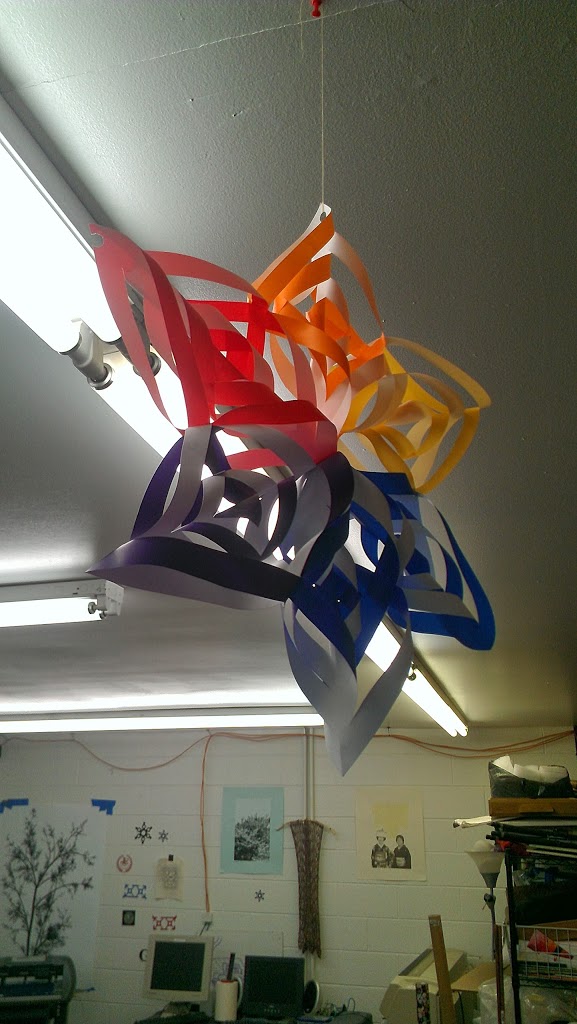
At the October Nightweavers meeting, a chapter of the Weavers Guild of the North Shore, we made snowflakes for the upcoming Fine Art of Fiber taking place at the Chicago Botanic Gardens November 8-10, 2013. The designs are surprisingly easy to put together and look quite pretty in white paper. I am across some colored origami paper that\’s white on the back, so I decided to try the design using six sheets of that, instead.

The white added a depth to the snowflake that I didn\’t anticipate and like very much. I think it would look pretty, and very different, when done on paper that has designs on both sides, especially if the designs aren\’t identical.

I nipped its ear when I was punching a hole to hang it with; you can see it on the tip of the red ear here.
If you\’re curious, the location where it hangs is the Pumping Station: One, a hackerspace here in Chicago. This is the art room and the view in the background is to one of the consoles for one of our 3-D printers.

I\’m working on the fringe for the Belii Shawl and wanted to do a laticework effect with the beads. Since the image I\’m using is from a book to which I don\’t have the rights, (I almost typed, \”writes,\”) I drew it for you here by hand:

The top picture is straight fringe; the bottom one is the lattice effect that I wanted to try to achieve. I used a fringe winder to ply the fringe together. What that means is, you take the yarns that are the fringe and figure out direction they are spun. All yarn has a natural direction of spin. One direction spins it further, creating more energy in the twist; the other direction essentially unspins the yarn (and with looser yarns can cause them to fuzz up).
When you ply fringe, you take two or more of the fringe yarns and twist them further in the direction of their natural twist, and then tie a knot. When you release the yarns, after they\’re knotted, they roll together creating a pretty, and more stable, fringe that will not knot up when you wash it, for example.
What my hope was, was that by taking yarns adjacent to each other and plying them together, I could create a lattice effect like I\’ve drawn, above. What happened was that in plying the second row of fringe, it increased the twist of the fringes above it and when I released the yarns after the second knot, they twisted together, creating a mess and not a pretty, flat lattice. I\’ll show you what I mean, and what I did instead.

This is the second side of fringe; the yarn ends are longer on this side (meaning, the fringe is longer). The fringe on the right has the first row of plying and beading done; as you can see, the beads are held in the middle of the twist by the energy of the plying. (They\’re not so tightly in there that they cannot move; I suspect when I wash it, for example, I\’ll have to push them back into place.)
The tackle box is there to provide weight on the main body of the weaving. By doing so, the fringe has something to pull against when you ply it.

This is the first row of fringe all done. The fringe will be trimmed at the end, but I\’ll wait until I have the beads in place, (three rows in total). The finished length will be between six and eight inches.

In this view, you can see both sides of fringe as well as the main body of the shawl. The loose threads on the body of the shawl will be snipped after its first wash. I don\’t want to wash it until the fringe is done, otherwise the threads will knot with each other and make a mess.

These are the tools I\’m using. Clockwise from top left: fringe winder tool, gold beads, scissors, COFFEE mug (if you don\’t think this is an essential tool at Knoontime Knitting, you haven\’t been paying attention), fringe comb, extra yarn, and purple beads.

This is the first attempt at the latticed fringe. As you can see, the second row of beading just causes the whole thing to twist up on itself.

We tried again, this time with my instructor holding the yarns under tension. It didn\’t help; as soon as we released the tension, they twisted together. I need a sound-effect, like FOOP! Foop, they twisted together.

I put the tackle box on the first row of beading and made the second row of plies on the same ply as the first. On the first row, I plied it 13 times; the second row didn\’t need that many because of residual twist; so I used seven twists instead.

Detail of both rows.

Final view showing the whole side. I\’m really curious to see what it looks like when it\’s done and washed. The fabric right now is thick and dense; it\’s mercerized (perle) cotton and it softens up after washing; I\’m curious what the hand of the shawl will be like once it\’s all done.

I am so excited to report that \”Taking a Chance,\” our short story from last year\’s Charity Sip Blitz, is being re-released November 20th. Stay tuned, and visit me on the Torquere Press LiveJournal for more information!

Our theme for the month of October at Beyond the Veil is \”ghosts.\” Ghost stories, ghosts of the past, ghosts that still haunt us. I started to write a light romp and it turned dark on me, but sometimes stories do that. Join me for an autobiographical look at the past and the ways it can haunt the present.
Join me for the first Torquere Author Chat with my fellow Torquere Authors. Lots of fun!

Join me over at the Writer\’s Retreat because you can never have too much coffee.

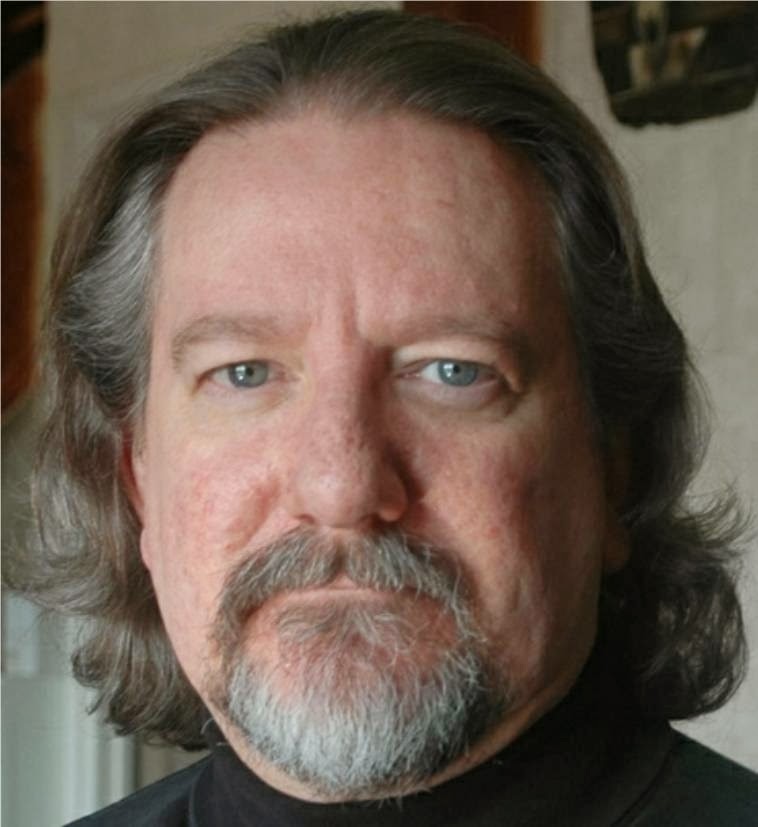
I\’m tickled to be able to bring you a talented and interesting author today. Author and retired Naval Officer David Bridger joins me from across the Atlantic to talk about writing, life, and his foray into the Young Adult space with his new book, A Flight of Thieves, Book 1 of the Skyships series.
ACN: I heard a broadcast on NPR (National Public Radio) recently, which is the public radio station here in the states. They interviewed the filmmaker of Twelve Years a Slave, as well as various actors and others in the film industry who have worked on similar projects recently. One of the comments was that “the money’s in the States, so if you want to make an expensive movie, you’ll eventually have to work there.” It got me thinking of the “four hundred pound gorilla,” if you will, relative to my friends who are authors in other countries and who write for audiences that aren’t exclusively American. How does “Americanization” affect your writing?
DB: It doesn\’t affect my writing at all, but depending on the publisher it can affect the final product. I heard recently that some young Americans posted book reviews complaining about lots of spelling mistakes, when actually those books had been written and published with correct British spelling. I don\’t concern myself with that sort of thing, but I suppose publishers have to decide whether or not they\’ll take any notice of it.
So an example of a way in which Americanisation might affect me would be if a novel was set in contemporary Britain and populated with British characters, but my publisher\’s house rules were to always use US spellings. That would feel odd, and would undoubtedly be scorned by my British readers. I\’d just have to hope they would understand the decision wasn\’t mine and would still be able to enjoy the book.
ACN: Writing in the Young Adult category is a departure for you. What made you take the plunge?
DB: I want to recapture the thrill of adventure and exploration, and to reconnect with the honesty and wisdom that is closest to the surface for many of us in our teens. I like and respect that in my readers.
ACN: Why steampunk?
DB: Airships, pirates, intelligent robots, adventure, friendship and loyalty, enemies and betrayal, an untamed world and the freedom to explore it, and, and, and breathe… ☺
ACN: How much period research went into writing A FLIGHT OF THIEVES?
DB: Apart from frontier-type medicine, very little. The steampunk elements are practical and arise from my future world\’s ecological situation, rather than from social pressures or mores. My research was mostly about geography and steam engines.
ACN: What surprised you about writing A FLIGHT OF THIEVES?
DB: How the world grew. The story idea I started with was big on human action and impact, but it was contained within the quite small geographical area that is the Irish Sea and the coastal places around it. The world outside the immediate story grew fast while I was writing. That wasn\’t a chore or a pressure. It was a delight, like hiking through unexplored lands discovering secret valleys and mountain ranges and isolated communities. So at the same time as I was writing A Flight of Thieves I found myself planning the rest of the Sky Ships series, and seeding into this first story elements that will take us all over the world later.
ACN: Where do you do your writing?
DB: In my study at the back of our house, which is cut into a hillside. (Photo below.) It\’s warm and comfortable, with no distractions. Perfect.

ACN: What’s the worst piece of writing advice you ever got?
DB: \”Show, don\’t tell.\”
Okay, we all know it\’s right, in moderation. The problem with these nuggets of wisdom is that some people fashion them into hatchets and use them to chop hell out of other people\’s good writing. It\’s mindless fundamentalism, and you see it a lot in critting circles on certain writing sites. That\’s the sort of place you\’ll see me walking out of quicker than I walked in.
All I can say is, there are times when a story needs to move on, so its write just needs to tell. Not everything has to be shown. Imagine a novel in which every single thing was shown. Nothing would ever happen. And if it did, it would take so long we wouldn\’t care anymore. There\’s a time and place for everything, and my place is anywhere I can\’t hear anyone standing on a soapbox shouting, \”Show, don\’t tell!\” at people.
ACN: What’s it like being in the Royal Navy? Would you ever go back?
DB: I had a hell of a time. Some great highs, some terrible lows, and a lot of grinding-it-out sheer bloody hard work. As time went on I found myself attracted to working in small, specialised units. So I wouldn\’t say my experience was typical, but I expect many people would say the same of theirs. It was just that I avoided big formal military outfits whenever I could.
I wouldn\’t go back. For one thing, in the end it broke my body quite badly so I couldn\’t do it now. But more importantly, I\’d find it impossible nowadays to accept military stupidity, and that wasn\’t easy even back then.
ACN: How did your experience in the Navy inform A FLIGHT OF THIEVES?
DB: Two ways: in the command structures and shipboard routines that I adopted and adapted; and in my old tendency to want to go off and work outside the big formal stuff.
ACN: If you could Captain a dirigible, what kind of craft (military, merchant marine, pirate) would it be and where would you ply your trade?
DB: I\’d be a smuggler! Oh, yes! There are lots of coves and crannies along the coast where I live.
ACN: What’s it like living in England’s West Country?
DB: It\’s the nearest thing to heaven on Earth that I\’ve ever found. Green wooded hills, clean air, clean rainfall into our rivers and clean seas surrounding us. It\’s beautiful and I love it.
ACN: You’ve lived a life full of adventure – Royal Navy, science-fiction and fantasy author, now YA author. What other careers interest you, if you retired from writing tomorrow?
DB: I\’m an amateur archaeologist and years ago flirted with the idea of taking it up professionally, but it was a popular career choice and nowadays the industry is crammed full of people so I think I was right not to pursue it. Maybe an academic historian. In another life, maybe a Viking blacksmith. The truth is, I love writing and no other career would tempt me away from it.
ACN: If the leaders of the G20 gave you fifteen minutes to speak to them, what would you say?
DB: \”You are a disgrace. You have the resources to end poverty, thirst and starvation in the world right now. Do it. Do it quickly before your souls wither any further into shameful corruption.\”
I really appreciate David taking the time to put his thoughts to keyboard for us and look forward to the reading his book. Here\’s a teaser to whet your appetite:

In a world of isolated island communities, a thousand years after Earth’s apocalyptic flood, Princess Victoria and her robot mentor, King Henry, recruit a ragtag band of airship adventurers to help her fight the military traitors who intend to murder her family and enslave the kingdom.
Victoria has spent all of her sixteen years in a secluded palace on Ben Nevis Island under the protection of King Henry, one of the three original robots programmed by the ancestors to rule the flooded planet Earth. She’s safe there, but her family and their intelligent clockwork servants treat her like the tomboy child she used to be—and sometimes still is. She yearns to fly away in one of the great iron airships to see the world.
It seems too good to be true when Henry asks Victoria to board the Royal Airship Elizabeth, with him disguised as her robot footman, and fly over the sea to meet the Lord of Ireland. Victoria jumps at the chance for an adventure and they take to the skies together. But the world is a dangerous place. Air pirates prowl trade routes, and slaver fleets cross the oceans to raid unprotected islands. The Royal Navy is building up to a war, and Henry’s old friend, the Lord of Ireland, is accused of giving safe harbor to pirates. Victoria and Henry must overcome them all in order to make their way home to a kingdom that might not still be standing.
Available from: Taliesin Publishing | Barnes and Noble | Amazon | Amazon UK
David Bridger settled with his family and their two monstrous dogs in England\’s West Country after twenty years of ocean-based mischief, during which he worked as a lifeguard, a sailor, an intelligence gatherer and an investigator in the Royal Navy. He writes science fiction and fantasy for teens.
Join me today at the Torquere Press Blog, Romance for the Rest of Us, for a photo journey through a junkyard – Worldbuilding by Junkyard. What inspires you?
Today I decided to read to you from my short story collection from 2008, the March FADness. FAD stands for \”Flash-A-Day.\” The stories are archived on my blog here, but you can hear me read this one to you below. I\’m glad you\’re here!

In publishing, (I suppose I should clarify that to be in traditional publishing and not self-publishing), there are three answers one can receive when one submits one\’s book for publication: Yes, No, and Maybe. Here\’s my thoughts on each of them, based on questions folks have asked me over the years.
1. \”Yes.\”
Ask yourself if you really want to work with this house, though you probably should have already decided that before you submitted to them. But if you\’ve got simultaneous submissions out, is this your preferred house?
Read the contract! For Heaven\’s sake, don\’t just swoon, say something equivalent to, \”They want me! They really want me!\” and sign away your project. Chances are, this novel, novella, or other book-length manuscript took a large chunk of your life energy to write – some folks labor for a year or more on theirs, especially in the beginning.
The contract is in legal language, since it\’s a legal contract. While it\’s not required, it\’s recommended that you have an attorney or your agent review the contract with you. Failing that, you should talk to others who are familiar with contracts and get their input. Keep in mind, you\’re signing a binding legal agreement to which you will be subject for a period of time. You want to make sure that you don\’t regret it down the line, to the best of your current ability.
2. \”No.\”
Don\’t just delete the email! The \”No\’s\” can be instructive. If it\’s a form letter, then perhaps not, but if it\’s a letter from a real, live, human being you may be able to find out why they rejected it. Remember: they\’re rejecting the BOOK, not YOU. If you\’re very lucky, their letter will say why they rejected it: they just published something similar, or it\’s not a good fit for their house, or the plot isn\’t tight enough. Whatever the reason, digest it and think hard about it. Do you agree with the criticism? Is there something you can do to improve the manuscript?
3. \”Maybe.\”
In the publishing world, a \”Maybe\” is known by its letters, \”R&R,\” and doesn\’t mean \”rest and relaxation.\” It stands for \”Revise and Resubmit.\” This is not the end of the road, not at all, and can work out in your favor if you are careful.
In an R&R, what the editor is telling you is, they like the project. Pay attention to what they say they like. It might be the voice, or the plot, or something else that caught their eye and made them want to spend their valuable time offering you the chance to fix it.
They will also tell you what they want you to revise before they see it again.
Stop and think for a second here. You don\’t want to just blindly rush off and do the equivalent of \”Yes, sir, No sir.\” Do you agree with their changes? Will the changes make the project stronger?
I know it\’s tough to contemplate changing your project. You\’ve labored long and hard and it\’s how you like it. Here\’s the thing, though: publishers are in the business of selling books. They know their market, and they know what their market wants. If you agree with their changes, it will mean a book that will appeal to their market, readers whom you, presumably, want to reach.
That said, if you don\’t like the suggestions, then you don\’t have to take them. You can always take your project and submit somewhere else. Maybe the changes will make it weaker, in your mind, or you just don\’t want to take the project in that direction. Be very careful here that you\’re letting your Best Self and not your Ego drive here – with humility, you might find yourself with a fantastic editor at the house of your dreams.
If you do like the suggestions, then by all means make the changes. Many times, the editor will clarify things for you as you work so that you can hit the bullseye.
Note – if you decide not to accept the R&R, by all means thank the editor for their time. This person clearly saw something in you, enough to take time and offer suggestions to improve your project so that they could work with you. Respect that professionally. Editors talk to each other. Snubbing someone because your ego got its feelings hurt is rarely a smart move for your writing career.