

Category: Uncategorized

  • L Is For… Lace!

    \"\"

    Lace | Art | Fun

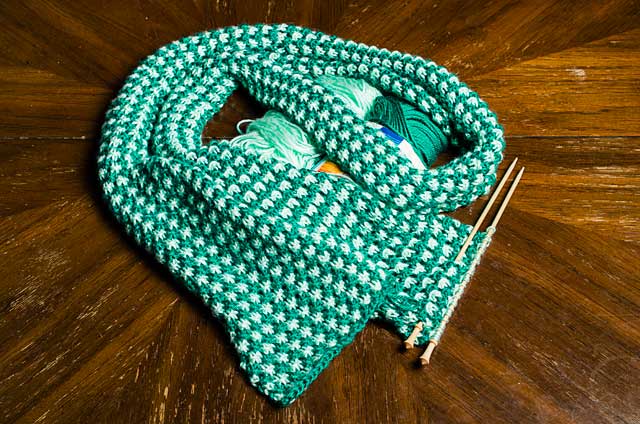
    Lace is to a knitter what oils are to a painter:  something toward which to aspire, elevated from craft to Craft, and darned fun to work with.  Tricky, too; did we mention that?  You can\’t just clean your oil paint brushes in water, and it takes 24 hours at least for a layer to dry so you have to have commitment to paint in oils.  Knitting lace is similar:  it looks complicated to do (but isn\’t always); it requires concentration; and it\’s a ton of fun.  But it\’s tricky – if you lose count of your rows or stitches, you can get lost in the middle somewhere without the breadcrumbs to come home.

    I would be mistaken to say that lace knitting and knit lace are the same; there\’s a hot debate in the knitting community, (yes, Dear Reader, knitters have our quibbling over details just like readers and writers do).  The difference, simply put, is lace knitting is putting holes in regular (plain) knitting, and knit lace is making lace with knitting needles.

    Wow, that\’s a really obvious distinction, huh?  Not.  🙂

    I have found that I like lace knitting.  I have found knit lace more challenging, because it\’s easier to mix oneself up; however, if you concentrate and start with a simple pattern with just a few row repeats, you\’ll be off to the races in no time.

    What about you, Dear Reader?
    What complicated tasks can you perform today, that seemed hard before you learned to do them?

  • K Is For… Knitting

    \"\"

    Knitting is magical.  You take a continuous filament of fiber, two sticks, and make art.  How cool is that?

    Despite how it looks, knitting isn\’t all that old.  Crochet is a much more ancient art; the earliest known knitting artifacts are from Turkey about a thousand years ago.  If you\’re a fiber geek, here\’s a look at the first known knitting, along with an engrossing article about knitting history on the popular online knitting magazine, Knitty.

    One of the reasons knitting wasn\’t done more frequently is that the metallurgy technology to make consistently-sized needles didn\’t exist in Europe until the Renaissance.  What makes knitting repeatable and consistent is the diameter of the sticks used; in earlier times, knitting needles were actual needles made of metal.  Nowadays, of course, we can find needles made with all sorts of materials – acrylic, bamboo, ceramics, and wood, to name a few (and I unintentionally alphabetized the list, thank you A-Z Challenge!).

    Aside from the art and history of it, I knit because of the Zen of it.  I find the magic of knitting in the simple fact that putting one stitch after the other makes something beautiful, it\’s relaxing, and it warms my hands.  I can do it around other people and carry on a conversation, I knit while watching television shows, or I knit on the train.  It\’s something I can do anywhere, in all kinds of weather unless it\’s swelteringly hot – though even then, I\’ve managed to make tiny things like amulet bags.

    What about you, Dear Reader?
    What made you start your favorite hobby?


  • J Is For… Jobs

    J Is For… Jobs

    \"2015-04-11With the way the economy is, jobs are challenging to find. The landscape of the job search has materially changed in the last five years, with new tools like LinkedIn and old tools like networking even more valuable.

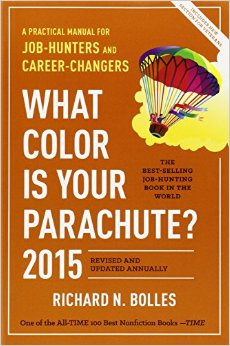
    One tool that has kept pace with the times is What Color Is Your Parachute by Richard Nelson Bolles.  This was recommended to me when I graduated college.  Mr. Bolles updates the book every year, completely rewriting it and making sure that the new tools are clearly explained.  His explanation of how to create a useful network for yourself is highly useful.

    What about you, Dear Reader?
    What\’s your favorite job search resource?

  • I Is For… Inquiry

    I Is For… Inquiry

    \"2015-04-10Curiosity.  What\’s that they say about it?  It killed the cat?  Not a very auspicious axiom for those of us who are afflicted by it.  The thirst for knowledge can be an anodyne to modern life, the bustle and invasion of distractions in the form of social media and entertainment.  But all that chaotic, frantic chatter is simply the next chapter of the Great Conversation that humanity has been having with itself since Lascaux.

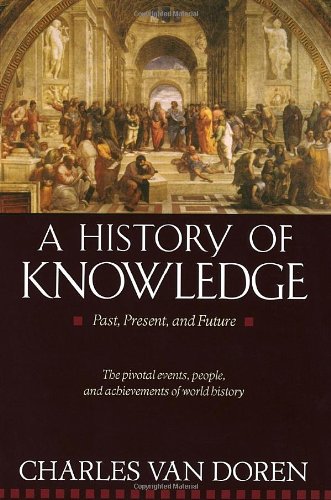
    Charles Van Doren\’s book, A History of Knowledge:  Past, Present, and Future – the Pivotal Events, People, and Achievements of World History is a good overview of how we got where we are today.  They say that those who ignore history are doomed to repeat it, and being aware of roots can help us in all sorts of ways.  Understanding the impact of the printing press on society and how it forced open the gates of knowledge, for example, can help us see the possible implications of the internet on the world today.

    What about you, Dear Reader?
    What subjects intrigue you?

  • H Is For… Home Design!

    H Is For… Home Design!

    \"20150405_0086\"

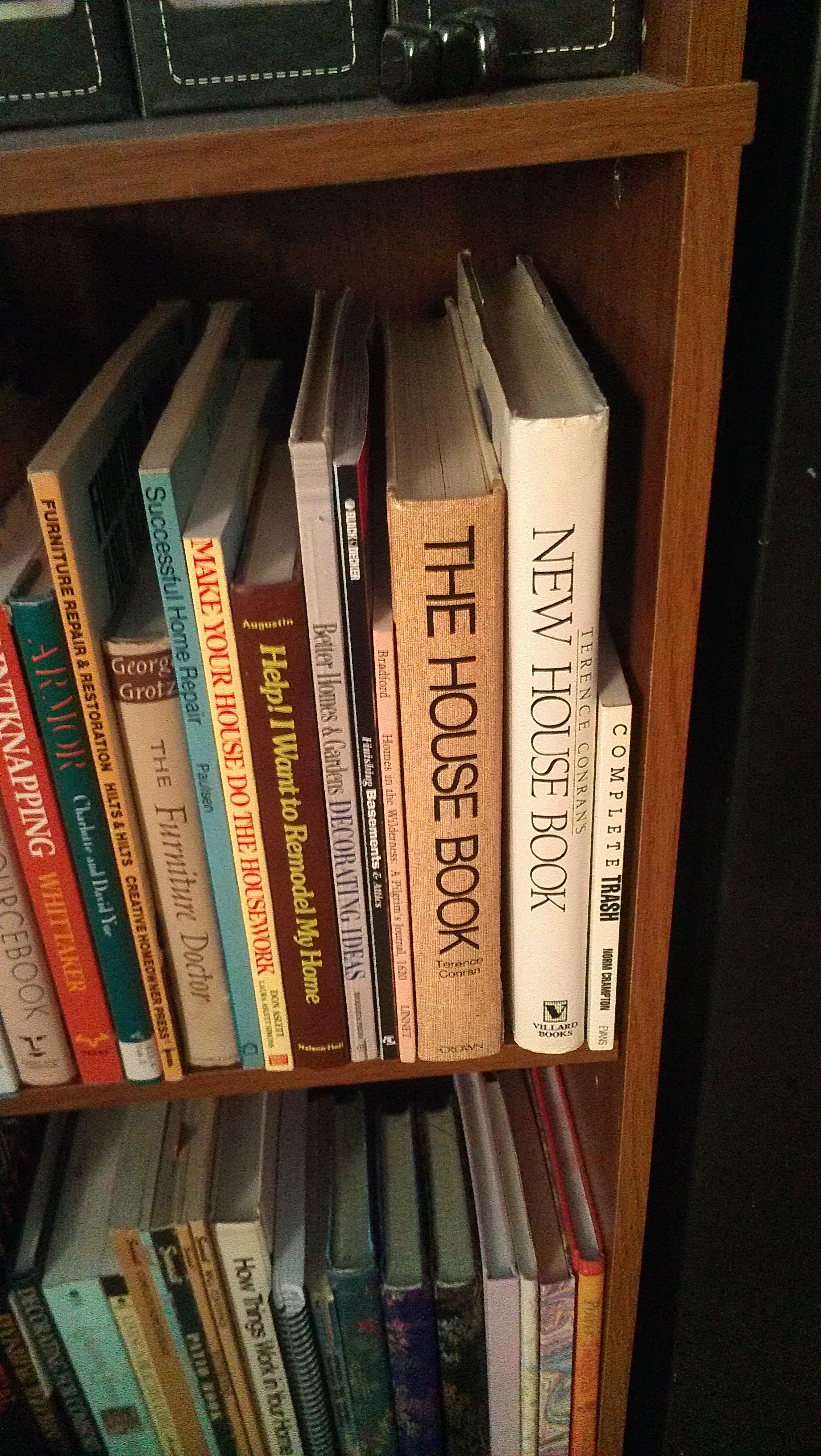
    Used book sales are a lot of fun, because you can find all sorts of things that are now out of print.  I have several collections of different subjects, and one of them is what I\’ve decided to call, Home Design.  A while back I did a series about redesigning my home library, and how the shape of the subjects my husband and I collected told me something about us in the same way an autobiographical sketch might.

    \"20150405_0087\"


    I have a mix between practical how-to books and design books.  I differentiate those by whether they tell me how to achieve a particular aesthetic (design) or how to make or fix something (how-to).  I also found that I have a fascination with how to manage a home; things as varied as a housekeeping manual (I have several) to how things in the home work (which is the actual title of one of the books).

    In my fiction, I have found recurring themes of Home and Belonging.  The two are related:  how to create that home where one can feel a sense of belonging, and how to find that home in terms of stories and allegories.  It\’s cropped up in fiction, poetry, and apparently, on my shelves.

    What about you, Dear Reader?
    What are some of the subjects that you have on your shelves, or like to read?

  • G Is For… Gratitude

    G Is For… Gratitude

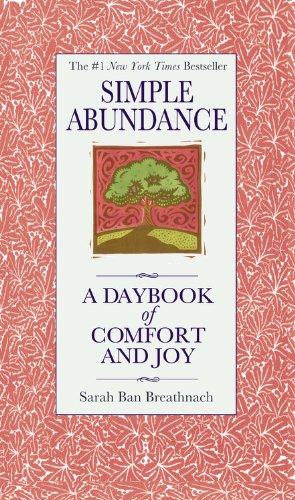
    \"2015-04-08One of my favorite books is Simple Abundance by Sarah Ban Breathnach.  One of her fundamental suggestions is to write a daily list of five things for which we\’re grateful.  She believes that it is a life-changing exercise and I have to say, I agree with her.

    She recommends making a Gratitude Journal, which I have done at times.  Other times, I\’m not able to keep up with it in a separate book so I have taken to doing it in my Morning Pages journal or in my planner.  What I have found is that the more I make space for it, whether or not it\’s in a separate journal or not, the more I\’m aware of the positive in my life.

    I have found that listing five things is just enough to keep me grounded, even on those days when it\’s difficult to be thankful for anything.  On those days, she recommends noticing the fact that the day is over – which, while it made me laugh, is very appropriate.

    What about you, Dear Reader?
    For what are you grateful today?

  • F Is For… Ferry

    F Is For… Ferry

    \"\"

    Ferries are a trip.  Their wide bottoms make them stable in the water, so it\’s unlikely they\’ll capsize.  I\’ve been on two, so far; the one pictured above is the Bainbridge Island ferry off the Sound from Seattle.  The other one was on Lake Erie, across its choppy water.

    \"2015-04

    Very choppy.  ~shudder~  That\’s not my picture, obviously, since I was on the ferry; however, it sure felt like that when we rode it.  I\’m sure it wasn\’t actually that bad, as I don\’t actually remember water coming over the bow of the boat.

    I like the ideas of ferries in principle; they sound so romantic.  Traveling on a slow-moving, graceful conveyance over miles of water, gazing at the landscape rolling by…

    What about you, Dear Reader?  What type of transportation have you been on that was less thrilling than you imagined it?

  • E Is For… Eggs!

    E Is For… Eggs!

    \"20140314_0020\"

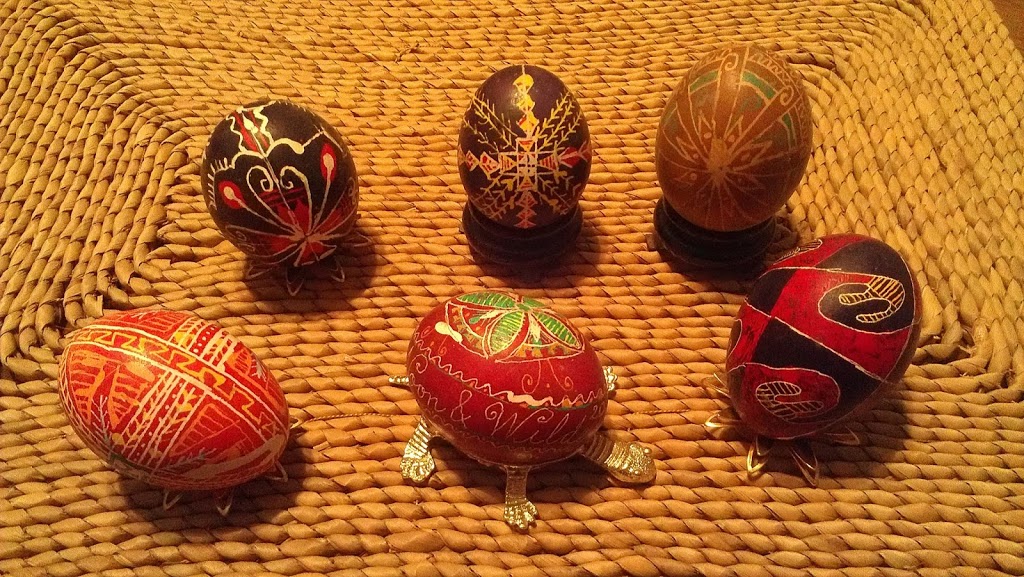
    These are pysanky, or Ukrainian decorated eggs. According to legend, a demon monster would destroy the world but it\’s chained, unable to complete its destruction. As it fights its bonds, the links of the chain are weakened. Every year, the chain is strengthened by the number of pysanky that are made or exchanged.

    Make pysanky or die. I love it.

    What about you, Dear Reader? What\’s your favorite legend?

  • The Emerald Keep Book Tour Continues!

    The Emerald Keep Book Tour Continues!

    \"2015-03

    The tour has been truckin\’ along.  I checked today and we\’re up to 229 entries for the Rafflecopter!  Holy moly, Dear Reader, how awesome that is.  Thank you so much for your support!

    a Rafflecopter giveaway

  • D Is For… Dogs

    D Is For… Dogs

    \"Bedface,

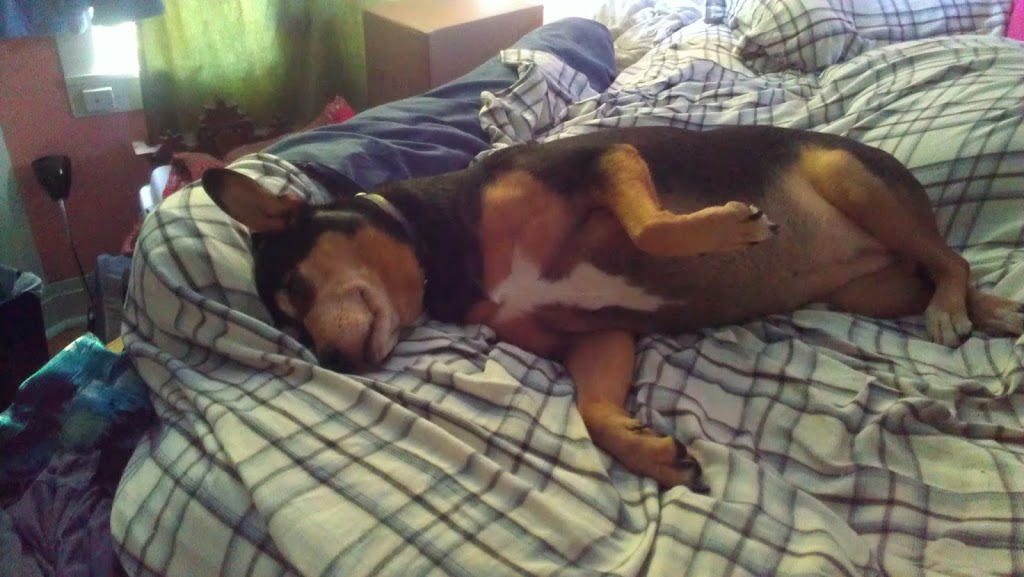
    Dogs, and the people who love them.  If you love dogs, then you get it.  If you don\’t, then you don\’t.  It\’s that simple, really.

    Our sixty-five-pound bundle of joy came to us eight years ago from the Anti-Cruelty Society in Chicago.  She\’s gotten comfortable as a part of our family.  She likes to take her half of the bed out of the middle, leaving my husband and I to find what space we can in the remaining spaces.

    Author Lynda Barry, who wrote What It Is, suggests thinking about all the dogs you\’ve ever known.  Where did they all go?  That question rang like a bell to me.  I\’ve used it a couple times in prompt circles and the memories come back more strongly each time.

    What about you, Dear Reader?
    What\’s your first dog memory?

  • C Is For… Calligraphy

    C Is For… Calligraphy

    \"20130731_0015\"

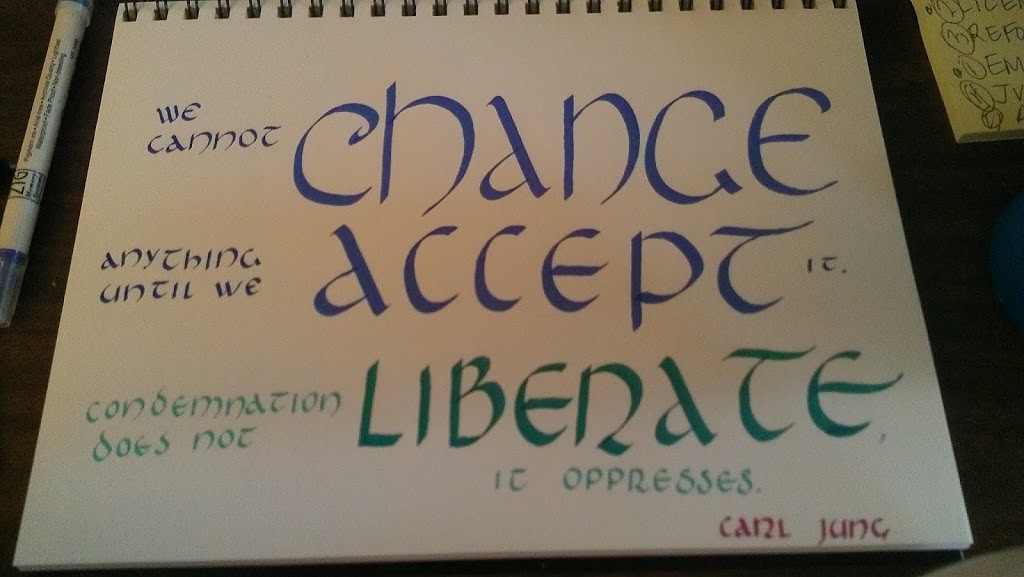
    Before the printing press, there were pens and paper.  The art of calligraphy is from the Greek, Kallos graphos, or beautiful writing.  Like the printing press, there\’s an ancient history of calligraphy in Asia, and it\’s even tied to meditation practices.

    I discovered calligraphy when I was about ten years old, when one of my classmates\’ handwriting caught my eye.  She wrote so beautifully, letters that were even and round on the page.  I studied her writing for four years, endeavoring to copy it.  I finally succeeded and, in the process, discovered the art of calligraphy.  The Scheaffer calligraphy set that I was given as a gift opened a new world to me.

    Despite becoming good at it, I dropped its pursuit in college due to family opinion that I should focus on college and the necessity of making a living.  About eighteen months ago, I re-discovered the art.  The technology in felt-tipped pens is much better than when I was young.  In particular, my favorite is the Zig brand double-tipped pen.  I found a set of six of them and played for a few months, before buying one of each of the colors available.

    What about you, Dear Reader?
    What art did you play with as a child that you have picked up, or might like to, as an adult?

  • B Is For… Books

    B Is For… Books

    \"George-peabody-library-2\"

    Books.

    They\’ve been around for a while now.  When I was younger, I thought that we Westerners invented them, but it was the Chinese who came up with the printing press 400 years before Gutenberg\’s bible.

    Whoever first did it, I\’m ever so grateful they did.

    The first time I started using the library on my own, I wandered the stacks of my grammar school\’s library.  I didn\’t know how to find books I liked, and it was so hard to figure it out from the covers.  They were blank, hardbound books with dark covers that held secrets between their pages.  How do you dig into them, short of reading all of them, to find out which ones you enjoy?

    I remember their smell, these old books.  I read somewhere that the smell was a unique combination of a bug that eats paper and the decomposition of that same paper.  I don\’t know if that\’s true, but I love the idea of a real bookworm.  My favorite author back then was Phyllis A. Whitney, who wrote mysteries.

    What about you, Dear Reader?
    What is the first book you remember reading?