Tag: #atozchallenge

  • B Is For… Belonging!

    B Is For… Belonging!

    \"Hands

    Belonging isn’t something I wait for anymore. It’s something I build — slowly, deliberately, the way you build a studio you can actually breathe in.

    In my world, belonging starts as sanctuary: a place where your nervous system unclenches, where you don’t have to perform, where your creativity can arrive without apology. A place that feels like coming home to yourself.

    But belonging is also permission. Permission to take up space. Permission to make things that aren’t perfect. Permission to follow the thread of your own curiosity instead of someone else’s expectations. Permission to be weird, tender, ambitious, contradictory — and still welcome.

    And most of all, belonging is a practice. A rhythm. A ritual. A way of returning to yourself again and again, even on the days you feel scattered or small. It’s the candle you light, the playlist you trust, the notebook you keep reaching for. It’s the quiet agreement you make with yourself: I get to be here.

    In the studio — and in the life I’m building — belonging isn’t earned. It’s cultivated.

    What does Belonging mean to you?

  • A is For… Atmosphere!

    A is For… Atmosphere!

    \"Image

    Every studio has a pulse — a subtle hum of presence that shapes the work long before the first word is written or the first thread is pulled. For me, “A” begins with atmosphere: the quiet, intentional way a space invites me into making.

    Atmosphere isn’t about perfection. It’s about cues. The soft scrape of a chair on the floor. The way light pools on the desk. The scent of wool, ink, or the last cup of tea. The small altar of objects that remind me who I am when the world gets loud.

    Before I begin any creative practice — writing, weaving, stitching, photographing — I tune the room. I open a window. I clear a corner. I place a stone or a spool of thread where my eye will land. I let the space tell my body, “You’re safe to make things here.”

    Atmosphere is the first ritual of the studio. It’s the threshold between the outside world and the one I’m building with my hands.

    Happy A‑Day from ACN Studio.

  • B Is For… Bulbs!

    B Is For… Bulbs!

    \"#AtoZChallengeFall bulbs are a mystery to me. How you can plant little onion-looking things in the ground right before winter and have them turn into gorgeous flowers is like botanical magic.

    However, I adore daffodils.

    Our daffodils haven\’t come up yet, since it\’s still cold out. BUT, we have a ton of narcissus and another kind of flower that I didn\’t write down the name of.

    I think this gets back to the idea that I\’m a feral gardener, not one of those lady gardeners that goes out with white gloves and a floppy had that comes back pristine and clean. I come back with dirt under my nails, smudges on my face, and the other day I actually had dirt in my hair.

    Hmph.

    Flowers are pretty though. Take a look:

    \"\"

    These are the ones that I can\’t remember the name of. They\’re little purple flowers and some are purple and white stripes. I want to weed the grass on the outside of the planter, because it doesn\’t look very neat.

    \"\"

    These are the narcissus. I tried to stagger them on a zig zag, and I like the way they\’re coming in.

    \"\"

    Close up of the pink one.

    \"\"

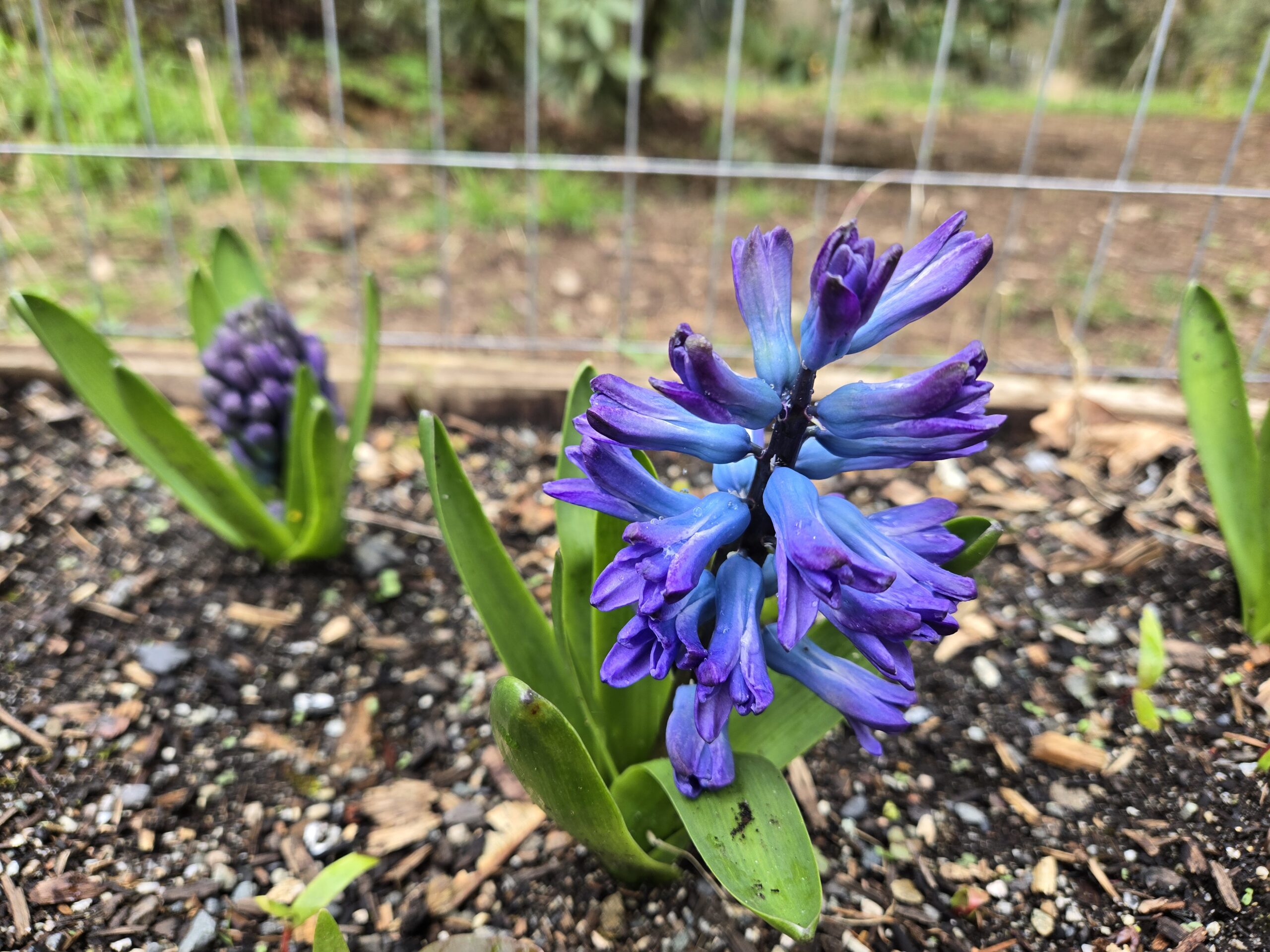
    Close up of one another one; I love this one. I love the color; it\’s amazing how it\’s actually blue!

  • A Is For… The A to Z Challenge!

    A Is For… The A to Z Challenge!

    \"#AtoZChallenge

    Greetings from the rainy Pacific Northwest! I\’m Noony, and I\’ll be your host this month for the A to Z Blog Challenge here on my blog.

    First, though, I want to share something of critical importance. Now, more than ever, it\’s critical for creatives to stand together and support each other. To that end, those of you here in the States, we are rallying this coming Saturday, April 5th. On this single day, four groups have come together: 50501, Indivisible, Hands Off, and Women’s March. They are organizing on two websites: Hands Off and See you in the Streets.

    NOTE: As of Saturday night, 885 protests have been logged. Protests are being added daily. These are *non-violent* protests. Hope to see you there! If you can\’t come in person, please help spread the word, either on social media or with your local press. Let\’s show these billionaire oligarchs that America is not for sale.

    Second, on to my theme, which is,

    The A to Z of Our Forest and Gardens!

    If it\’s your first time visiting me, my husband and I live on a homestead in rural Washington.  We are both transplanted urbanites, so we\’re learning a whole new way of being that includes things like invasive species management and how to competently grow a tomato.

    Now, I gardened in Chicago for twenty years, and even was part of several community gardens including the Peterson Garden Project and the Global Garden. The microclimate on our property here in Washington is completely different, AND is not in sync with the rest of Duvall since we\’re at a higher elevation. It means that we\’re about a month behind the gardens in town and this has completely messed with my tomato mojo!

    Add to that the fact that we can get property tax credits for properly managing our forestland and it\’s all become and amazing learning adventure.

    Last fall, we took a forestry class through Washington State University in partnership with King County Conservation District and the Washington Department of Natural Resources. It was twelve weeks long and covered how to create a Forest Management Plan, a document that is the first step to those tax credits. Not only did they help with the writing of the plan, but also with the doing of the things IN the plan – invasive species management, wildlife conservation, forest product development, and water quality initiatives. They even had a segment on managing our wildlands for wildfire, which is a growing threat in our area due to human caused climate change and land management practices.

    This past January, I saw an email talking about another class from the same group, this time called, \”Grow Your Groceries.\” What\’s more, the class came with twenty seed packets! We signed up and are in class every Thursday through May.

    This month, I\’ll take you on a tour of our forest. We\’ll see our trees, talk about snags and wildlife habitats, birds and beasts, gardening from bulbs and seeds to using the harvest, and I might even experiment with microgreens! It\’s all raw and authentic, and there may even be video.

    Come along with me and enjoy… the A to Z of Our Forest and Gardens!
     

  • J Is For… Just Write It! (aka Following One\’s Own Advice)

    \"\"

    So. It\’s the 12th. Of April.

    Yeah, I noticed that too. It was the 6th of April like five minutes ago. Oof.

    Here\’s what I tell others when they say to me during a challenge, \”But I\’m so beehiiinnnd!!!\” I say, \”So start with where you are!\”

    What does that mean for me today?

    Well, for a start, it means posting on the blog. I checked my Postcrossing stats, just to see where I was on sending out cards – my goal is to have all cards out at all times, and last time I checked I still had four out – and it turns out I\’m behind there, too:

    \"\"

    This is what it looks like once you sign up for an account on Postcrossing. (If you\’re interested, you can click the image and I have it set up to take you straight there). When you start out, you only get a few cards to send, but as you send more and others note they\’ve received them, then your send count goes up.

    I\’ll grab my postcard stash and request an address, and then work through the list one at a time. I once selected six at the same time and then got busy, and couldn\’t write them in a timely fashion; I don\’t do that now. I pull the address when I am sitting in front of my postcards so I can send them right away.

    How many of you are already in Postcrossing?

    If you\’re not into it yet, would you like to know more about it?

    Let me know in the comments!

    Write on!

  • E Is For… Easter Cards!

    \"\"

    I love getting non-bill mail. One of my favorite things to do, is to find offbeat holidays and send cards to my friends and family. Even if you don\’t practice Christianity, the Easter holiday here in the States has become a secular celebration of Spring. We have the Easter Bunny, decorated eggs, chocolates, Easter baskets, and best of all, CARDS.

    You can find inexpensive Easter cards at the dollar store and big box stores. You can find special fancy cards at the fancy card shops. You can find handmade and unique artist cards on shops like Etsy or at local small stores that specialize in gifts or unusual things. You might even find that your community supports artist collective shops where you can go in and see products produced by multiple different local artisans. You can even just use regular paper in an envelope and a stamp – it doesn\’t have to be fancy to say, \”I\’m thinking about you and wish you well.\”

    I need to go find my cards, pardon me. 🙂

    Happy writing!

  • C Is For… Corresponding with Someone

    \"\"

    When people find out that I like to write letters, a question I often get is,

    \”What do you write about?\”

    Here, then, are some suggestions:

    Start with a Draft

    You can do this old school (on paper) or in a document you keep on your computer. I like to do this on paper because I find that handwriting my ideas slows my brain down. This serves two functions: one, it\’s a form of mindfulness; and two, it lets me see the shape of my thoughts and really sit with them, allowing them to develop.

    Jot down things you want to include in your letter – three things you want to mention

    Why three? I find that if I can get to three, I can get to infinity. One is too few, it doesn\’t leave me anywhere to go. Two is adversarial: this, or that. Dark, or light chocolate. But three, three allows me to suddenly make connections, create a shape, get three dimensional. Try it and see what happens for you.

    Have Three Questions

    No one likes someone who only talks about themselves, right? Then don\’t be that kind of correspondent! Show an interest in your penpal, and ask them questions. One of my favorites: \”What\’s new in your world?\” Another one is, \”Describe for me what a normal day is like for you.\” You can also go on Google and look up \”good icebreaker questions,\” and pick some to include.

    To Enclose or Not To Enclose

    Some penpals insist that one must include something in their letter as an enclosure, and I\’ve seen all sorts of rules for what kinds of things to include – and they rarely agree with each other. Me, I\’m more of the middle way: if I have an enclosure I want to include, I will; otherwise, I\’ll let my words and thoughts stand on their own.

    But what kinds of things work as enclosures?

    • A packet of tea
    • Ephemera like small slices of decorated paper
    • Maps
    • Menus
    • Washi tape
    • Stickers
    • A handmade woven \”mug rug\” that I wove on a pin loom (I\’ve used this as an enclosure multiple times)
    • Bookmark


    It comes down to what you feel comfortable including, and how much postage you want to spend. A note of caution: be sure to weigh your letter; you don\’t want the recipient having to pay for extra postage in order to read your letter.

    What\’s the most unusual letter you\’ve received?

  • B Is For… Blogging!

    \"\"

    If you\’re visiting from the A to Z Challenge, then chances are you know a lot about blogging. Today, I wanted to talk about one blog in particular: the Postcrossing blog. You can visit it, here. Their tagline is, \”Stories about the Postcrossing community and the postal world.\”

    Postcrossing is an international community of penpal afficionados. It\’s an interesting concept: members send postcards to members around the world. The blog discusses news from within the community, and also postal mail in general. One recent article highlighted the Malta Postal Museum.

    The thing I love about Postcrossing is that it\’s not a big investment. Writing a postcard is a tiny bit of text, and a small amount of postage. You can decide whether to mail members just in your country, or whether you\’re willing to write to folx in other countries.

    Each month, they send you a list of your \”stats\” – to which countries you sent cards; from which countries you received cards; etc. I use it as a way to keep the pump primed, as Julia Cameron would say.  In the process, I\’ve even made some friends along the way. Not every person in Postcrossing is interested in a more extended correspondence, but I\’ve met a few. It\’s the best of both worlds: a quick note to someone new, and a few longer, more crunchy letters.

    What about you, Dear Reader? Have you tried Postcrossing?

  • A Is For… A Letter!

    \"\"

    Welcome, friends! And Happy April!

    Every year, in the month of April, there is an international blogging challenge called the A to Z Blog Challenge. I\’ve done it in previous years, but as with many of my writing friends, the last couple years have been difficult. Between the pandemic; war in Ukraine (Slava Ukraini!); the George Floyd riots and subsequent awakening of the American people to the continuing evils of racism, misogyny, and homophobia; the climate emergency; and the rise of Christo-fascism in the U.S. and around the world, it\’s been a difficult climate in which to be a creative. It\’s easy to feel lost in the midst of all of the onslaught.

    I think it\’s important to remember that we are physical beings. We aren\’t avatars, and we don\’t live in social media: we are flesh and blood beings with physical bodies and THAT is where our connection, our reality, must live.

    And therein I found my theme for this month\’s blog challenge. I decided to join at the last minute; I literally wrote the theme out yesterday and had to ask myself, \”Am I nuts? Do I really want to do a 30 day challenge right now after coming off a severe dry spell?\” In answer, my brain\’s squirrels awoke and not only was the answer yes, but I got ideas for my other sites and themes.

    Thus, here I am.

    Which brings me to today\’s subject: letters!

    What do you get in your physical mailbox? Do you get garbage mail, paper spam, bills, and nothing interesting? Nothing uplifting? Connecting you to people from far away?

    Well, I LOVE getting \”non-bill\” mail. It turns out, you get what you put out there, and that\’s doubly true for receiving letters. If you write letters, you will get letters back. Pretty magical, nu?

    And so my theme this month will be around my love of penpalling. I\’ll share some pictures of letters and postcards I\’ve received (never with the sender\’s address visible), and I\’ll talk about how I meet other penpals and snail mail aficionados. I\’ll even talk a little bit about mail art. While I don\’t consider myself a mail artist, I am fascinated by it and have participated in a couple Artist Trading Card swaps.

    But for today, I\’ll simply close with an invitation. Would you like to be my penpal? If so, please drop me a note at a.catherine.noon AT gmail DOT com and include your name, how you like to be called (if your nickname is different than your given name), and your mailing address. International folx welcome – I just got in a new set of international stamps. 🙂

    Tell me, Dear Reader, what do you like to receive in the mail?

  • J Is For Joie de Vivre, Which Is French for Birds Feeding

    Okay, it\’s not really French for birds feeding; please my French speaking readers, don\’t converge on me. And if you don\’t speak French, joie de vivre is translated to English as, keen enjoyment of life, as in, \”they were filled with joie de vivre.\”

    Well, here: you watch.

    I couldn\’t get them to come back to the seed, because I was standing too close, but I didn\’t want to step back or I would have been in the street. But I think they\’re adorable. I have such mixed feelings about feeding wild birds; everything I\’ve read from a conservation point of view advises against it because it interferes with their natural food-gathering and/or hunting habits. But I confess, I love watching them when there\’s a feeder to hand.

    And more on the \”J\” theme, even though it\’s not AT the botanical gardens, here is a very lovely rhodi, \”Just because:\”

    \"\"

    Isn\’t she lovely? The centers are a deep, blushing pink, but the blooms are a warm, creamy white.

    \"\"

    Here\’s another one where you can see mostly the blooms; I\’m astounded that such a deep reddish pink turns white when they open!

    \"\"
  • I Is For Ivy, That Covers and Hides; The Groundcover of All Things, It Moves Like the Tides…

    \"\"

    I have a confession to make: I adore ivy. When I lived in Chicago, I moved into a brick \”three-flat,\” which is Chicagoan for a brownstone with four apartments. No, that doesn\’t make sense; this is because the basement apartment was added in the 1960\’s or so in an illegally-made addition done with, get this, plywood. But no matter; I called that little tiny place home for nearly 15 years. In front of our building lay a bedraggled mess that, I\’m sure, the former owners intended to be a lawn, but due to the two enormous, stately Norway maples in front of it, ended up as a sun-choked home for weeds and the occasional beetle.

    My landlady and I were friends, and I lived in that building for one year shy of two decades. In that time, one of my first projects and what ended up as my longest-lasting one was to install a garden. We called them \”The Beehive Gardens,\” named for the building (the Beehive) and the gardens (plural because there was more than one tiny weed patch). Besides. The Beehive Gardens sounds so much better than \”that little tiny garden that you stuffed in between the concrete sidewalks.\” And when you put your mind to it, you can get quite a bit of gardening done in a very small space.

    So into that front yard that had been a sad attempt at a village green went three things: English ground ivy, vinca vine (variegated and plain), and Creeping Charlie. \”But those are weeds!\” you might exclaim and, Dear Reader, you\’d be right: but what is a weed but simply a plant growing where you don\’t want it to? And one thing all three of those so-called weeds do is spread.

    Unlike the grass, you understand.

    \"\"

    Now this challenge is for the Bellevue Botanical Garden\’s A to Z, but as I mentioned in my \”N\” post, I\’ve got a cold – so I\’m actually writing this \”I\” post on the 16th of April and back-dating it, thanks to the wonders of modern technology. But this further means that these photos weren\’t snapped at the Bellevue Gardens but along my walk today at lunch (\”today\” being Tuesday and not last Wednesday). There is plenty of ivy on my walk, and ivy gets everywhere – including under this juniper bush! – ooh, lookatthat. A \”J\” picture. Maybe I\’ll post that tomorrow… which is to say, for last Thursday.

    And now that I\’ve totally lost you, and just at that point in my walk where I was wondering if I\’d really need all these pictures of ivy, I came across this lovely spot:

    \"\"

    I wonder who is living in that little shady abode, eh? Spiders and moles, voles and mice, maybe the odd raccoon or duck? Looks like a good place for a nap, but that might just be the cold medicine talking.

    And just as I was thinking enough is enough, I saw this:

    \"\"

    Now I don\’t know about you, Dear Reader, but I watch quite a bit of British murder mystery fiction. And I\’ve watched American and Swedish ones for good measure, and even the odd French and Norwegian one thrown into the mix.

    Does this not, Dear Reader, look like the owner of this apartment complex might have buried an unhelpful tenant under a bed of ground ivy?

    I shall run back to my nice, warm desk and hide for the rest of the day, because after all, one can never spot a serial killer because they could look like everyone else.

    I don\’t know that I like that ivy all that much now… ~shudder~

  • H Is For Horticulture, the Science of Plants

    \"\"

    This is a long view, just down from the Tateuchi Viewing Pavilion, toward the Ravine Experience. The piece in the distance looks like a high-backed faerie throne. The water goes under the walkway; I stood on a pathway bridge to take this shot.

    Which got me thinking: what is horticulture? How is it different from gardening?

    My husband and I, as geeks often do, talked about it yesterday and ruminated on the Latin origins of the word, \”horticulture.\” It\’s composed of two Latinate words, \”horto,\” for garden, and \”culture,\” for… something. Probably culture, one would assume; but we already know from other studies that sound-based etymology is bad linguistics. We also know that the motto of the city of Chicago is \”Urbs in horto,\” or \”City in a garden.\” So we know horto and garden are connected. But where does \”culture\” fit in? Does it refer to the culture of gardening? Probably not, since vermiculture is the cultivation and care of worms, and agriculture is the cultivation and science of agri-stuffs, or crops. Which are growing things, just like hortos.

    Aside from the pleasant mental gymnastics of our conversation, we decided that alas, to Auntie Google we must go. \”Google, what is horticulture?\”

    \”The word horticulture comes from two Latin words which mean \’garden\’ and \’culture.\’ Horticulture is the art and science of growing and handling fruits, nuts, vegetables, herbs, flowers, foliage plants, woody ornamentals, and turf.\” From Extension: Issues, Innovation, Impact; \”What Is Horticulture?\” accessed from the following link, here.

    What\’s the difference between horticulture and gardening? Ian Graham, self-identified \”Craft Gardener,\” has this to say on Quora: \”Horticulture is the production of plants for a purpose – food, ornamental, forestry, medicines, fuel etc. Horticulture is a science, using scientific research and the scientific method to produce \’better\’ and more productive plants. Gardening is a personal or community pursuit to produce environments (personal or public) of beauty and functionality, using plants (ornamental and food), water, and \’stone\’. Gardening also includes personal food production, ie veggie patches.\” Accessed from the following link, here.

    I like Mr. Graham\’s distinction, \”production of plants for a purpose:\” aside from the pleasing alliteration, which, less face it, I\’m all for that, I think it defines the science a little more. But \”science,\” in the old days, simply meant applying the scientific method: create a hypothesis, try it, record the results, try again. In gardening, that could be \”I\’ll try planting tomatoes in this pot.\” Then record the results. \”Well, that worked, but they need more sun so I\’ll try that spot over there in Spring.\” Lather, rinse, repeat.

    So in some ways, I think horticulture is just a fancy way of saying gardening, a way to legitimize and sciencify something we humans have been doing for generations. But I\’ll note this: they\’re called Botanical Gardens, not Horticultural Exhibits. Though now that I say that, I suspect there probably are horticultural exhibits. This is one of the things that makes English so difficult, is its propensity for stealing from other languages and calling it English. 🙂 I think, on balance, that shall remain, as did Galadriel, myself; a gardener.

    Next up is the Letter I like Iowa. But there aren\’t any plants like Iowa, are there?

    You\’ll have to check back, Dear Reader; you\’ll have to check back. Cheers!