Tag: Herbalism

  • Writer Wednesday

    \"\"

    It\’s Wednesday, and I\’m a writer. That\’s about the only reason the title is what it is, and because I couldn\’t think of anything else to use. Check-in sounded too session-y, and holy shit the world\’s on fire a little histrionic. Both are, however, true. So this is a Writer Wednesday Check-In Because the World Is On Fire.

    And in some ways, my sentiment is, Burn, baby, burn. It\’s well past time we reckon with the consequences of the genocide we\’ve committed against Black and brown people in this country, (I\’m in the U.S. if that wasn\’t already clear), and the convulsive changes occurring here and around the world are necessary for growth.

    Sure ain\’t easy, though. Mr. Floyd was laid to rest yesterday. I keep trying to write something coherent about it but run up sharply against the fact that the world doesn\’t need another horrified white lady extolling … well, anything on race right now. No shit, it was horrible that he was murdered. But the truth is, this has been happening for hundreds of years, in big cities, in small towns, and in rural places in the back of beyond. Like Will Smith said, racism isn\’t new, it\’s just being filmed.

    So how do we move forward from this moment? Particularly when we\’re gripped in a global pandemic and an environmental cataclysm that may make everything else moot if we don\’t get on it?

    I don\’t know. And that\’s not a bad thing, this not-knowing. It\’s not comfortable, I know that. But I want to invite you to sit with that not-knowing, that place between what we knew to be true and the place of what is actually true, or at least the next threshold. The more we can hold this place of not-knowing, the better we can listen and have a chance to really hear the lessons we\’re being called to learn.

    What that looks like for me is a couple things.

    One is, I learned a new concept this week: \”Performative.\” There are many kinds of resistance and, unfortunately, we\’ve seen a lot of performative acts over the last week and a half in the wake of Mr. Floyd\’s murder by white people. The most egregious example of this are the statements by NFL CEO Roger Goodell, where he apologized to … whom, us? the players? Colin Kaepernick? for censuring players for their peaceful protests of police brutality. Why is this performative? It cost him nothing. Mr. Kaepernick wasn\’t re-signed, and the fines paid by him and other players have not been returned, at least as of this writing. But it\’s on a smaller, more localized scale too. Many of my fellow whites have been vociferous on social media about the horrors of racism and police brutality, and there\’s a subset of these folx who are acting as though they\’ve just become aware of it. There\’s also a sense that this is what we\’re doing this week, but next week when something else comes into our consciousness we\’ll go do that and forget about Black Lives Matter. What makes it performative is this aspect of publicly doing it: \”See? I\’m a good person because I\’m shouting out loud how bad this is, and how much it hurts me to see it, and how enraged I am.\” I\’m not going to restate things that BIPOC folx have said better and more informatively than I can, and frankly we should be listening to them.

    Which is my point: I\’ve been very quiet the last week or so because I\’ve been sitting with my own racism and unconscious bias, and asking hard questions about why I\’m posting this or that? Am I doing it to keep the focus on BIPOC voices and activists? Am I doing what they are asking me to do as an ally, or am I doing things to make myself feel better or express my horror and outrage without realizing that the BIPOC community has been traumatized from watching on video Mr. Floyd\’s murder? The young woman, all of seventeen years old, who filmed the murder has been the subject of frequent harassment and has been made to feel unsafe. Is my jumping up and down going to help her? Or Mr. Floyd\’s devastated family and friends? I ask myself, if it was my family member murdered on a video went viral so that I see it everywhere from social media to the news to analysis shows, how would I feel?

    And so, I\’m quiet. Because I\’d be fucking devastated.

    I\’ve joined a private reading group to wrestle with these ideas and educate myself better. The book we\’ve chosen to read first is called How To Be An Anti-Racist, by Ibram X. Kendi. The link is to Chicago\’s only Black woman-owned bookstore. It\’s a safe space to discuss the ideas in the book as well as a place to ask embarrassing questions like, what do I tell my Black friend when her neighbor is acting badly? I\’d just call the police, but I don\’t fear that I might be shot if I did that. I\’m at absolutely no risk of it, and in fact depend on the authority my whiteness gives me. What does wipipo mean? Can I use it, or is that not a term that I should be using? How do I talk to my friends and coworkers of color about race? How do I not be an asshole when I\’m trying to help?

    There are many resources, and if you\’re looking for things, may I suggest you look to BIPOC leaders who have already written extensively on the subject? You don\’t need me, a white person, educating you on how to be a better ally. We, each of us, need to be doing that work for ourselves and listening to the BIPOC thinkers who are willing to talk to us about it. And we need to not bother our friends, neighbors, and family members with it – they\’ve been traumatized by the events of recent days. It\’s not up to them to educate us. And we need to be very suspicious of our own desires to ask them: are we asking out of a genuine desire to know? Or are we asking them in specific so they know we\’re \”enlightened and woke\” now? If you absolutely don\’t know where to start, check out your public library. They\’ve got curated lists and librarians willing to answer all sorts of questions for you.

    I know this is a long one, but thank you if you\’ve read with me this far.  I wanted to share, and I wanted to write about what\’s going on, but it\’s been really difficult to find my voice in the middle of what\’s going on. For that reason, I\’ve decided to coordinate a session of Finding Water starting this Sunday. There is no charge for it and the course will go for fourteen weeks. Head on over to our writing group site, Writer Zen Garden, for more info.

    Other than that, I\’ve been learning to weave and having a ball with it. I\’m also taking a class on Herbalism called the Science and Art of Herbalism, and I made some lavender tincture with brandy this week. It will steep for a month, and then we\’ll see how it turned out. I\’m going to start featuring more of that kind of activity on my craft blog, Knoontime Knitting. If you enjoy making things, I hope you\’ll come on over the join the conversation.

    I hope you are staying safe and healthy. COVID appears to not be going away any time soon, so make sure to strengthen your immune system and be smart about being out and about in public. Hug your loved ones close and keep on writing.

    Love,

    Noony

  • Sunday Box Talk – How To Unblock. With Rats.

    Sunday Box Talk – How To Unblock. With Rats.

    \"2015-10-11-Garden-Before\"

    Ordinarily, I talk about my garden on my craft blog, Knoontime Knitting. But I learned something this summer and it clarified itself yesterday. The boxes of our lives are created as we live them, and if we don’t question them – think out of the box, if you will – then we get stuck in them. We know that.

    Sometimes we get stuck in them without even knowing it. We get blocked.

    Then what?

    I’ll answer that question, but bear with me. There’s a story here.

    In my studies to find tools that work for me in terms of creativity, writing, and trauma recovery, I’ve looked at various journaling methods. Journaling has long been a tool of psychologists and artists, and many times for the same goals. Tristine Rainer has done a lot of research on the subject of autobiographic writing and she mentions a Japanese treatment that involves a lot of journaling and “light manual labor” in a rural location with lots of greenery and fresh air.

    Gardens, quite literally, are in the ground, unless of course you have a container garden and create the ground yourself. (I can see the precise among you saying, “But what about air gardens?” Chill, dude. I’m makin’ a point here.) The idea of light physical or manual labor appeals to me because it’s a way to put ourselves into our bodies, and for many of us who are writers, we have a tendency toward over-intellectualization. You can’t think a plant strong. You have to give it what it needs: dirt, water, fertilizer, food, light, and a good growing environment.

    Hmm. Mayhap there’s a metaphor there?

    Which brings me to my point about yesterday. My coauthor, Rachel Wilder, and I are together for our autumnal retreat. We met with our Founders Circle group at the end of September for a literal mountaintop retreat (I’m not kidding, the place was on the top of a mountain – awesome), and then we came home to Chicago to do a bunch of projects, both writing and homemaking. Yesterday, we put the garden to bed.

    That’s where it gets complicated. What about the rats?

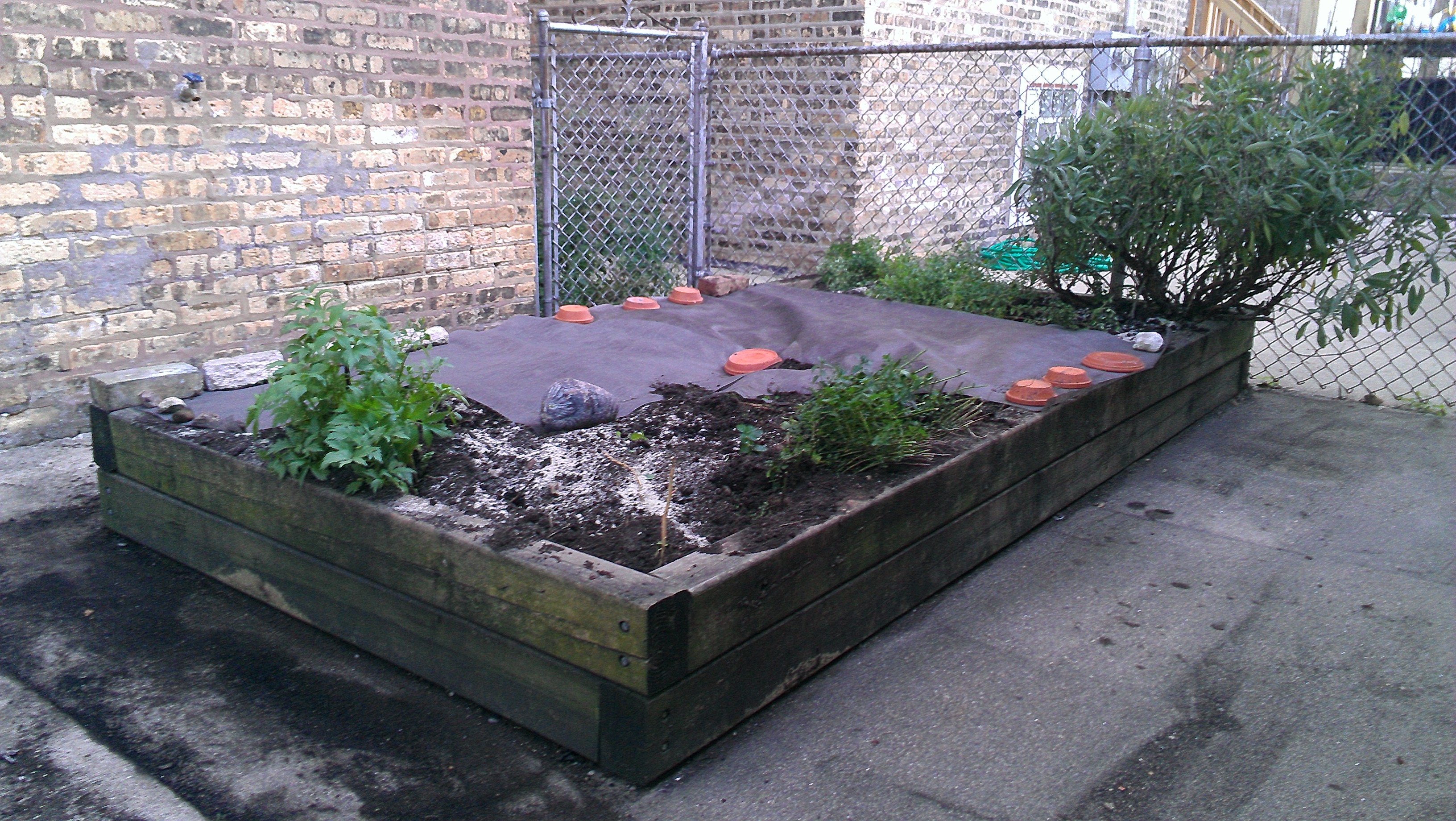
    I’ve been gardening here for over fifteen years. Four years ago, the City of Chicago had an abnormally warm winter, followed by another warm one. Last year was a deep cold snap, but it didn’t kill off the rats. They’ve become a serious problem on the north side and the park district has signs all over the river park about not leaving trash out to attract the rats. Unfortunately, my raised bed garden, my little, tiny corner oasis of fifty square feet (ten feet by five feet, people, we’re not talking huge) is a rat Mecca. They love it.

    Now, you might ask, Noony, what do you do about rats?

    This is the short, and utterly useless, “How-To” section of this post:

    1. Call the city and tell them you have rats, so they’ll come out and bait the alley.
    2. The city will come out and bait the alley.
    3. The rats, apparently, laugh in the face of danger. And hide. In my raised bed.
    4. Call the city and tell them we have rats in the raised bed.
    5. They send a guy who is a professional rat assassin to come and assassinate my rats.

    Tangential: have any of you seen The Rats of N.I.M.H.?

    My rats aren’t like those rats. Jus’ sayin’.

    Anyway, where was I? Oh, yes. 6.

    1. Last year, Year 3 of the Rat War, the dude the city sent came out in his customary bluish grey overalls. (By the way, romance novels that have pictures of sexy rat assassins on their covers, who woo passersby with their sultry charm, are LYING!) You know what his brilliant advice was?

    “Whatcha gotta do is call your friends and have ’em come over. Give ’em each a shovel. Stand around the raised bed in a circle. You’ll have to have someone next door in that yard, since ya got a fence right there. Yup, have ’em climb right over the fence and stand there with a shovel.”

    “What’s the shovel for?”

    “Well, ya gotta getcherself some road flares. The kind you snap open and they spew out that flame stuff. Get a brick, and light the road flare. Stick the road flare down the rat hole and put a brick on it. When the rats come boiling outta the garden, you and your friends chop off their heads with the shovel.” Pause. “Oh, and watch out. ’Cause they bite.”

    And that, my friends, is the wisdom of the city of Chicago’s rat assassin.

    1. Purchase your own rat poison and put it down the rat holes; put a brick on top of it and plug up all the rat holes. I looked it up; the poison won’t affect the plants that you’re growing – like, say, tomatoes that you want to eat.

    On the other hand, you can’t compost dead rats, so I’m not sure what they have to say about dead, poisoned rat carcasses rotting in one’s garden, but I digress.

    1. Build a cage around your garden. I think this is what we’ll try next year, if we’re still living here in Chicago. I don’t have the skill to do this, but my husband does, so we’ll see.
    2. Buy rat repellant. Don’t laugh. No, really, it gets better. They apparently make the stuff using fox or ferret piss.

    ~blink~

    I’m imagining buying a bottle of yellow liquid on the internet and having it shipped. What if it breaks, leaks, or otherwise vents its precious cargo all over my poor package carrier? I’ll never get Amazon again.

    Apparently, they pelletalize the stuff. You read that right: they turn it into pellets. (Wouldn’t THAT be a fun job? “Bobby, today your project is to figure out how to take this,” pats the jar, “and turn it into inert, odorless pellets that little old ladies can use in their gardens to repel pests.” “Uh, boss? That smells like piss.” “That’s because it is, Bobby. Isn’t chemistry fun? Oh, and I’ll need it before lunch, ’cause the boss is waiting on it. His wife has a garden problem.”

    So we bought some.

    I read the ingredients. Mint is high on the list. It’s apparently a rat repellant. The other stuff on the list is some organic foo-foo that doesn’t actually involve a canid’s pee. So I think my landlady either got confused, or tried something less noxious than milking a ferret.

    So I planted mint. A lot of it.

    Then there was the garden vandalism incident.

    That’s right, folks, my garden was vandalized by the basement tenant. She flipped out and hacked off all my plants, then piled all the dead stuff on the few remaining live plants. Which killed almost all of the mint but one clump, which I’ll get to in a second. But the point is, I don’t know if mint repels rats.

    It certainly doesn’t repel crazypants tenants, I know THAT for sure.

    1. Give up.

    I’m not really there quite yet, but getting close. This year, my coworker and I went in on a community garden and I had 200 square feet (which felt like a wealth of land next to my meager raised bed) to play with. We had a bumper crop of tomatoes, and even some Romas and beefstakes (which, if you’ve been reading me awhile, you’ll remember I don’t have luck with here due to lack of enough sun, though my cherry toms do great). We also had rabbits.

    Rabbits like lettuce, chard, kale, broccoli, and Brussels sprouts, in case you were wondering.

    They are, however, cuter than rats. And the repellants for them are much the same: predator pee.

    Seriously? Who thinks this stuff up?

    Next year, we’re going to plant herbs – lots of mint, since it supposedly repels rats and not neighbors; chamomile, lavender, marjoram, thyme, chives, cilantro, and a few other things I’ll think up between now and then. Also, we’ll plant flowers: some more lilies (because the crazy neighbor killed eight Lily of the Valley plants and all three of my big lilies that I don’t know the name of but I think are called star lilies), snapdragons, marigolds and calendula (which I read are actually two different plants), pansies, Johnnie-Jump-Ups, daffodils, and whatever else will grow in partial sun.

    You know, a’la rat.

    What about you, Dear Reader? Any rat tips?

    And for those of you still with me, the point of all this is that the shrinks were right: gardening IS grounding, and it does help us get back on the page. I just blasted out this blog post, for example, and actually have some inklings on what to do next on the novel that’s stuck in the mud. (Maybe I’ll put some rats in the novel and then kill them off in various creative ways.) (Just not with shovels and road flares, KTHXBI.)

    And if you\’re still with me, some pictures:

    \"20151008_0317\" \"20151008_0316\" \"20151008_0318\" \"20151008_0319\" \"20151008_0320\" \"20151008_0321\" \"20151009_0323\"


  • Hair Tea – Emerald Fire and Herbs

    In writing, we get to use what we know.  This used to intimidate me (what if I don\’t know anything??) until I realized that\’s my inner critic talking.  I do too know stuff.

    So.  What do I know?

    The airspeed veloc…  Nevermind.  Hair tea!  I know how to make hair tea.  Not tea you drink, though I do know how to make that too, but tea you put on the hair to make it healthy and shiny – and augment the color.  In writing Emerald Fire, Rachel and I got to put that knowledge to use and give it to the Keepers.

    I figured I\’d share some of the secrets today at Torquere Press:

    \”Research and World Building – Teeka’s Special Hair Tea Blend\”

    I hope you have a moment to stop on by!

  • Thursday 13: Thirteen Herbalism Terms Defined

    In the study of herbalism, I come across a number of terms that are both interesting and mystifying, since they\’re not things we use in everyday conversation. I thought I\’d share 13 with you – out of a list of quite a bit more than that! o.O… Never knew whatcha didn\’t know, huh? Me neither.

    So. Here we go:

    1. Abortifacient: A drug or other agent that induces the expulsion of a fetus.

    2. Alterative: An agent that produces gradual beneficial change in the body, usually by improving nutrition, without having any marked specific effect and without causing sensible evacuation.

    3. Analgesic: A drug that relieves or diminishes pain.

    4. Anaphrodesiac: An agent that reduces sexual desire or potency.

    5. Anesthetic: An agent that deadens sensation.

    6. Anthelmintic: An agent that destroys or expels intestinal worms; vermicide; vermifuge.

    7. Anthocyanins: Any of a class of soluble glycoside pigments that are responsible for most of the blue to red colors in leaves, flowers, and other plant parts.

    Bonus: Glycoside: Noun: A compound formed from a simple sugar and another compound by replacement of a hydroxyl group in the sugar molecule.

    8. Antibiotic: An agent that destroys or arrest the growth of micro-organisms.

    9. Anticoagulant: An agent that prevents clotting in a liquid, as in blood.

    10. Antiemetic: An agent that counteracts nausea and relieves vomiting.

    11. Antihydrotic: An agent that reduces or suppresses perspiration.

    12. Antiperiodic: An agent that counteracts periodic or intermittent diseases (such as malaria).

    13. Antipyretic: An agent that prevents or reduces fever.

    Source: Jeanne Rose,The Medicinal Herbal, Aromatherapy and Herbal Studies Course, 2001, page 102