Tag: journaling

  • J Is For… Journals / Joy / Joining!

    J Is For… Journals / Joy / Joining!

    Journals are the quiet keepers of a creative life. Not the polished kind — not the curated spreads or the perfect handwriting — but the lived‑in notebooks with ink‑blotted corners, taped scraps, half‑formed ideas, and the soft spine that remembers your hands. I’ve kept a journal since 1984, and daily since 1995 — a long, quiet thread running through every version of my creative life. Journals are where the raw material gathers. They hold the questions, the sketches, the spells, the lists, the moments you weren’t ready to say out loud yet. They are the studio’s memory.

    Joy is the spark that makes the work feel alive. Not the loud, performative kind — the small, steady joy that arrives when the pen moves smoothly, when the color lands just right, when the thread pulls through the fabric with that satisfying whisper. Joy is the warmth that rises when you realize you’re not forcing anything. You’re simply here, making, breathing, being.

    Joining is the subtle magic that happens when your inner world meets the page. It’s the moment when intuition flows into ink, when thought becomes gesture, when the studio becomes a place of connection rather than isolation. Joining is not about merging with others — it’s about aligning with yourself. It’s the soft click of recognition: yes, this is mine; yes, this belongs.

    Journals teach us to witness ourselves. Joy teaches us to stay open. Joining teaches us to trust the thread that runs through it all.

    Where does your creative life feel most alive — in the pages you fill, the joy you follow, or the moments when everything quietly joins together?

  • Self-Care September – Writer Wednesday | Journal Tools – Future Visioning

    \"\"

    Future Visioning

    I\’ve been keeping a journal for almost as long as I\’ve been alive. I started with one of those silly little ones they give small girls with a dopey lock that doesn\’t really lock and only about a paragraph\’s worth of space for each day. Such constraint! I\’ve tried all sorts of things in the intervening years, settling on my trusty Strathmore 400 Series 9 x 12\” spiral bound journals with the hardboard cover, because I can use it anywhere – on my lap on the bus or train, on the ferry, in a park, at the beach, in my office, on my balcony out back, in my car… (Dr. Seuss anyone?)

    There are many, many different ways of keeping a journal, too – from the straight up \”Dear Diary\” type of chronicle, to bullet journals, listing, the unsent letter, and all sorts of methods in between. Today I want to talk about Future Visioning.

    What Is Future Visioning?

    Future Visioning is between creative writing, narrative non-fiction, and journaling. It\’s a way of spending time in our minds, fleshing out what we want to create and making it real to our creative brain. Like writing a book, we create the setting and characters and see how they interact. Like narrative non-fiction, it\’s telling a story about real or imagined real events. Like journaling, this is meant to be private: between ourselves and our imagination, and not for the eyes of anyone else.

    How Do You Do It?

    I recommend setting a timer for ten or twenty minutes. Grab your favorite journal notebook or a keyboard and fresh document. It\’s up to you whether you prefer to type or write by hand. I prefer (and recommend) writing by hand because there\’s something kinesthetic that happens when we do that, but use what works best for you. If you\’re not sure, they both and keep what method you like best.

    Then, write down what you\’re wanting to create. Let\’s say our statement for today is, \”I am a prolific author.\” So I\’d start by writing that at the top of my page. Then I take a moment or two with my eyes closed and breathe deeply. I imagine what does me being a prolific author look like? I imagine it\’s this time next year, on a Wednesday afternoon, and I\’m on my balcony with the birds singing. When I have that image clear, I open my eyes and begin to write.

    It\’s a Wednesday afternoon and the sun is out. It\’s not too hot outside and the breeze feels good. I\’m so pleased because I\’ve finished my blog posts for the day and I just hit \”send\” on my newsletter. Our next book is ready to be uploaded, since I just got it back from our book packager. This will be our sixth book in the series and our twentieth book overall. My body feels calm and grounded, and there are no butterflies in my stomach. Writing is so deeply satisfying, and I\’m so grateful that I finally allow myself to do it.

    Let your timer be your guide, and just focus on getting the picture as clearly as you can in your mind, and write down what you see. Try to incorporate all five senses. What are you seeing? What does it feel like in your body to be in this new reality? What are you hearing around you, and from others in your orbit? What are you thinking as a result of your new reality? What in your life is easier?

    We spend so much time complaining that it\’s easy to think that\’s the only thing we can do. But with a little creativity, we can use our journal as a potent tool for positive change.

    Tomorrow, join me for our first September Challenge!
  • Sunday Box Talk – The Toolbox

    Sunday Box Talk – The Toolbox

    \"Screen

    \”Success doesn\’t come to you, you go to it.\”
    – Marva Collins

    It’s easy to lament the things we don’t have yet. The media bombards us with images of more successful, more slender, more athletic, more successful people every day. New media come online every day, methods of distracting us from ourselves: even the dollar store as the “dollar store radio network” to talk to you while you hunt for bargains. Is it any wonder we feel bombarded? Or, worse, bad about ourselves because we’re not where we want to be?

    I offer a thought for a beleaguered mind: gratitude.

    Give thanks for the good that exists in your life, right now. Even if there doesn’t seem like much you could possibly be grateful for, the fact that you are alive and reading this newsletter is enough. Imagine if you were in Baghdad right now, sitting in the bombed-out shell of your temple, trying to pray with the sounds of mortars booming in the distance? What if one hits your neighborhood? The fact that we live in relative peace and calm, pursuing making a living and our hobbies, is a subject we can offer much gratitude for. Sure, not everything is perfect. But much of it is good.

    Try numbering a sheet from one to ten, and write down ten things you’re grateful for. See if you can’t go past ten. How do you feel?

    Now I propose that we become pilgrims on the path to self. We will do this together, side by side, shoulder to shoulder. Our tools are our bright minds and our love for each other. The first item in our toolbox is Gratitude. Learn to say thank you with an open heart. If you need ideas for how, go grab a copy of Sarah Ban Breathnach’sSimple Abundance, one of the best books written in the last two decades. Try her Gratitude Journal. Select a small, pretty book. Each night, just before you go to sleep, write down five things you are grateful for from the day. That’s all. Just five.

  • Sunday Box Talk

    Sunday Box Talk

    \"funny-my-box-cat-attacking-dog-pics\"

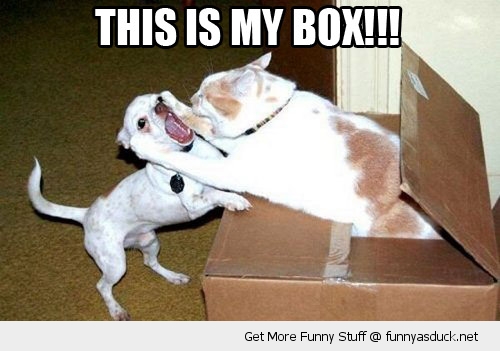
    Boxes.  I\’ve talked about them before.  We get into them by following set patterns of behavior without question.  So what do we do when we realize we\’re in a box that we don\’t want to be in anymore? More importantly, what do we do when we have no idea what box we do want to be in?

    There are a lot of resources out there that talk about how to network, how to find the job of our dreams, etc. But the more important work, the core work, is to figure out what we want.  Stephen Covey once said that we can fight and scratch and climb our way up the ladder of success, only to get to the top and find that the ladder is on the wrong wall.

    Today, I want to talk about how to find the right wall. Sometimes, all we need is to find the right village with the walls that we enjoy – meaning, we don\’t necessarily need to flip our entire lives inside out when we\’re dissatisfied. We can incorporate elements of our ideal lives into the one we\’re living now. By doing so, small changes can be made that, over time, can help realign our lives – and our ladders – onto the right wall.

    So how do we figure out what we enjoy?

    One way is to grab our trusty journal. Don\’t have a trusty journal, you say? Go to the dollar store and grab a spiral notebook, or get some loose-leaf paper. Something, anything to write on will do. Now, number your page from 1-5. Moving as quickly as you can, write down 5 occupations that sound fun.

    Next, number from 1-5. Write down 5 occupations that intrigue you, but you\’d personally never try. They might include professional skydiving instructor or tarot card reader with a traveling circus.

    Now, write 5 hobbies that sound fun.

    And finally, 5 things you would love to try once, if you didn\’t have to tell anyone you did it. Maybe, go to a strip club, or midnight golf, or hitch hike to New Orleans (which is more fun if you don\’t already live in New Orleans, but you get my point).

    Now you have your list of things to explore. You can read up on them, do internet searches about them, talk to people who are already doing them. There are many ways to incorporate our desired lives into our current ones if we are willing to start small, be creative, and honor our own creative impulses.

    Now, I\’m curious. What\’s one thing from your lists that you\’re willing to share? Mine is be a professional tarot card reader and psychic with my own storefront, Madam Noony. What about you?


  • A Writer In Her Library – Journaling with Deena Metzger

    A Writer In Her Library – Journaling with Deena Metzger

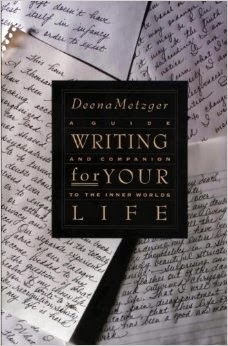
    I’ve re-discovered one of the books in my personal library, Writing For Your Life: A Guide and Companion to the Inner Worlds, by Deena Metzger. I’ve been doing a lot more journaling in the last year and it re-ignited my interest in books about journaling and ways that have worked for other diarists.

    This particular book has an emphasis on specificity and poetry. She has us examine our observations as though we were a traveler in a foreign country, visiting a new place. By doing so, we turn our attention to things and see them as though for the first time. She invites us to get more specific in what we see. In this way, we can bridge into poetry and metaphor, see the importance of what we’re seeing in a new, and deeper, way.

    I like books that have exercises in them because, at the end of the day, I’m a writer and not just a reader. I prefer books that invite me to be an active participant. I think that’s why I enjoy mysteries – because I get to solve the story along with the characters. Metzger has us experiment with many different methods, trying each of them on to see what works for us and for our writing.

    It is through facts that we can get to the heart of emotion. Rather than tell the reader, “I felt sad,” we show the reader what sadness felt like and its uniqueness in that time and place. Each sadness is different: different causes, different participants, different consequences. The more we can report the facts of the feelings, the more we can get to the center core of Truth in our experience. I think this is at the heart of the old writer’s adage, “show, don’t tell.” When I say to the reader, “I felt angry,” I’m telling the reader what I felt. When I say, instead, what that anger did to me physically, what I said and how others responded to me, and what was left unsaid, I show the reader a moment in time – so much more than just the emotion of angry, but an entire scene and its aftermath.

    I’m only in the first part of the book right now but am thoroughly enjoying myself. Highly recommend this to those of you that enjoy journaling, or that think you might want to give it a try.

    What how-to books do you recommend?
  • Tue Cent Twosday – In Defense of the Pen

    Diarists know what many of us have forgotten – people have been chronicling their own stories in diaries and journals for more than a thousand years. In order to better know themselves, or to express their own truth in the face of a public reality, or just for the fun of it, people have been writing for longer than some civilizations have been around.

    All that changed in the last 30 years with the advent, first, of the personal computer and then of the internet. We are seeing the first generation in the history of our planet that does not need to use the written word as it’s traditionally meant. In another generation, it will be unthinkable that some folks don’t know how to type – and it will, some predict, create a huge culture gap between those who have access to the internet and those who do not.

    But that’s not my purpose today. No, today I have a humbler calling. I simply wish to defend the simple, humble, pedestrian pen. Once known to by mightier than the sword, it is now relegated to the place next to the buggy whip: a beautiful piece of craftsmanship, but obsolete.

    But is it?

    I argue it is not. When we write, we connect ourselves to our physical or kinesthetic truth. The study of penmanship, or graphology, can tell us quite a bit about a person and, it follows, the practice of writing can therefore tell us a lot about ourselves. We cannot get a feel for the emotion of a typist unless it is through their word choices and syntax. Yet we can know at a glance the emotional state of a writer by whether the letters are calm and even or erratic and out of control. Did the writer tear the paper with their emotion? Are there teardrops on it? Lipstick? Did the writer press hard on the paper and leave ridges on the back, or did they leave barely an impression of themselves behind?

    Writing by hand can inform us of our shifting moods the way the tide can inform us of the moon’s gravitational effect on us. Subtle yet powerful, writing by hand connects us to ourselves and to our subconscious. Try writing with your non-dominant hand and you’ll see what I mean.

    There is beauty in writing, even that of an untrained hand. Lovers have known this for centuries. The personal, intimate handwriting of a loved one can bring comfort in dark times, solace to the lonely. When’s the last time you sent a letter through the mail? For less than half a dollar in the U.S., only a little more if you’re sending outside it, you can bring a smile to the face of someone for whom you care. In my group of friends, we call that “Non-Bill Mail.” If you save these letters, over time they become like a scrapbook, reminding you of moments in time encapsulated in an envelope.

    What would you preserve by hand if you had the time?

    Next time: “In Defense of Learning to Type”

  • Tue Cent Twosday – The Pen vs. the Keyboard

    In my writing group, I often hear complaints when I suggest we try a written exercise as opposed to one with a laptop or other computer device. I have said it before and I’ll likely say it again: writing by hand is important and valuable to anyone working with their own creativity, be they writers or other artists. In fact, I would argue that writing by hand is useful for everyone, and not just creatives. That does not mean that writing with a keyboard isn’t valuable in its own way too, but that one shouldn’t avoid handwriting altogether.

    Here are the five most common complaints and suggestions on how to address them:

    “I never write by hand.”

    I’m surprised by how many people say this to me. What’s even more surprising is how many of them aren’t Gen Y folks. The stereotype is that Gen Y folks only type, and that Gen X and Boomers are more “old school.” I haven’t seen this stereotype borne out.

    My response to it is simple: give it a try. Even if you only use it for writing exercises, think of them like you do the gym or music drills. The more you do it, the easier it gets.

    “I write too slow, and forget all the things I want to say.”

    This isn’t necessarily a bad thing. Our minds become fragmented by technology. I watch people try to have a conversation during writing group, or even just write. Smart phones buzz and people immediately look at them, even mid-sentence, to see what they say. Like coffee-fueled five-year-olds, we have lost the ability to carry one thought in our minds for longer than a few moments before we are distracted, like the dog in the movie “Up.” This isn’t healthy, nor is it good for our intelligence.

    Writing by hand slows us down so that we can catch up with ourselves. Typing on a computer means that we are staring at a clock, are prone to distraction from Facebook, email, and other programs, and that we can go at the speed of hyper instead of the speed of the hand. There is a reality within us that we can only hear when we slow down enough to listen.

    “My hand cramps.”

    This is a reasonable complaint. Like any other physical activity, stretch often and build up your strength. Maybe only write for fifteen minutes the first time, then work your way up to a longer session.

    “I can’t read my own writing, so why bother?”

    It’s like when we were taught to write way back when we were kids. Just practice. You’ll get better with time and attention.

    “It’s more efficient to type.”

    The objective isn’t to be efficient, it’s to see what we have to say. Efficiency is not the most important goal for a writer; clarity is.

    Give it a try. You might be surprised what you learn.

    Next time:  \”In Defense of the Pen\”

  • Sunday Box Talk – The Journal As Tool

    One of the best ways to get better at understanding our own boxes and their effect on us is through journaling.  I don\’t mean the stereotypical daily page-by-page, blow-by-blow accounts, but more like letters to ourselves.  In fact, writing a dialog with ourselves is tremendously useful.

    How does it work?

    As we write, sometimes we have other responses in our heads to thoughts we write down.  For example, we might write, \”I want to go to France.\”  A response might be, \”Yeah, right, like I have money for that.\”  Another response might be, \”Well, I could set up a savings account for it.\”  And then, \”Well, I\’d better set up an appointment at the bank to talk about options for savings.\”  If we label that first thought A, and then label each response, we can begin to follow a conversation:

    A:  I want to go to France.

    B:  Yeah, right, like I have money for that.\”

    A:  Well, I could set up a savings account for it.\”

    C:  I\’d better set up an appointment at the bank.

    \”C\” is the advisor that helps us get in touch with our deeper wisdom.  It might be D or E.  But if we dig deeply enough, we can find the inner strength to navigate many tough problems.

    What do you think about journaling?  Do you use one?