Tag: Rachel Wilder

  • G Is For… Gratitude

    G Is For… Gratitude

    \"2015-04-08One of my favorite books is Simple Abundance by Sarah Ban Breathnach.  One of her fundamental suggestions is to write a daily list of five things for which we\’re grateful.  She believes that it is a life-changing exercise and I have to say, I agree with her.

    She recommends making a Gratitude Journal, which I have done at times.  Other times, I\’m not able to keep up with it in a separate book so I have taken to doing it in my Morning Pages journal or in my planner.  What I have found is that the more I make space for it, whether or not it\’s in a separate journal or not, the more I\’m aware of the positive in my life.

    I have found that listing five things is just enough to keep me grounded, even on those days when it\’s difficult to be thankful for anything.  On those days, she recommends noticing the fact that the day is over – which, while it made me laugh, is very appropriate.

    What about you, Dear Reader?
    For what are you grateful today?

  • G Is For… Gardening

    G Is For… Gardening

    \"20140518_0007\"

    Gardening.

    I love to garden.  I adore the smell of loam, the feel of the plants in their new home, and to play with flowers.  I love getting the fruits of my labor: coming outside to pick peppers and tomatoes with chives and basil for dinner.

    Gardening is one of those humbling tasks, because it doesn\’t take a bunch of smarts.  It doesn\’t even really take books (though I think I have every gardening book known to womankind).  It takes consistency.

    Uh-oh.

    It\’s kind of like writing, in that sense.

    What about you, Dear Reader?
    What color is your thumb?  Green, like the farmers and gardeners of old?  Or you an armchair gardener, content to look at other peoples\’ gardens?  Or somewhere in between?

  • F Is For… Ferry

    F Is For… Ferry

    \"\"

    Ferries are a trip.  Their wide bottoms make them stable in the water, so it\’s unlikely they\’ll capsize.  I\’ve been on two, so far; the one pictured above is the Bainbridge Island ferry off the Sound from Seattle.  The other one was on Lake Erie, across its choppy water.

    \"2015-04

    Very choppy.  ~shudder~  That\’s not my picture, obviously, since I was on the ferry; however, it sure felt like that when we rode it.  I\’m sure it wasn\’t actually that bad, as I don\’t actually remember water coming over the bow of the boat.

    I like the ideas of ferries in principle; they sound so romantic.  Traveling on a slow-moving, graceful conveyance over miles of water, gazing at the landscape rolling by…

    What about you, Dear Reader?  What type of transportation have you been on that was less thrilling than you imagined it?

  • F Is For… Fancywork

    \"2015-04-07

    Fancywork.  It means fancy needlework or crochet, even tatting, that is decorative.  It was popular during the Victorian era and brought us all sorts of neat things like tatted lace edgings and crochet doilies and such.  For anyone interested in textile arts, fancywork comes up in the lineage of our art even if what we do now is ultra-modern.

    Interweave Press, the popular publisher of many different kinds of textile arts books, magazines, DVDs, and sites (Knitting Daily is inspiring even if you\’re an occasional knitter), re-released the historic needlework collection, Weldon\’s Practical Needlework.  What I found fascinating about the collection is its emphasis on figuring it out oneself.  There\’s a lot of knowledge that\’s assumed, that for modern craftspersons isn\’t necessarily part of the repertoire.

    And then came Jane Sowerby, with Victorian Lace Today.  She looks at several historical sources, including Weldon\’s, and reinterprets them for modern artists.  While the book focuses on knitting, it gives a fascinating look into historical craft and gives modern interpretations that are sure to have you reaching for your needles.

    What about you, Dear Reader?
    What historical craft speaks to you, even if its skill isn\’t within reach right at the present moment?

  • E Is For… Embroidery

    \"20140111_0016\"

    Embroidery.  It was the first textile art I ever learned.  Crewel embroidery is an art with a long history.  The Bayeux Tapestry, in fact, is not a Tapestry, nor woven:  it was, in fact, embroidered.  The Victoria and Albert Museum in England has a fantastic page on the history of English embroidery, here.  Embroidery has a wide history, not just in Europe, with some of the oldest references dating back to China 500 B.C.E.

    I find it relaxing.  I have started to work on my own designs, usually modifying an existing one as from a kit, like the one from the left (which is one of my oldest pieces, and I did not modify it; I think I made it around 1987).  Embroidery artists are able to translate their graphic ideas into needle, thread, and fabric, and do so either from their own original designs or by adapting from paintings and other art.  I find that pretty darned amazing, to be honest.

    I confess, though, that I adore kits.  I find ones that I like, and then it\’s like coloring in designs in a coloring book.  My mind relaxes while my hands are kept busy, and I get to play with color and texture.  While embroidery seems intimidating to the beginner, needlepoint and cross-stitch are both needle arts that similarly have kits and can be done with little to no experience.  If you\’ve a mind to try embroidery, though, give it a shot – I made this piece before I learned anything from another textile artist, and was able to follow the instructions.  Most of the stitches are fairly simple ones; the only more complex bit the French knots (which, in the spirit of full disclosure, I found horridly difficult – so after this kit, I made sure to pick ones that didn\’t require them).

    But for the adventurous artist, and for those of you who are able to translate flat, written instructions and graphics to the three-dimensional world of canvas and thread, the world is your oyster.  There\’s a burgeoning interest in needlework and some amazing books that have come out recently that are sure to delight both the novice and experience needleworker.  My favorite of the new artists is Jane Nicholas, but beware: viewing her site may consume many hours of your time because her art is captivating.  You have been warned.  🙂

    What about you, Dear Reader?
    What classical art catches your fancy?

  • E Is For… Eggs!

    E Is For… Eggs!

    \"20140314_0020\"

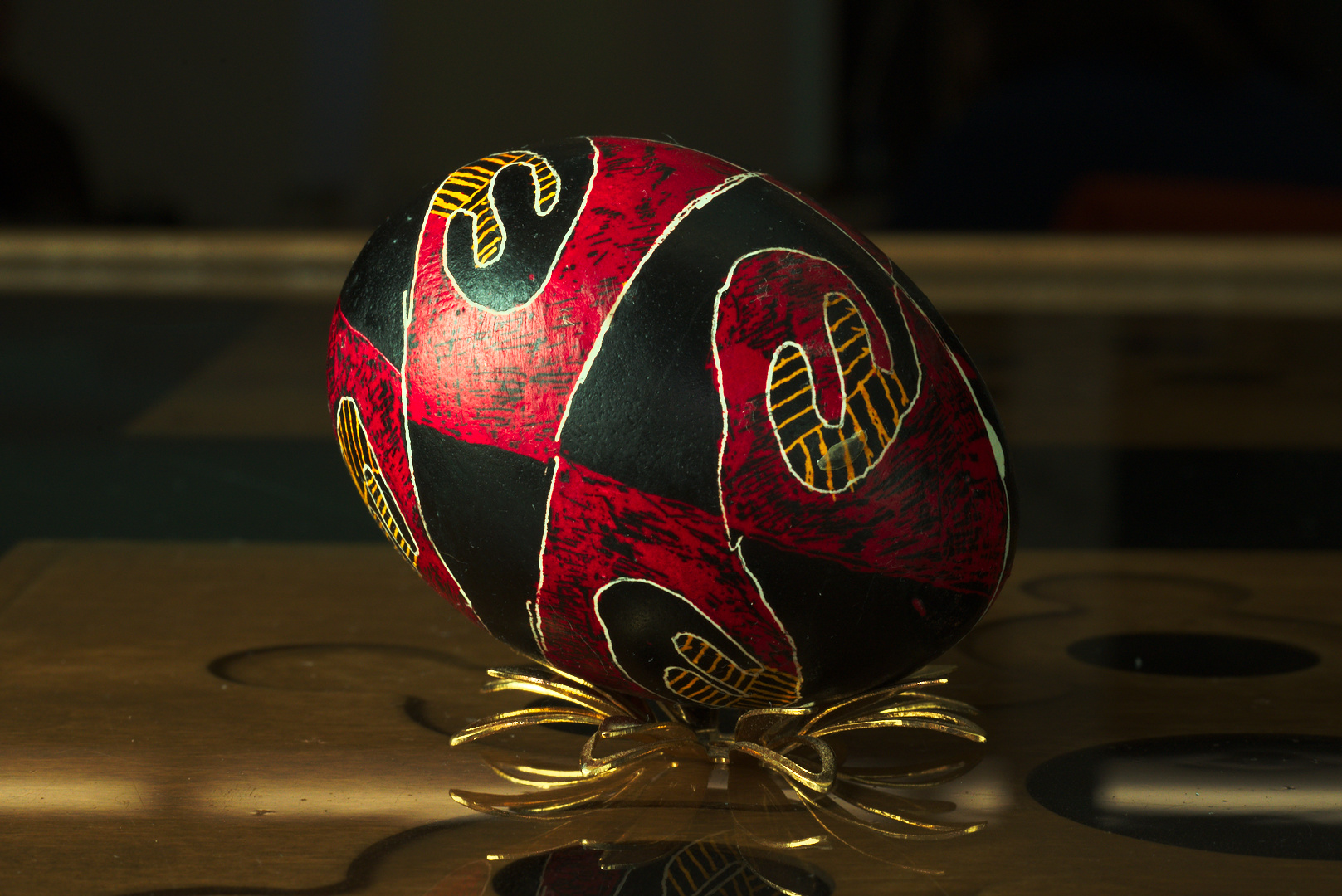
    These are pysanky, or Ukrainian decorated eggs. According to legend, a demon monster would destroy the world but it\’s chained, unable to complete its destruction. As it fights its bonds, the links of the chain are weakened. Every year, the chain is strengthened by the number of pysanky that are made or exchanged.

    Make pysanky or die. I love it.

    What about you, Dear Reader? What\’s your favorite legend?

  • The Emerald Keep Book Tour Continues!

    The Emerald Keep Book Tour Continues!

    \"2015-03

    The tour has been truckin\’ along.  I checked today and we\’re up to 229 entries for the Rafflecopter!  Holy moly, Dear Reader, how awesome that is.  Thank you so much for your support!

    a Rafflecopter giveaway

  • D Is For… Dogs

    D Is For… Dogs

    \"Bedface,

    Dogs, and the people who love them.  If you love dogs, then you get it.  If you don\’t, then you don\’t.  It\’s that simple, really.

    Our sixty-five-pound bundle of joy came to us eight years ago from the Anti-Cruelty Society in Chicago.  She\’s gotten comfortable as a part of our family.  She likes to take her half of the bed out of the middle, leaving my husband and I to find what space we can in the remaining spaces.

    Author Lynda Barry, who wrote What It Is, suggests thinking about all the dogs you\’ve ever known.  Where did they all go?  That question rang like a bell to me.  I\’ve used it a couple times in prompt circles and the memories come back more strongly each time.

    What about you, Dear Reader?
    What\’s your first dog memory?

  • C Is For… Calligraphy

    C Is For… Calligraphy

    \"20130731_0015\"

    Before the printing press, there were pens and paper.  The art of calligraphy is from the Greek, Kallos graphos, or beautiful writing.  Like the printing press, there\’s an ancient history of calligraphy in Asia, and it\’s even tied to meditation practices.

    I discovered calligraphy when I was about ten years old, when one of my classmates\’ handwriting caught my eye.  She wrote so beautifully, letters that were even and round on the page.  I studied her writing for four years, endeavoring to copy it.  I finally succeeded and, in the process, discovered the art of calligraphy.  The Scheaffer calligraphy set that I was given as a gift opened a new world to me.

    Despite becoming good at it, I dropped its pursuit in college due to family opinion that I should focus on college and the necessity of making a living.  About eighteen months ago, I re-discovered the art.  The technology in felt-tipped pens is much better than when I was young.  In particular, my favorite is the Zig brand double-tipped pen.  I found a set of six of them and played for a few months, before buying one of each of the colors available.

    What about you, Dear Reader?
    What art did you play with as a child that you have picked up, or might like to, as an adult?

  • B Is For… Books

    B Is For… Books

    \"George-peabody-library-2\"

    Books.

    They\’ve been around for a while now.  When I was younger, I thought that we Westerners invented them, but it was the Chinese who came up with the printing press 400 years before Gutenberg\’s bible.

    Whoever first did it, I\’m ever so grateful they did.

    The first time I started using the library on my own, I wandered the stacks of my grammar school\’s library.  I didn\’t know how to find books I liked, and it was so hard to figure it out from the covers.  They were blank, hardbound books with dark covers that held secrets between their pages.  How do you dig into them, short of reading all of them, to find out which ones you enjoy?

    I remember their smell, these old books.  I read somewhere that the smell was a unique combination of a bug that eats paper and the decomposition of that same paper.  I don\’t know if that\’s true, but I love the idea of a real bookworm.  My favorite author back then was Phyllis A. Whitney, who wrote mysteries.

    What about you, Dear Reader?
    What is the first book you remember reading?

  • B Is For… Bargello!

    B Is For… Bargello!

    \"\"Today\’s letter, B, can mean many things. My favorite in terms of crafts is Bargello, the Italian needle art that resembles flames and waves. The image to the left is a common style, with the colors undulating back and forth across the canvas but all relating to each other in their pattern.

    It\’s a simple pattern to work, because it\’s essentially vertical or horizontal. There\’s no fancy stitchwork involved, just carefully placing the stitches neatly one beside the next, offset in order to create the characteristic wave or flame effect.

    A quick search of Google images reveals many, many modern interpretations of this relaxing art; I recommend wandering around or, if you\’re ready to take the plunge, grab a kit and try it for yourself. For the brave at heart, you don\’t even really need a kit. Just select some colors and play with the wave effect across a swath of mesh fabric.

    What about you, Dear Reader?
    What\’s your favorite craft that starts with the letter \”B\”?

  • Sound – A Poem

    Sound – A Poem

    \"\"

    The sounds are still,

    Silent now in the wake of madness.

    The crowds came through like locusts,

    Digesting everything in their path as

    Huge earthmovers rearrange landscape.

    The air is frigid and wet, an arthritic\’s nightmare.

    Paper detritus blows in the breeze, a dance without music.

    The anniversary has passed, the revelers gone home,

    Their legacy filling the large garbage trucks

    That will prowl the predawn streets before traffic.

    But here, now, it\’s still night, and cold, and

    The sounds are still.