I built a Pandora profile that now links to my Facebook, so it’s got my branding consistently throughout (thank you, Pandora, for building in that functionality!). So I am now up on Pandora so you can participate with the stations I create for my characters and for world-building, and share your stations with me. Cue the music!
Thursday 13: A Writer In Her Library
Today we continue with craft books. The fun thing about craft books is that they can serve as inspiration for art that one wants to create. I get ideas and inspiration when I read them and see pictures of things. It’s one of the reasons I love knitting and crochet magazines, because the full-color glossy pictures are fun to look at and imagine myself making the outfits. Even if I don’t make the specific item in the picture, the design ideas influence my own creations.
1. Epstein, Nicky: Crocheted Flowers; Sixth & Spring Books, New York, 2007
This is the publisher that handles a lot of the current Vogue books. They do a lot of Ms. Epstein’s as well. I love this book. She’s an amazing designer with a seemingly endless fount of ideas, and her instructions are easy enough that I, as a novice crocheter, can follow them. I’m sure that anyone without my 2D/3D hangups would find them super simple to follow along. I even made an enormous blue crocheted rose, as practice, that turned into a gift for a friend out of town. Fun stuff.
2. Knight, Erika: The Harmony Guides: Basic Crochet Stitches ; Sixth & Spring Books, New York, 2008
This is the second of my crochet reference books that I have in my main, working collection. This is an awesome book. I’ve heard excellent things about the Harmony Guides series; if they’re anything like this one then they’re well worth the investment. I had taken one crochet class and was able to follow the instructions in here; again, someone without my 2D/3D issues would find it very clear and easy to follow. Highly recommended.
3. Jacobs, Kate: The Friday Night Knitting Club; Berkley Books, New York, 2007
Here we switch gears entirely to fiction with knitting in it. (I’d say “knitlit” but someone thought of it first and came up with a series; see below.) (Wish I thought of it first, though!)
This was a gift from my sister-in-law and follows the lives of the people in the Friday Night Knitting Club. It’s a cool idea for a story!
4. Murphy, Bernadette: Zen and the Art of Knitting: Exploring the Links Between Knitting, Spirituality, and Creativity; Adams Media, Avon, MA 2002
If I were to write a memoir about my thoughts on knitting and spirituality, this would be the title I’d want to give it. I love it. Ms. Murphy wrote a deeply thoughtful, fun and accurate book about how knitting can connect us with the deeper vibration. Brava!
5. Roghaar, Linda & Molly Wolf: Knit Lit and Knit Lit Too; Three Rivers Press; New York, 2002
These two are awesome. Find out why you should “Never Knit Dog” and how one woman’s abduction in a war-torn country was turned into something much less sinister with the power of knitting. Highly, highly recommended. They also have KnitLit the Third: We Spin More Yarns – MAN, I wish I thought of these titles! ~grin~ I haven’t read the third one, but that’s a function of time rather than inclination. ~eyes TBR pile~
Moving on then…
6. Better Homes and Gardens, Knitting Year-Round; Better Homes and Gardens Books, Des Moines, 2003
I really love this book because it lays out a plan for knitting the entire year, including how to finish season-specific items in time for use during that season, but also so you’re not knitting a really heavy woolen sweater in the middle of July’s heat. Lots of fun.
7. Bush, Nancy: Knitting on the Road, Interweave Press, Loveland, CO, 2001
This is one of the first design books I bought, and I really love it. She’s got a lot of great thoughts about knitting while traveling, and all sorts of thoughts about portability. Lots of fun.
8. Carles, Julie and Jordana Jacobs: The Yarn Girls’ Guide to Beyond the Basics; Potter Craft, New York, 2005
I got this book when I was part of Crafter’s Choice. It’s not bad, but it’s not something I’d say run out and buy immediately either. The authors are spunky and fun, and it’s a good idea generator.
9. Epstein, Nicky: Knitting On Top of the World: The Global Guide to Traditions, Techniques and Design; Nicky Epstein Books; New York, 2008
This is a gorgeous book. It’s essentially a coffee table book, due to size and glossiness, but Epstein as always delivers an expert product. She’s an incredible designer and I recommend checking this out – even if you only do so at the library, the pictures alone will make you swoon. Her thoughts and instruction on design interpretations around the world are worth the read.
10. Falick, Melanie; Handknit Holidays; Stewart Tabori and Chang, New York, 2005
I love this book, and the next one I have by her: Weekend Knitting; Stewart Tabori and Chang, New York, 2003. Falick edted for Interweave and her experience shows. These are professional, well-designed, and very informative – not to mention, fun. Highly recommend both of these.
11. Family Circle; Easy Sweaters; Sixth & Spring Books, New York, 2001 and Easy Afghans, 2003.
I like both of these as good, solid, simple compendiums of easy projects to make. They’re a good way to learn how to do structures and such, and I’ve made several of the afghans multiple times as gifts.
12. Griffiths, Melody: Knitting in No Time; Reader’s Digest Association Inc., New York, 2006
A surprising and fun book. Mulitple quick-to-knit projects of all kinds, this is a great place to go when you need gift ideas or stash-busters.
13. Harding, Louisa: Knitting Little Luxuries: Beautiful Accessories to Knit; Interweave Press; Loveland, CO, 2007
I love Louisa Harding. She’s another of my favorite designers. This book is beautiful – full of lovely photographs of elegant knits from shawls to sweaters to unusual items. I like this collection because it gives you ideas for things to make with one or two skeins of luxury yarns, so that the project matches the quality of the fiber. Lots of fun.
I hope you enjoyed this week’s glimpse into my library, and that maybe I’ll inspire you to start checking out the wealth of information in craft books. Even better, maybe you’ll pick up a craft or two. Happy TT!
Thursday 13: A Writer In Her Library
Welcome to another segment of my ongoing series, “A Writer In Her Library.” Today, I’d like to pull the focus a bit and talk about categorizations.
When one goes to a library, the books are organized according to some particular method. The most common are the Dewey Decimal System, as seen in many high school libraries and some public ones; and the Library of Congress System, as seen in, well, the Library of Congress, as well as many universities and some public libraries (for example, the Chicago Public Library System).
Both of these systems are useful, and a good way for Librarians to manage information. When I set up my library, though, I wanted something simpler and that fit the way I use my books. This leads me to an important observation about managing information that I’ve learned over twenty-five years managing offices and the information in them.
The critical part of any information management system, be it books, paper files, or online content, is getting the information back out of the system when it’s needed. Fifteen years ago, before Google was even a common term, (Google was founded in 1998), the internet was described as a global library where all the books were piled in the middle with no rhyme or reason. That’s one of the reasons Google has been so successful. Its search algorithms allow users to get more and more precise search results for information they need. There are other methods of doing so, Yahoo! being one of the most markedly different, but my purpose here is more to discuss the philosophy of organization rather than its specifics. I use Google as an example, though, because its key success factor is its ability to return the information that the user needs, when the user needs it.
That, fundamentally, is the purpose of any organizational system. Some of them require more training on the part of the user in order to use them (Dartmouth’s university library catalog in 1993 is one of the most complicated I have seen), but the fundamental purpose behind them is the same: organize data in such a way that it can be retrieved, as needed, in accordance with the need of the user. (So when you look up flowers, you don’t get baking flour, for example.)
What I’ve learned handling this process for various offices and people that I’ve worked with is that this last point is the most challenging. It doesn’t matter how well I understand file management. It matters how the people USING the files recall the data, because that is how they’ll look it up. Some people recall colors better. Some recall people and authors better. Some, like me, recall by date and subject.
In setting up my own library, something I haven’t taken the time to do until recently, I have complete authority over the subjects I pick. This is a rare pleasure. Usually, I’m working with a team and I need to set up the system according to how the team thinks rather than my personal preference. But now, with my books, I get to be boss and peon.
I was surprised to find out, then, that my cookbook collection had a lot more subject divisions than when I started to pull all of the books together. It was fascinating to start separating them into their relevant subjects and I found that I had more than I thought. I’m one short of 13, so it’s not a proper Thursday 13, but I share my subject headlines both from a sense of personal pride and fun in that I get to determine the subjects, but also in the rare chance that one or more of my readers might see something in my subject divisions that might inspire them with their own libraries.
1. Comprehensive Cookbooks
These are the traditional “cookbooks” that one thinks of when one thinks of the generic term: Betty Crocker, Better Homes and Gardens, etc. General, all-purpose, and comprehensive; the cookbooks in this category fill most of the needs of the home cook from main dishes to beverages and such.
One interesting thing I noticed is the books in this category tend to be organized in one of two ways: by meal or by ingredients. Some cover topics like Breakfast, Lunch or Light Fare, Dinner, Entertaining, Beverages, and Desserts; the second group covers topics like Meat, Fowl, Fish, Soups and Stews, Vegetables, Beverages, Cakes, Pies, Candies, Ice Creams and Frozen Custard, etc.
2. Cooking for Two/Working Adult Cookbooks
If you had asked me before I started collecting cookbooks when I thought the “cooking for two” idea came about, I would have said it was my own generation (Generation X) when we were in high school in the 80’s. The so-called nuclear family of Reagan and then the growing propensity of people to marry late and have children late would have engendered a need for such books.
Boy, was I wrong. My earliest book of the type is 1963. Granted, it’s not strictly for two people, but it’s called THE WORKING WIVES’ (SALARIED OR OTHERWISE) COOKBOOK by Theodora Zavin and Freda Stuart. They discuss smaller portions and also the ideas of making items ahead and all sorts of time-saving ideas. I have also seen titles from the 1920’s on the same subjects, so my generation is hardly the first to realize that the primary cook of a household may, in fact, work for pay outside that household but still need to feed its members adequately.
3. Canning and Storage
It will come as no surprise to my long-time readers that I was probably born in the wrong century and would privately love to be a frontierswoman. In fact, I used to play in the Society for Creative Anachronism, otherwise known as the SCA, who at times describes itself as an organization for re-creating the medieval times but with plumbing and without the Plague.
I like the idea of canning and storage. While I haven’t had the time to devote to it or a large enough garden to make it cost-effective, my plan is to remedy that when we buy either our first or second home. In the meantime, I’m an armchair frontierswoman. I love reading about malic acid and fruit pectin, and know that apples can be used as a good natural thickener. Until I can really go to town putting up the fruit crop from my peach orchard, I’ll fantasize in my books.
Besides. My neighbor has a lovely mulberry tree and if I go late at night, maybe they won’t notice my ladder and bucket. Pardon me, I’ll be right back…
4. Family Cookbooks
It turns out I have several cookbooks compiled by family and for family. I find these at garage sales, through my family, and as fund-raisers. They’re an interesting window on how other people cook, as well as their favorite recipes.
5. Cook’s Illustrated
This is both a magazine and they do a hard-back annual compendium. I have one of the annuals, as well as a couple years’ worth of subscriptions. Of all the cookbook magazines, I like this one the best because they review multiple cooking methods for the same type of food, as well as multiple iterations of the same kind of dish (like, say, oatmeal).
6. Specific Technique and Equipment
This is fairly self-explanatory. It’s a category for the cookbook that came with our microwave or the blender, etc. I have a title called ELECTRIC BREAD, for example, that has recipes for using a breadmaker. Anything of that type goes in this section.
7. Meal-Specific Books
Again, pretty self-explanatory. It’s not the compendium as mentioned in section one, but it’s a book all about a specific meal – I have one entitled BRUNCH, for example.
8. Weight Watchers
It startled me how many Weight Watchers cookbooks I actually own. (They’re really good about making their cookbooks sexy, full-color, and food-porn, though I’m sure their marketing department wouldn’t describe them in those terms.) (But if I didn’t like food porn and sexy full-color exposes on my food, I wouldn’t NEED Weight Watchers, now would I?)
(Get your mind out of the gutter. I don’t mean porn with food, I mean food porn. As in, a sexy spread about Zanzibar Chocolate Ice Cream that won’t add twenty pounds to your ass just by reading the recipe.)
9. Vegetarian
Um, this about, like, Vegetarian cooking.
Duh.
10. Health and Instructional Books about Food and Eating
Hmm. My topics are getting more and more self-explanatory.
Do I need to discuss what Health and instructional Books About Food and Eating are?
In all seriousness, I include topics like the Specific Carbohydrate Diet for treatment of intestinal disorders and other such topics in this area.
11. Culture-Specific Cookbooks
Russian, Jewish, Mexican, Asian, etc. all fit in here. I have, for example, an excellent review of all types of Russian cooking by Anne Volokh, the first post-Soviet food reporter in Russia. (Prior to Glasnost, they didn’t have such an occupation; at least not openly.) I lump other cuisine-specific books in this category because that’s where I expect to find them when I go looking for ideas.
12. Ingredient-Specific
As in, 101 Different Ways to Prepare Chicken, and such. I have a book on Mustard, one on Garlic, and actually two on Mushrooms (since my husband LOVES them).
I don’t have a 13th Category, so I ask you, the Reader: tell me, in Comments, what you might add to my list or how you organize your own cookbooks.
As I’m typing this, my buddy who is sitting here reading while I type, said, I have one. So, here is Dorothy’s additional category:
“Making Ingredients” as in, How to Make Cheese, How to Make Flavored Vinegars, How to Make Butter, How to Distill Oregano, etc.
Oooh. Those sound fun. Hmm. Maybe I need to go cookbook shopping here soon.
Book addiction? Me?
Silly. There’s no such thing. ~nods~
Happy TT!
Wiley Wednesday: Music and Editing
I know it’s been awhile, but I am getting caught up with my blogging duties. Since tomorrow is Wednesday (well, in 35 minutes it’ll be midnight so really it’ll be tonight…), I posted my Wiley Wednesday at the Writer’s Retreat Blog.
If it’s been so long you can’t remember what the heck that is, Wiley Wednesday essays cover informational topics related to writing – either the craft or the business. I hope you enjoy!
Thursday 13: A Writer In Her Library
Chapter Three
Today’s TT focuses on Knitting Reference books. These books focus on particular techniques, rather than a designer’s vision of patterns, and include stitch dictionaries. I love knitting reference books. They usually have things in them I don’t already know, or look at a particular topic in a new way.
In fact, when I signed up for the Master Knitter course through TKGA, a bibliography is part of the course. I figured, in my arrogance, that I am The Noony! Of COURSE I have all the books on the bibliography, and what books I don’t have aren’t worth bothering with, because I am The Noony.
Boy, was I stunned. I had, like, two.
Out of FOUR PAGES.
Sheesh. Put me in my place, whydon’tyou?
I have since collected several of the books on the recommended bibliography and wow, those folks sure know what they’re doing! These books are awesome!!!
Anyhoo, back to MY list, because after all, I am The Noony.
1. Crompton, Claire; The Knitter’s Bible; David & Charles; Cincinnati, OH; 2004
I like this book a lot. It covers the basics, but after each technique, it includes projects that use what you just learned. There are several projects that I want to try myself, including gorgeous little sachet bags and blankets and purses and things. Well-rounded, fun book.

2. Epstein, Nicky; Knitting On The Edge; Sixth & Spring Books; New York; 2004
Knitting Over The Edge, 2005
Knitting Beyond The Edge, 2006
Nicky Epstein is an amazing designer. She doesn’t only ‘do’ knitting, she’s published books on crochet design as well. She travels internationally, teaching, and even came to our guild here in Chicago two years ago.
She decided to write Knitting On The Edge when she realized there weren’t any guides to edging techniques available at the time. Some books had some edgings, but nothing really dedicated to the edges of garments. She started researching and collected a number of edging options, as well as designing a bunch on her own, and voila: a phenomenon was born. Immensely popular, On the Edge was followed a year later with Over the Edge, and then Beyond the Edge. These are stitch dictionaries as opposed to longer design books; they are filled with ideas that you can incorporate into your own projects. There are a few projects given that utilize the patterns, but for the most part, it’s simply a graphic of a particular edging pattern and instructions for how to work it.
Since she has a very involved website, I’m going to include that here rather than an image of her table of contents. You can check out her work here: http://nickyepstein.com/. She doesn’t only have textile arts; she created a line of handmade buttons and clasps that are incredible and well worth a browse.
The books are available for purchase:
Knitting On the Edge


Knitting Beyond the Edge

3. Golden Hands; Aran & Fair Isle Knitting; Marshall Cavendish; London; 1977
A classic book, but worth a look if you like the style of knitting. It includes detailed instruction on the art of Aran (cable) knit sweaters and Fair Isle (colorwork). It’s got a number of interesting patterns that will expand your skills and experience with these two techniques.

4. Kooler, Donna; Encyclopedia of Knitting; Leisure Arts Publication; Little Rock, AK; 2004
This is a good all-around technique dictionary. There are some lovely pictures, and I totally want to make that handbag on the table of contents.

5. Leinhauser, Jean; Learn to Knit in Just One Day; American School of Needlework; San Marcos, CA; 1994
This one holds a special place in my heart. I dearly wanted to learn to knit for most of my life. I couldn’t master crochet, and I tried the one needle knitter from K-Tel with some success. But I really, REALLY wanted to learn to knit.
Sadly, I can’t translate two-dimensional instructions into three-dimensional reality.
I really tried, too.
I picked up this book several times over the years, and could NOT master it. I finally took a class in 2000 from Sharon Shoji, a Chicago instructor and designer. I haven’t looked back.
And do you know what? After I took the class, this book suddenly made sense!
If you don’t have the 2-D/3-D disconnect, this is a remarkably easy book to learn from. It’s thorough and teaches you to make sweaters and afghans in a very short time. I actually like it because it doesn’t have a lot of the clutter of some of the modern glitzy books, which can be good when you’re trying to learn.
6. Leisure Arts; 99 Knit Stitches; Leisure Arts Publication; Little Rock, AK; 1997
This book a surprise. It’s put together in a booklet format that seems light-weight, but when you delve into it, it’s got a very well-rounded group of stitches to try. It’s a good little stitch dictionary and has the benefit of not weighing a lot in one’s knitting bag.
7. Rutt, Richard; History of Hand Knitting; B T Batsford; London; 1989
This is the classic book on knitting history. Written from the point of view of scholar and not knitter, it’s a little dry, but the information is comprehensive and well-researched. If you’re curious about knitting’s origins in history (like the fact it probably comes from the Middle East, for example, and the oldest extant knitted textile is a sock from Turkey), this is the book for you.
8. Starmore, Alice; Book of Fair Isle Knitting; Taunton Press; Newton, CT; 1988
I coveted this book for ages. Starmore is my hero. I looked up the book and couldn’t find it for under $150, since it had gone out of print. I saved and saved and one year, got two gift certificates for Amazon. I found it for $99 and pounced on it.
The next year, Schoolhouse Press re-released the book.
🙁
Not that I have anything against Schoolhouse Press. Lovely group. But sheesh!
If you are serious about Fair Isle (colorwork), this is a phenomenal book. Starmore teaches you about design, not just the knitting process. She also discusses the history of the art, which is worth a read.
9. Sterling; Knitting School: A Complete Course; Sterling Publishing Company; New York; 1990
I bought this through the Crafter’s Choice book club. I do not recommend it. Poorly done, with inadequate explanations. I kept it because I already know how to knit and figured that some of the instruction might be useful, but this is little better than a stitch dictionary.
10. Vogue; Vogue Knitting and Vogue Knitting Quick Reference; Sixth & Spring Books; New York; 2002
These are excellent reference materials. The Quick Reference can be carried in a knitting bag. Vogue Knitting covers all the basics, and has an excellent overview of different cast-on and cast-off methods, construction, and a modular sweater design method that breaks down the design process into clear steps.
11. Vogue; Stitchionary: Volume One – Knit and Purl; Sixth & Spring Books; New York; 2005
Stitchionary: Volume Two – Cables, 2006
These are good stitch dictionaries. There are more volumes than the two I have, but Volume III is colorwork and IV is crochet, neither of which I really need. These two basic ones are good. They’re not great; they don’t have details about the stitches or how they work, and I find the Harmony Guides better for basic instruction. But I’m loyal to Vogue and like these two books.
12. Vogue; The Ultimate Sock Book; Sixth & Spring Books; New York; 2007
If you like socks, BUY THIS BOOK.
‘nuff said.
I love it. It covers toe up and cuff down, all sorts of design information, and then a whole library of designs for you to play with. Loff!
13. Walker, Barbara G.; A Treasury of Knitting Patterns; Schoolhouse Press; Pittsville, WI; 1998
A Second Treasury of Knitting Patterns; 1998
Charted Knitting Designs: A Third Treasury of Knitting Patterns; 1998
A Fourth Treasury of Knitting Patterns; 2000
Awesome!! These are an excellent basis for any knitter’s library. In fact, Walker has nearly eclipsed Alice Starmore as my Number One Knitting Hero. I use Walker’s books more often than Starmore’s, as it happens. She’s smart, funny, and opinionated. I love her. Her stitch books put the Stitchionaries to shame: she gives details for EACH of the stitch patterns she includes in her books, which include her thoughts on the history of the stitch, how it works in garments and projects, whether it looks good on the front and back or if it’s one-sided, etc. I love these books, and am grateful to Schoolhouse Press for re-releasing them.
If you are a knitter who is familiar with Walker’s books, you should check out the Walker Treasury Project. It’s a blog that records modern color pictures of the patterns in the four books. Four more information, visit the blog.
Happy TT!
Fiji Kit
My friend works in an industrial sales office, and is around men most of the day. She lives in the Midwest, but I think would be more comfortable in a writing cabana by the ocean where she had nothing to do all day but write.
Since I can’t buy her the cabana in the Caribbean, I’m making her a desk set instead. It’s one of those awful, uber-cute desk sets, too – the kind you find at White Elephant sales and bad parties.
Yes, I’m that kind of friend. ~leer~
But in all seriousness, the box for paperclips and the stapler cover shaped like a shark are worth the kitsch. Here’s a picture of the kit in its entirety:

I’ve finished knitting the cabana box cover bits, and now all that’s left is to felt them. Since the rest needs to be felted too, I figured I’d do it all at one time to save washer water. Here are the box pieces:

This is the base piece, done in plain stockinette stitch (which is knit a row, purl a row). I actually finished these and realize I don’t have a picture of that, so that will have to wait. But here are some more pix:
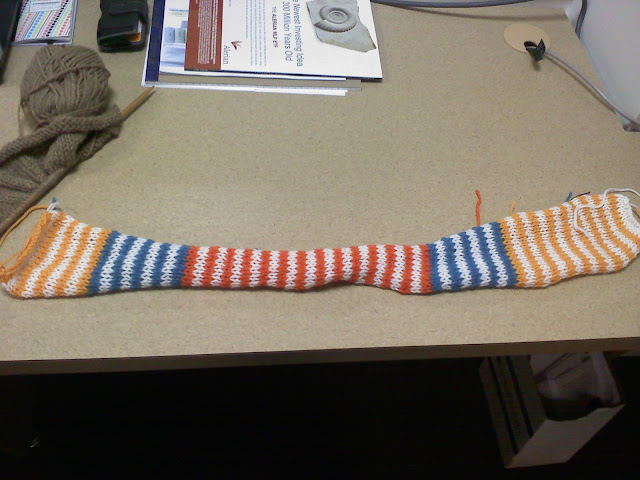
This is the base all finished up. As you can see, it’s quite long. It will shrink when it’s felted, and it will be sewn together over a plastic mesh base.

The bottom is knit in plain stockinette in a sand color. At first, I couldn’t figure out why they selected a mud brown for such a cheerful piece, and then I realized that it’s supposed to be the sand floor.
Duh.

These were fun to knit. The cabana caps are just about the right size to be a cat hat.
Yeah, don’t try that at home…

Knit in the round, you can see the gradual decrease pattern in the grid under the knitting. You decrease each of the four sides on the decrease rounds, so it has a very pronounced triangular or pyramidical shape.

Next we come to the wrist rest. Knit in intarsia, it’s got a complex little picture of fish and kelp. Quite cute, if you’re needlepointing.

Rather more complex if you’re knitting. Each of those strings hanging down is a bobbin of color that you pick up and knit with at the relevant point in the design. While one could knit complex needlepoint or counted cross-stitch charts this way, it is very detailed and requires concentration.
I’m just past the halfway point in the intarsia design, and should be done in another week. The rows take about 15 minutes each, since they require wrapping each new color. I could not for the life of me figure out why the stripes on the edges are brown and light brown, until someone said “oh, when does the color start after the sand?”
Bong.
Sand.
Duh.
~knityfy~
Update from the Itinerant Knitter
Our writing group, the Writers Retreat, had a mini-retreat March 4th through the 6th in Indianapolis, Indiana. Authors A. Catherine Noon, Nicole Gordon, Darla M. Sands, and the Pack Rat met for a weekend of touring and hanging out and, of course, writing.
Since I went along, we of course had to do a side-trip to the LYS (Local Yarn Shop). We visited:
Mass. Ave. Knit Shop
Susan Brennan, Proprietor
862 Virginia Avenue
Indianapolis, Indiana 46203
Main tel: (317) 638-1833
Website
It’s a very large store with a big sale room. I found some neat stuff on sale:
di.ve brand, from Biella – Itally, a ribbon yarn that’s full of luscious fall colors and a startlingly bright silver splash. It’s the Luxus line, which is 91% Polyamid and 9% Polyester; I bought color 29204, lot 1496.

I first swatched with garter stitch on size 10 needles. It yielded a very dense fabric, springy and stiff. I didn’t like it, and since garter uses up so much yarn and I only bought three balls, I decided to try something else.
I swatched a pattern from Barbara Walker’s A Treasury of Knitting Patterns called “Vertical Lace Trellis.”

Vertical Lace Trellis
Odd # sts.
R1 & 3 (WS): P
R2: K1 *YO, K2T
R4 *SSK, YO, REP *, END K1
Since it’s only 4 rows, and only 2 of those rows are the pattern row and the rest is purl stitches, it’s a very easy pattern to follow. I’ve done another scarf in this pattern, but need to post some pictures of it. In the meantime, here’s what I’m trying with the Luxus:
CO 3
YO after first and before last stitch, all even-numbered rows; do pattern in the middle on the odd-numbered stitches.
This will create a triangle shawl.

I think I’ll add a bead at the point of the triangle for weight, or maybe some tassels. We’ll see.
A Writer In Her Library, Chapter Two
Thursday 13: A Writer In Her Library
Happy Saint Patrick’s Day! As a fourth-generation Irish American, today has special significance since my uncle, the oldest surviving Irish relative on American soil, passed away this month. Our family draws together to remember our connections and to celebrate our family ties. I wish you and yours a very happy and bountiful year! As you raise a glass in celebration, please toast to my Uncle Tom and the family of poor Irish potato farmers who have “made it good” in the new land.
Today I offer the second installment in my series, “A Writer In Her Library.” We continue with craft books today and venture out of the anthologies and into the single titles. I have an eclectic collection spanning some of the glitzy modern photo-intensive books that have little in the way of actual instruction, to those older books from the 50’s and 60’s that have a lot of instructions and much less glam. Enjoy!
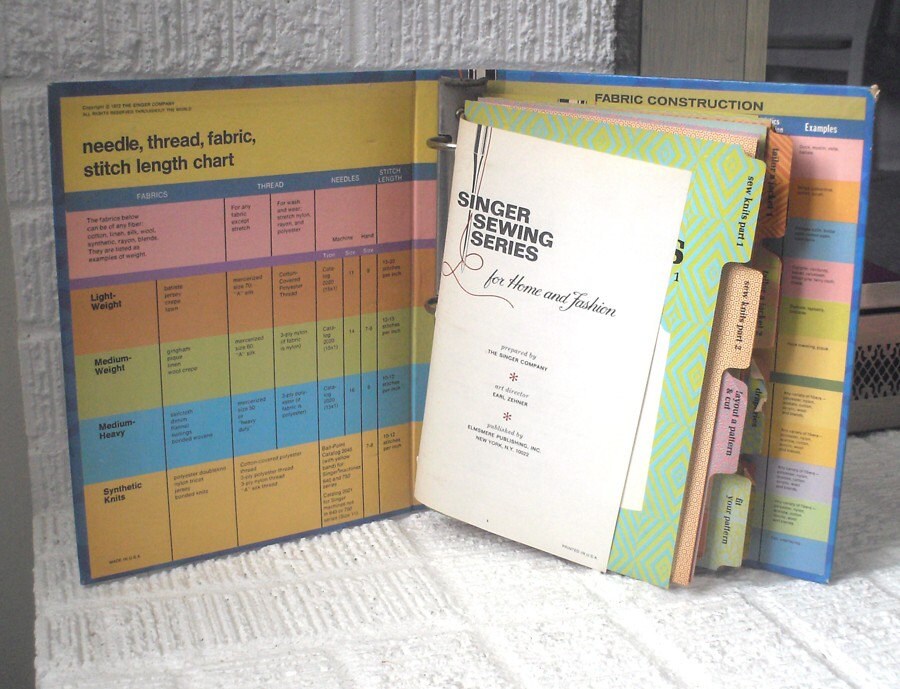
1. Singer Sewing Series, Sew and Save for Home and Fashion, Elmsmere Publishing Inc, New York, 1972.
This one caught my eye at a Brandeis Used Book Sale a couple years ago. It’s a battered 3-ring binder, like the Better Homes and Gardens Cookbook, and covers all sorts of the basics of sewing. Since it’s also targeted to the thrifty home sewer, there are a lot of tips on mending and wardrobe construction.

2. The next five are all from Reader’s Digest. Some of my acquaintance don’t like the RD books because they are abridged; however, I have always enjoyed their how-to books for their depth and breadth of coverage of the topic. I remember the first time I saw a stitchery book and coveted it so badly! It took another decade before I broke down and bought one used, and I love it.
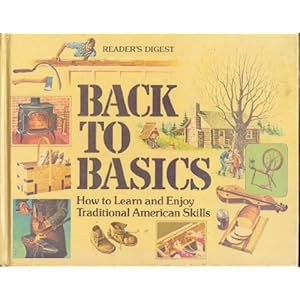
Back to Basics: How to Learn and Enjoy Traditional American Skills. Reader’s Digest Association Inc., Pleasantville, NY; 1981.
This one is a gem. It’s got all SORTS of cool stuff. The one that got my husband is ‘build your own stone house.’ Now he wants to go out and collect rocks. 🙂

3. Complete Do-It-Yourself Manual. 1973.
When my husband and I moved in together, we merged our libraries (which were both prodigious). We each had a copy of this book.
‘Nuff said.

4. Complete Guide to Needlework. 1979.
There she is!! This is my first compendium of needlework purchase, and I love it! It’s got stitchery alphabets and instructions for all sorts of crafts! I don’t always learn from 2D to 3D very well, but once I got the basics elsewhere this was a snap – and if you don’t have the whole 2D/3D problem, you’re set.
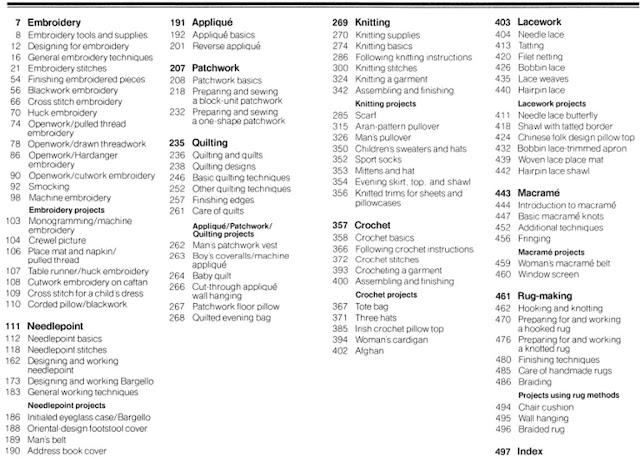
The interesting thing about this one, is that it has sections on both macrame and lace (including bobbin lace and tatting), which after about 1985 is not something you see much of.
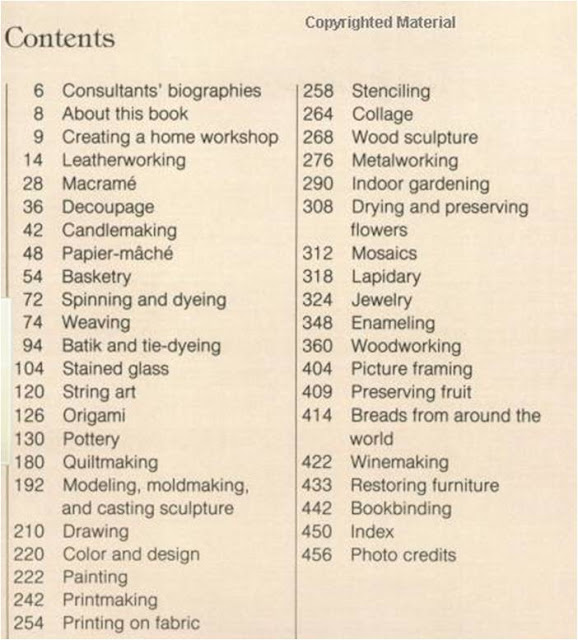
5. Crafts and Hobbies. 1979
JACKPOT! This is awesome. The breadth of crafts included here is staggering, and almost rivals the Family Creative Workshop – and this is only one volume! It goes from Drawing to Enameling to Preserving Fruit, all in the same book. Who needs a television with this thing around??
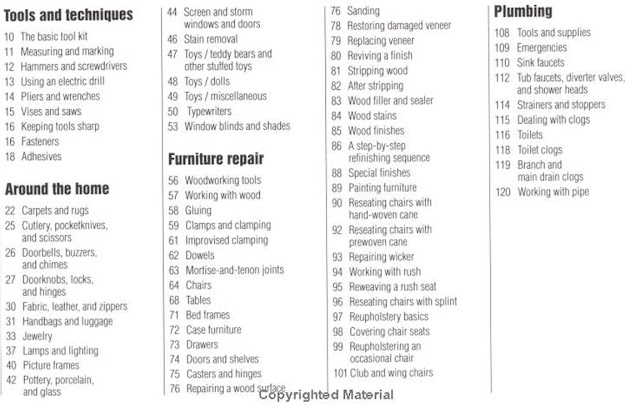
6. Fix-It-Yourself Manual. 1977.
This is a good book to have around if you own your own home or do your own repairs. It’s got oodles of advice for how to handle common household problems, and includes a section on Furniture Repair that’s exceedingly useful.
7. Better Homes and Gardens Sewing Book: Sewing How-To For Home and Family. Better Homes and Gardens Books, 1981.
This is an excellent resource. I’m wondering if I have a typo in my bibliography, because what I found online was 1961 where the cover matched my recollection. Either way, this is an excellent sewing book. It covers adjusting patterns and making fitting fixes better than almost any other sewing book I own. I highly, highly recommend this if you are serious about sewing garments for yourself or others.

8. Jefferys, Chris; Learn to Sew: A Beginner’s Guide. New Holland Publishers Ltd, London, Cape Town, Sydney, Auckland; 2005.
I really like this one. It’s big and has very clear pictures. The projects, as you can see from the Table of Contents below, are broad-ranging and non-repetitive, but cover all the basics you need to develop a good basis for making your own garments or soft furnishings for the home.

I love the Silverware Roll; that seems like a fun gift for the holidays. The Table Runner with Mitered Border is beautiful and I like the zippered bags. I find zippers intimidating, and the idea of making several small bags to practice seems wise.
9. Oops! Missed a Reader’s Digest. I have it in a different spot on the shelf because it’s in a different format than the ones I listed above; I simply included it in the single titles on the shelf.
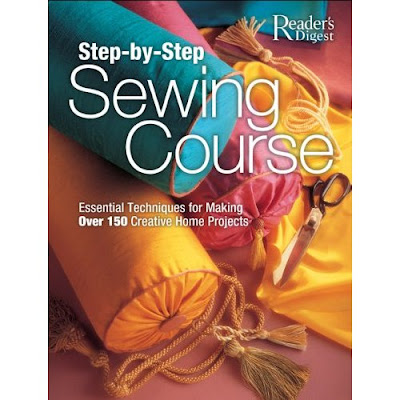
Step-by-Step Sewing Course: Essential Techniques for Making Over 150 Creative Home Projects. 2005.
I couldn’t resist the cover.
I’m shallow. ~shrug~
I really want to make that bolster! Maybe this will be the year. From the book jacket:
“Learn to sew and make beautiful gifts and decorator-style custom furnishings for your home with the Step-by-Step Sewing Course. This handy guide is filled with more than 150 projects and variations for beginner, intermediate, and advanced sewers, complete with clear, easy-to-follow, illustrated instructions that lead you through each project, one step at a time. Along with vital information about essential sewing equipment and basic techniques, you’ll discover how to make…: Quick and easy bedspreads, Tablecloths with lace panels, Decorative window treatments for every type of window, Shower curtains and bath mats, Pillows with romantic ruffles, Duvet covers, Padded fabric headboards, Gift bags for special occasions, …and so much more! “
10. Simplicity, Simply the Best Sewing Book: Revised Edition. Simplicity Pattern Co., Inc., New York, 2001.
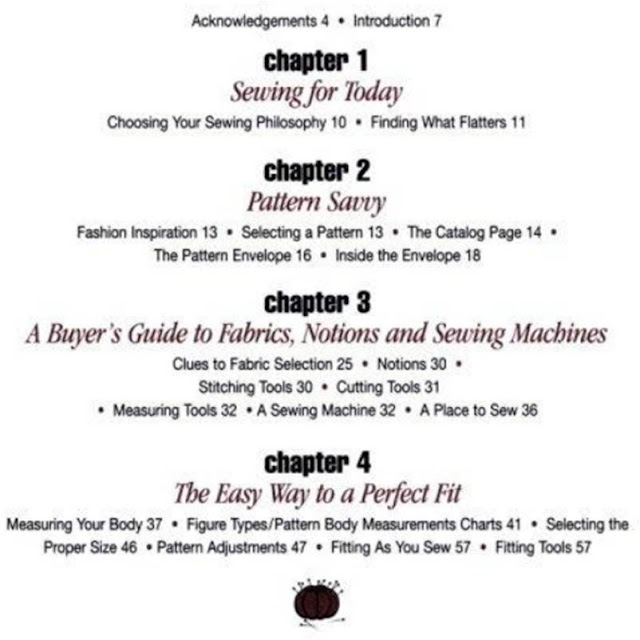
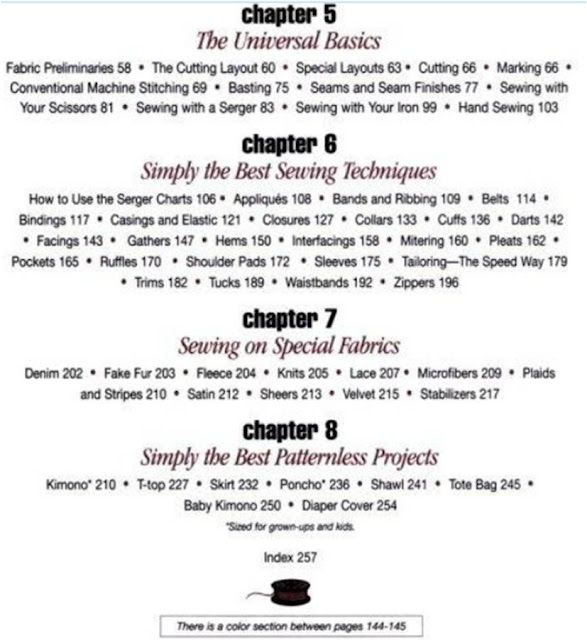
This was the recommended book for Veronica Brackett’s excellent sewing courses at Vogue Fabrics in Evanston. If you ever get a chance to take one of her classes, DO IT. She’s the single best sewing instructor I have ever met.
The book is good. It starts with your sewing philosophy (do you want to sew simple and buy complicated? Or spend time sewing complicated and buy simple?) and goes through basics. It’s even got a selection of basic patterns to get you started.
11. Singer, Sewing Step-by-Step. Cy DeCosse Incorporated, Minnetonka, MN, 1990.
I like the Singer books. They good, solid, basic, and I have a Singer machine so the instructions are targeted for my equipment.

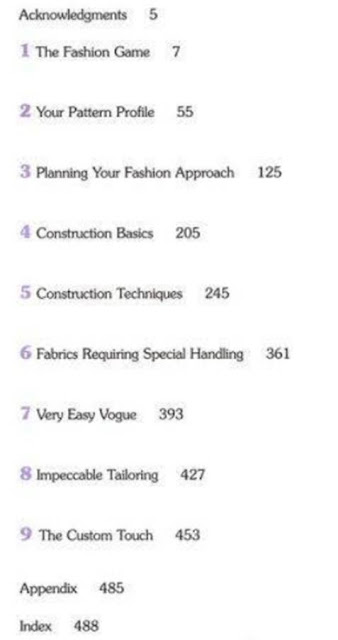
12. Vogue, Vogue Sewing Book. Butterick Publishing Company, New York; I have two editions – 1975 and 2000.
The 1975 has a section on menswear and is much more in-depth. The 2000 eliminated the menswear section (and it’s only been this year that I’ve started to see men’s patterns making a comeback on the pattern sites) and is a lot more sparse on the instruction. Still, this is a classic reference and well worth having on the shelf.
The Table of Contents, below, is from the current edition but is substantially similar from edition to edition.
13. And now we switch gears into the Knitting Reference section. This is distinct from the Knitting Patterns section, in that the material here covers the basics in how to knit or includes various stitch guides like the Walker books and the Vogue Stitchionaries.
This first one is a surprising find, to me anyway, because I’d already purchased my reference books for knitting and didn’t think I needed any more. I’ve since learned that Debbie Bliss is a knitting luminary and well worth taking a look at her work; this book is no exception. Truly an excellent resource.
Bliss, Debbie, How to Knit. Trafalgar Square Publishing, North Pomfret, VA, 1999.
In looking at this today, I realize that I should crack it open and review the section on colorwork, since I’m working on an intarsia (color block) project that’s proving a bit of a challenge. ~glee~

Thank you for visiting today, and I hope you’ve enjoyed this glimpse into one writer’s library. Happy TT!
Welcome to the St. Patrick’s Day Blog Hop!
My offering for this Blog Hop is a sweet romance with a twist that I wrote for a Flash Fiction Carnival. The subject was the elements, and this is for Water. I figured it was fitting, since Spring is just around the corner. Enjoy!
To start the Blog Hop, go here.
Water
Fionula ran the water into the kettle, the filter making a soft high-pitched whine as it worked. It was an extra unit she’d had from her last apartment and she’d given it to Kirby for his new place.
“Hey,” Kirby greeted, wandering into the kitchen and sitting down on one of the only chairs that didn’t have boxes or packing material stacked on it.
“Hi there. How ‘ya feeling?” she asked brightly, noting he didn’t look very good. More like depressed and mopey. She never really liked Sara, and this was just another black mark against Kirby’s ex-girlfriend.
He sighed and looked out the window. “Okay, I guess.”
She set the kettle on the stove and lit the gas. She bent to rummage in the canvas sack she’d lugged over and pulled out the smaller bag of produce and set it in the sink. She set the pork roast, still chilly from the freezer, on the counter. Finally finding the tea buried under the net bag of potatoes, she fished it out and plumped the cardboard box back up.
“Well, cheer up, Kirby. I brought pork roast and vegies, and tea. And then you can have a bubble bath and ice cream.”
He actually laughed at that, she was pleased to note.
“A bubble bath?” he scoffed. “Come on, Fionula. I’m not a chick.”
She turned around and put her hands on her hips. “Armand said to come over and cheer you up, so I’m going to do that. Besides. I’m gay, so whatever you have,” she waved her hand negligently toward his lap, “doesn’t interest me. So your virtue is safe with me.”
He stared at her, nonplussed.
She pulled her other bag closer and pulled out the bubble bath, followed by two glass container candles, a plastic bag with a pint of Zanzibar Chocolate ice cream, and her copy of Grimm’s Fairy Tales. “I’ll even read to you.”
He pulled the bag of ice cream closer half-heartedly and peeked inside. “There’s a cow on your ice cream.”
“Yeah?” she retorted. “That just shows it’s made with real cow juice.” She yanked it away and stuffed it unceremoniously in the freezer. “Show respect, that’s Zanzibar Chocolate.”
“‘Cow juice?’” he echoed faintly. “Ew?”
She snorted. “Then don’t complain,” she said in a reasonable tone of voice.
He smiled but it faded too quickly. She surveyed her supplies. She pulled out the greens and set them in the sink and washed the apples. She looked over her shoulder at him. “You want to help me wash these greens?”
He shrugged. “Yeah, sure, why not.”
They spent the next thirty minutes preparing dinner. He seemed to forget some of his melancholia in the routine and helped her position the pork on top of the chopped apples. She doused it with hard apple cider and put it in the oven.
“Okay. Now I’ll go start the bath.”
“Fionula, come on. I don’t need –”
“Shush. Come on.”
He groaned but got up and followed her. She started the water and he adjusted the temperature. She let the tub fill with bubble bath, the sharp scent of lavender filling the small space.
“Hey! This doesn’t smell half bad!” he blurted.
“Gee thanks.”
“You know what I mean, Fionula. It’s not all girly and whatever.”
“Kirby, that’s not an improvement,” she said, laughing. “I could have brought bubble gum. Or baby-fresh scent.”
He grimaced. “Ew.”
“Okay. You get in the tub and I’ll come back in and read to you, k? Oh! I’ll get the ice cream.”
“Before dinner?” he asked, actually smiling.
“Of course! ‘Life’s short, eat desert first,’” she quoted. She closed the door on him before he could think of a response.
It didn’t take him long to get ready and he did seem a lot more relaxed once he was actually in the water. She handed him a bath pillow with a big silly pink bow on it. “It’s a housewarming present,” she told him.
He smiled. “Thanks!” He seemed to really mean it. She put the bow on the counter and he blew the pillow up, then sat back with a sigh.
“Okay.” She settled herself on the toilet, using a towel as a pillow. “Hänsel and Grethel.”
“I know this one!” He sounded pleased.
“Bet you don’t,” she countered, meeting his gaze. “Have you read the originals?”
He looked perplexed. “The original what?”
“Grimm’s Fairy Tales aren’t kids’ stories, really. They’re folk tales that were changed for children, made lighter. The originals are really dark and, well, grim.”
“Oh!”
She read him the story and by the end, he seemed really engrossed. She went to check on the pork and came back to find him looking through the book. “Hey!”
He smiled and handed it back. “This one,” he requested, pointing.
“Brother and Sister, huh? Okay.”
By the time the bath was over and dinner was ready, the dull melancholy look had left Kirby’s eyes. She even got him to laugh a couple times during dinner.
As she put her coat on to leave, she looked at him. “Here,” she handed over the book, “you can read some more if you want.”
“Thanks!” He looked down at the cover and then met her eyes. “Thanks, Fionula. Really. I had a good time tonight.”
“I told you,” she said firmly. “It’s the Zanzibar Chocolate.”
“Right.” He shook his head and hugged her. He waited by his front door until the elevator came and then waved at her as she got on.
She hitched her bags a little higher and smiled to herself. It worked every time. Zanzibar Chocolate and a bath could cure anything.
The original post appeared here.
Air is here.
Fire is here.
Thanks for visiting!
Challenge – Noir Friday
I was challenged on Romance Divas this week to write a story a’la 1930’s noir fiction. The challenge was:
Your story should include the following: a dirty taxi, a missing councilman, a Dick Tracy watch (radio included), and should take place in the 1930’s.
Here, then, in honor of Flash Fiction Friday, is my story. I think it might work out to be a Chapter One in a possible novel; what do you think? Shall we continue? Read on and decide for yourself. (I should warn you, because of the time period, there is profanity and racism in the writing, so please don’t continue if you’re not comfortable with either.)
Taxis these days are abysmal. God damned pig-shit Irish think they run the place, and they can’t even keep the damn taxis clean. Damn Cermak, anyway, for getting shot when it should have been Roosevelt. World’s Fair comes here, you’d think they’d clean up the damn things.
“Move it!” my driver shouted out the window, his cigarette in danger of landing his lap. He shook his fist at some Black kid trundling a huge cart of flat cardboard boxes from sidewalk to sidewalk, wrestling the dumb thing up the eighteen-inch curb.
Progress. That’s what they call it in the papers. Just an excuse to beat up on the little guy, like always.
“Go left at the next street,” I told the driver.
“Look, buddy, you really don’t want –”
“Just do it!”
God damned pig-shit Irish, thinking they’re better than good honest Americans. Come over here with their potato famine and their accents and think they run the place. Stupid Cermak; why’d you leave us like this?
“Let me out here.”
The driver’s blue eye gazed at me in the mirror, his disagreement plain on his freckled Irish face. His nose didn’t show the signs yet, but they’re all drinkers. Irish whiskey, Scotch, it didn’t matter. They say God invented the stuff so the Irish would never win a war.
And now they’re in my town. Thanks a lot!
I got out around the corner from forty-seventh, smack in the Black Belt. Lieutenant Dziedziecz thought I was nuts for coming here, but here is where the witness lived.
“You’re a nice White boy, and Polish to boot, Lapinsky. How you gonna go to the Black Belt at night and find a tinker’s damn in the place without getting shot or worse? The Councilman sure as shit ain’t in the Black Belt, for Christsakes!”
“You wanna find the Alderman, or not?” Dziedziecz came from New York, by way of Poughkeepsie. Couldn’t get it through that brick he called a brain that Chicago had Aldermen, New York had Councilmen.
He kicked me out of his office with his characteristic profanity, and I gave as good as I got.
There are benefits to being a gumshoe and not a cop, chief among these is I don’t have to take shit from a Pollock no matter how rich he was. Still came from Warsaw, or at least his pop did, same as me.
My watch chimed and I glared down at it. A Dick Tracy radio watch, the genuine article! My kid bought it for me as a birthday gift last month. God damned comic book hero, and my kid thinks that’s what I do for a living. I’d leave the thing at home but the wife says it makes me a better father.
Because of a watch?
The bar I wanted was three doors down. And I mean down – the thing lived in the basement of a three-storey brick number. The three-flat housed two famous Black Jazz musicians and what was reputed to be a famous Black madam, but I didn’t care about that. I wanted the bar.
The hulking bouncers loitering by the cast iron fence and smoking promised to interfere with that plan…
I pulled out a cigarette and approached. “Got a light?”
The one closer to me turned to get a better look at me and then stared. “Lapinsky?”
“Joe Brown? What the Hell you doin’ all the way down here? I thought you was going to Los Angles!” I lit my own damned cigarette, since neither of them showed any sign of doing it.
“Los Angeles,” Brown drawled, spreading out the syllables like a Spaniard. “When you gonna learn another language besides Panglish?”
His buddy made a sound somewhere between a cough and a snort and covered his mouth with one huge black fist. If he could have turned red, he would have. Hell, maybe he did; with the night around us, Hell if I could tell if Black skin reddened.
“What are you doin’ here, man?” Brown asked me. “This is Reggie.”
Reggie nodded but said nothing, so I sketched a salute in his direction. “I’m lookin’ for the Alderman. Word is, your Bartender could help me.”
Reggie straightened, no longer blushing. Brown motioned him back and he hesitated, then leaned against the fence again. Except this time, I had his undivided attention.
“Police send you?” Brown wanted to know.
“I told Dziedziecz where I was going.” I paused. “He said I’d get my ass shot off.”
Brown laughed, a loud bray of sound that echoed through the street even over the sounds of Jazz coming from the place on the corner. “You might at that, you crazy Pollock. You might at that.”
I narrowed my eyes. “That mean you’ll let me in?”
Brown glanced at Reggie, who shrugged. He turned back to me. “Yeah. You can go on in. Ask for Marve.”
“Thanks.”
“And Pollock,” Brown added, “be careful.”
Great. First the Lieutenant and now Brown. You’d think I was shakin’ down Capone’s place or something, and not some Black dive bar in the middle of the Black Belt.
Progress, my ass.
I took a final drag on my cigarette and tossed it into the gutter. The steps led down to a black door. Here’s hoping they led up again.