↓
 
  • Noony’s Blog
  • About Noony
  • Extras
    • Essays
    • Flash Fiction
    • Poems

A Catherine Noon

Explore the Worlds of A. Catherine Noon | Bestselling Author

Header image
<< 1 2 … 79 80 81 82 83 … 102 103 >>

Post navigation

← Older posts
Newer posts →

Thursday 13: A Writer In Her Library

A Catherine Noon

As my Facebook friends know, I host a series called A Writer In the City. In thinking about what to focus on for my Thursday 13 responses, I decided to give my readers a glimpse into the books in my library – for, as I’ve been told, I have rather a lot of books.

Today I’d like to focus on one of the sections of my library, my craft books. I have several sections within it, including knitting, crochet, weaving, pysanky, woodworking, candlemaking, needlecraft (which includes Bargello, needlepoint, counted cross-stich, etc.), beads and jewelry making, polymer clay, PMC (precious metal clay), and more. (I’m startled to see how much more, as I am preparing for this Thursday 13.) Join me as I discuss thirteen of my craft anthologies.

One word on methodology. I’ve been keeping a bibliography of my library for more than a decade now, partly because I have so many books I need some simple way to keep track. A while back, I mentioned this to a writing friend of mine, someone who is already published. She gave me the assignment to write down the publisher for each of my books, because the library of books we like will be a window into the publishers who publish works we want to write. I decided that makes a lot of sense. Here are the categories I use in my Excel spreadsheet:

Label? (This tells me if I need to put a book plate in the book. I designed my own custom plates using Avery labels; you can use a regular one from the store or a fancy embosser, your choice.)
Location (i.e. what shelf or, sadly, box. I need a bigger house!)
Subject
Author
Title
Publisher
City (If it’s New York and a bunch of others, I just write, New York et al)
Year
Format (Hardback, Trade, MM for Mass Market)
Notes
Checked-Out? (I don’t loan my books. Ever. This column is for when I do.)

Thirteen Books from the “Crafts: Anthologies” section:

1. Family Creative Workshop, Ed.; Family Creative Workshop, 23 Vol. & Index; Plenary Publications International, Inc.; New York & Amsterdam; 1976.

These are awesome. Hands down, one of the best anthologies for crafts I have ever seen. If you’re lucky, you can even find the volumes library bound – if you do, buy it. They’ll last even longer. They cover truly the largest spectrum of crafts I’ve seen in any anthology – and note, it’s 23 VOLUMES – as in, 23 separate, big, lovely books with color pictures. An orgasm on the bookshelf.

And do you know what? These books are so popular, crafters keep them alive. There’s even, I kid you not, a Facebook page!

2. Nine volumes of the Singer Reference Library:

Creative Sewing Ideas
Decorative Machine Stitching
Quick & Easy Decorating Projects
Quick & Easy Sewing Projects
Sewing for Style
Sewing Projects for the Home
More Sewing Projects for the Home
Timesaving Sewing

Published by Cy DeCosse Incorporated; Minnetonka, MN; various years from 1985 to 1995.

These are very, very good sewing instruction books. As you can see, they cover a myriad of subjects, and are thin enough to not overwhelm but thorough enough to give you a good grounding in the topic. The “Quick & Easy” ones are excellent for beginners, and the others are good once you’ve got the basics down. Singer does a great job of filling their books with lovely glossy photographs that are a visual feast.

3. Greystone’s Creative Hands; The Complete Knitting, Dressmaking and Needlecraft Guide, Vol. 1-3; Greystone Press; New York, Toronto, London; 1975

I should say, at this point, that I like older craft books. Prior to about 1975 or maybe 1980, craft books actually had in-depth chapters and articles that weren’t driven by pictures and short-attention-span-theater. I have an EXCELLENT sewing book, for example, published in the 60’s that tells how to alter clothing for a full-figured woman. Since the average American is size 14 or higher, this is a useful skill – particularly when most off-the-rack stuff is 14 or smaller.

Greystone’s books are interesting in that they cover a lot of ground. I only found 3 volumes at a used book sale, but according to Library Thing, there are a total of 22. I like them because they cover all the basics and advance from there, and are targeted toward someone who is interested in doing most of the work themselves on clothing and home furnishings.

4. I’m not a huge fan of Time-Life books, at least not where anyone can hear me. (Which is a shame, because they’re really quite something.) I have two sets of books, the first of which is The Art of Sewing. They were published in 1975. They are incredible. The covers are different colors, depending on the topic at hand, and are inspiring from that alone – but the range of topics is even more awesome. Sadly, a search of the Time Life website today yielded no match; however, a look on Google for the art of sewing yielded many raves for the “vintage” collection of books.

The Art of Sewing: Boutique Attire
The Art of Sewing: Classic Techniques
The Art of Sewing: Decorative Techniques
The Art of Sewing: Exotic Styling
The Art of Sewing: Making Home Furnishings
The Art of Sewing: Novel Materials
The Art of Sewing: Personal Touch
The Art of Sewing: Restyling Your Wardrobe
The Art of Sewing: Separates That Travel
The Art of Sewing: Shortcuts to Elegance
The Art of Sewing: Sporting Scene
The Art of Sewing: Traditional Favorites

In particular, my two favorites are Personal Touch and Restyling Your Wardrobe. While the pictures are out-of-date because they’re from 1975, they are classic enough that with modern fabrics and a modern eye one can use them with current fashions. Restyling discusses how to, for example, make a skirt from a pair of suit pants – what a novel idea and a great way to use expensive suiting fabric! Pretty cool if you’re into the modern D-I-Y movement, too.

5. Oddly, my second set of Time Life was published in Alexandria, VA, and the first in New York. Weird, no? Anyway, this next antholody is Home Repair and Improvement. I actually remember seeing adds for this series, though the version I have is from 1997 and I won’t admit to watching TV in that year. ~smirk~

Home Repair and Improvement: Adding On
Home Repair and Improvement: Basic Wiring
Home Repair and Improvement: Energy Alternatives
Home Repair and Improvement: Fireplaces and Wood Stoves
Home Repair and Improvement: Kitchens and Bathrooms
Home Repair and Improvement: New Living Spaces
Home Repair and Improvement: Plumbing
Home Repair and Improvement: Porches and Patios
Home Repair and Improvement: Weatherproofing

These are fun for me, even though I don’t yet own my own home, because they give me ideas and information on how to do things when I do. Also, New Living Spaces helped me figure out ways to more efficiently use the space I do have now, even though it’s a rental.

6. The next several are single volumes. Better Homes and Gardens; Creative Crafts and Stitchery; Better Homes and Gardens Books; United States; 1976.

This has been published in multiple versions and I’ve wanted a copy since I was about 14 and saw it at my friend’s house who was a crafting goddess. (She had some seriously cool stuff at her place, and her mom owned the local knitting shop, so I was in serious adoration of these ladies.) This book is fun and feels like a textbook – same size and weight as my college calculus book, actually. (More fun though.) (Yes, I know I like math. But I like textile arts more. Hush, now, I’m’a talkin’ here!)

The section on knitting is fun to look at, because I never know what techniques I might want to borrow. I always browse the patterns in older books too, because the constructions are remarkably similar to current garments and sometimes the older explanations are easier to understand.

7. Guild, Vera P.; Good Housekeeping: New Complete Guide to Needlecraft; Good Housekeeping Books; New York; 1971

Similar to number 6, but from a different home company. I like both Good Housekeeping and Better Homes and Gardens; I think they’re both thorough and fun to read. I like this one because it presents a lot of needle crafts in ways that are easy to follow. I find the older pictures as inspiring as today’s glossy magazine photos, though I could wish more of them were in color.

8. McCall’s; Needlework Treasury; Random House; New York; 1964

Something I only learned in recent years, McCall’s, Vogue, and Butterick are all the same company. They each have a slightly different ‘feel’ from each other, and I’m not sure if it’s a recent development or they’ve always been part of the same group. This treasury is fun because it’s got, like 6 and 7, a lot of different options for exploring needlearts.

Sometimes, the older books cover things like tatting, bobbin lace, and other forms of knitting that aren’t looked at by the more modern books.

9. Crafter’s Choice; Complete Illustrated Stitch Encyclopedia; Crafter’s Choice; New York; 2001

I accidentally got roped into Crafter’s Choice a couple years ago. They’re like Columbia House, but for craft books. If you have any impulse control issues around books, which the fact that I’m doing a TT on books might clue you into the fact that I do, I do not recommend getting involved with any club that sends you stuff you have to send back in order to not buy. Once it’s in your hot little hands, you’re not gonna want to let it go.

Jus’ sayin’…

This isn’t a bad book, by any means. It’s big, and glossy, and modern, and has lots of good ideas. I kept it when I did a purge of my library, so obviously something in it calls to me. It’s just not one I’d say “thou must run thee out and buyest thee this book” or something.

10. Michael’s; Michael’s Book of Needlecrafts: Knitting, Crochet and Embroidery; Lark Books; New York; 2005

Okay, okay. It’s silly, I admit it. I mean, it’s a craft store, what could they POSSIBLY offer me in a book that I can’t get by a better publisher like the ones already listed above?

d00d. You walk by something for long enough, and pretty soon that puppy will be talkin’ to ya and seducin’ ya and then poof, it’s in ya’ll’s shoppin’ cart… (I admit, the backpack design had me at hello, and the needlepoint on modern projects just clinched it. I fought buying the stupid thing for months, walking past it at Michael’s stores from here to the coasts and back. I bought it though, ~mumbles~ ahem, Crafter’s Choice…selection of the month…~mumbles~)

11. Better Homes and Gardens; Decorating Book; Meredith Corporation; United States; 1976

Better Homes and Gardens publishing offices in the 70’s must have been friggin’ Mecca.

d00d.

This.book.is.awesome. It’s full of ideas and, even better, it’s full of how to do stuff. LOFF! And it’s set up like their cookbook, the one that’s in the binder and has extra little pages and stuff…

12. Better Homes and Gardens; Handyman’s Book; Better Homes and Gardens Books; Des Moines, New York; 1970

Same thing, but for Handyman people. (Handypeople probably didn’t scan well in the early 70’s.) (Besides, one doesn’t really hear of “handypeople jobs.”) (ANYWAY…) This one is useful for all sorts of things that go bump-crunch-bang in the middle of the night. Even if you have to hire someone to fix something, this book will tell you everything you need to know to evaluate what sort of, ahem, person you need to hire.

13. Rupp, Diana; Sew Everything Workshop; Workman Publishing; New York; 2007

BEST.SEWING.BOOK.EVER.

Srsly.

I’ve seen a LOT of sewing books. (Really. I once spent four hours in a circus tent full of books at a used book sale, drowning in the home ec section.) This is the single best sewing book I have ever seen in my life, trumping even the sewing bible, the Vogue Sewing Book. If you can only afford two books, get this and the Vogue one. If you can only get one, buy this one.

The one and only time I’ve WANTED to visit New York City was when I found out that the author has her own shop there. Make Workshop.

d00d. I wonder if she wants a love slave?

Happy TT!

New World Order – Making New Friends (Belinda)

A Catherine Noon

The next installment of New World Order, Chapter 18, “Making New Friends,” is up on Taurus and Taurus for your perusal.  Enjoy!

Spreading the Love Blog Hop

A Catherine Noon

Today, I’m going to share something a little sweeter for Valentine’s Day.  This little story was inspired from a picture prompt and I thought my readers might enjoy it.  I wrote it way back on March 30th, 2008, and I figured it’s time to blow the dust of it just in time for some Valentine’s Day inspiration.

Thanks for visiting.  Be sure to visit the other fine authors in this year’s Valentine’s Day Blog Hop, and good luck!

Blue Highway

“Hedges. Hedges, Wilhelm. Why is it always hedges?” Lars grumbled. “And look!” He pointed with an agitated arm. “Now they are putting hedges next to the trees!”

“Calm yourself, Lars. It’s not seemly to get so excited. It’s a beautiful morning,” Elder Wilhelm Yoder soothed. “Look there. You see how the trees form a line like they are walking to market?”

“Yes,” he sighed, “I see them.” He clucked at Mila and Kesta to hurry up. The two black mares obligingly moved into a light trot, their unshod hooves making soft ‘clops’ on the pavement.

The road was only two lanes. He and Wilhelm drove in the right-hand one. The English in this land drove on the right, but in their home country drove on the left. It numbered among the many things Lars didn’t understand. To the right of the white line separating the road, the ugly hedgerows began. Nearly waist-high and wide to the depth of his forearm, trees had been planted just beyond them, spaced evenly like in an orchard. But this close to the exhaust fumes of automobiles, the trees would be useless for produce. Another hedgerow started just after the trees, like a fence, and then the woods began.
“Are those Mr. Madden’s woods too?” Lars demanded, the thought popping unbidden to his mind.

“Mmm,” Wilhelm responded. “I do not know. Why is it you ask?”

Lars blushed and looked away. “Curiosity only, Elder.”

“We Amish are a curious people,” Wilhelm said softly.

After a moment, Lars realized he was teasing. “Forgive me, Elder. I feel out of sorts this morning.”

“And why is that, young Lars?”

“It’s Rebecca!” he burst out. “Viktor Sauder gave her flowers at the Meeting. Flowers!”

“It is Easter, my son,” Wilhelm said quietly. Then, “Are you out of sorts because you neglected to bring any?”

Lars shot a look at the Elder and found himself regarded by calm, age-filmed blue eyes. “Yes,” he said miserably and looked back at the road. “What if she chooses Viktor?”

“If you neglect to bring her any gifts, perhaps she will,” Wilhelm said gently. When Lars whirled to retort, he held up a hand. “I said ‘if,’ my son. ‘If.’ We go to market after Mr. Madden’s delivery.”

Lars stopped. That thought had not occurred to him. “I brought candles to barter,” he noted thoughtfully.

“Perhaps you should barter with Mrs. Mills, young Lars. She makes such pretty hair ties.”

When Lars met Wilhelm’s gaze, he found the old man twinkling at him. “Do you approve of the match?” Lars asked, greatly bold.

“I do, my son.” He patted Lars’s knee. “But first, to business. We have much work to do, and we are missing the scenery.”

Lars grinned and turned back to the road. The sun, not up yet, provided enough light that the woods were cast into bluish shadows. “Aren’t the hedges rather attractive in this light?” he asked the Elder.

Elder Wilhelm just smiled and settled deeper into his seat.

(Original post here.)

Start of the Blog Hop is here.

Thursday 13: Snowpocalypse 2K11

A Catherine Noon

This storm covered 30 states! Pretty amazing. Here are 13 random thoughts on the Lee of the Storm:

1. Tuesday night, we made it through Lakeshore Drive just in time, apparently. Michael picked me up at 3:30 P.M., having left his office at 3:00, and we didn’t get to our garage until 6:00 P.M. We were lucky: many, many people got stranded on Lakeshore and had to be rescued.

2. This is the view from our car, with 50 mph winds sweeping west (to the left as you’re looking at the photo), causing whiteout conditions and driving snow and ice before it. Lake Michigan is directly to the east of Chicago, so the storm picked up water off the lake to add to its fury.

3. Here’s an article with pictures about the Drive being back open, and all the stranded cars.

4. Several buses were even stuck, my bus driver this morning told me, and had to come to work the next day anyway!

5. The thermocouple on our furnace gave out. What’s a thermocouple? Here’s what Google gave me. What happened is that the furnace blew out (it’s gas operated). We re-lit it, and it blew out. We re-lit it, and it blew out again. We built a burm of snow around it, and it blew out – but this time, the flames came several inches out of the opening, missing my face by a breath, and burned all the hairs off my left hand.

Here’s the guys, building the snow wall:

6. The city did a terrific job of plowing everything. The streets are, by and large, open again. They plowed our street in the night, using a dump truck to get the snow out of the way.

7. The ‘problem’ with plowing the streets, is that it creates a burm. A burm is a small mountain of snow, snaking along beside the road from the snow that was pushed out of the way of the plows. The bus stop is on the curb, on the other side of the burm from the bus. This means I had to climb over a wide burm to get to the bus.

8. Our offices were actually closed yesterday, as was most of the city. The Chicago Public School System, CPS, closed for the first time in 12 years. My husband and stepson were home for the day too.

9. I didn’t get to have a traditional snow day, though, due to the wonders of modern technology. Our office has a VPN, or Virtual Private Network, so I can work from home.

10. Cable, however, was out. We use a cable modem. So my internet, wireless, AND television were all out.

11. I piggybacked onto my upstairs neighbors’ wifi, which let me access work files – but very sloooowwwwwlllllyyyyy. I live in a 1925 brick building, whose walls are 12” thick. So the signal, she wasn’t strong.

12. After the drama with the snow, and the fire in the furnace, and the shoveling and cable and working and VPN and food and stuff, I decided to take a moment to myself in my nice, warm bathroom.

And a giant friggin’ spider crawls up the wall and trundles on over to me to say hello.

D00D!

13. I am very grateful that today is a sunny day, and that we have survived Snowpocalypse 2K11! HOORAH!

It’s All About the Fabric

A Catherine Noon

I am weaving on a Schact table loom that’s been converted to a floor loom.  It is an eight-harness loom, but I’m only using four of the harnesses.  Unlike my previous project, which I wove on a four harness table loom, this loom uses floor pedals to control the raising and lowering of the heddles.  If you remember, the heddles are what control which warp threads are up or down for each pass of the shuttle; this is what creates the weave structure (like, for example, a houndstooth pattern or herringbone).

For my Quesquemitl, which is a type of shawl and poncho, I am weaving a 2-2 twill:  this means that 2 harnesses are up and 2 harnesses are down for each pass of the shuttle.  Twills are characterized by movement, meaning that the patterns are created by something called a “twill circle.”  This is in contrast to a balanced weave, like plain weave or basketweave.  (If you made potholders as a child, that is plain weave:  an equal amount of threads on the warp and the weft, and an equal weight to both.)

Here are some pictures that will illustrate what I’m talking about.

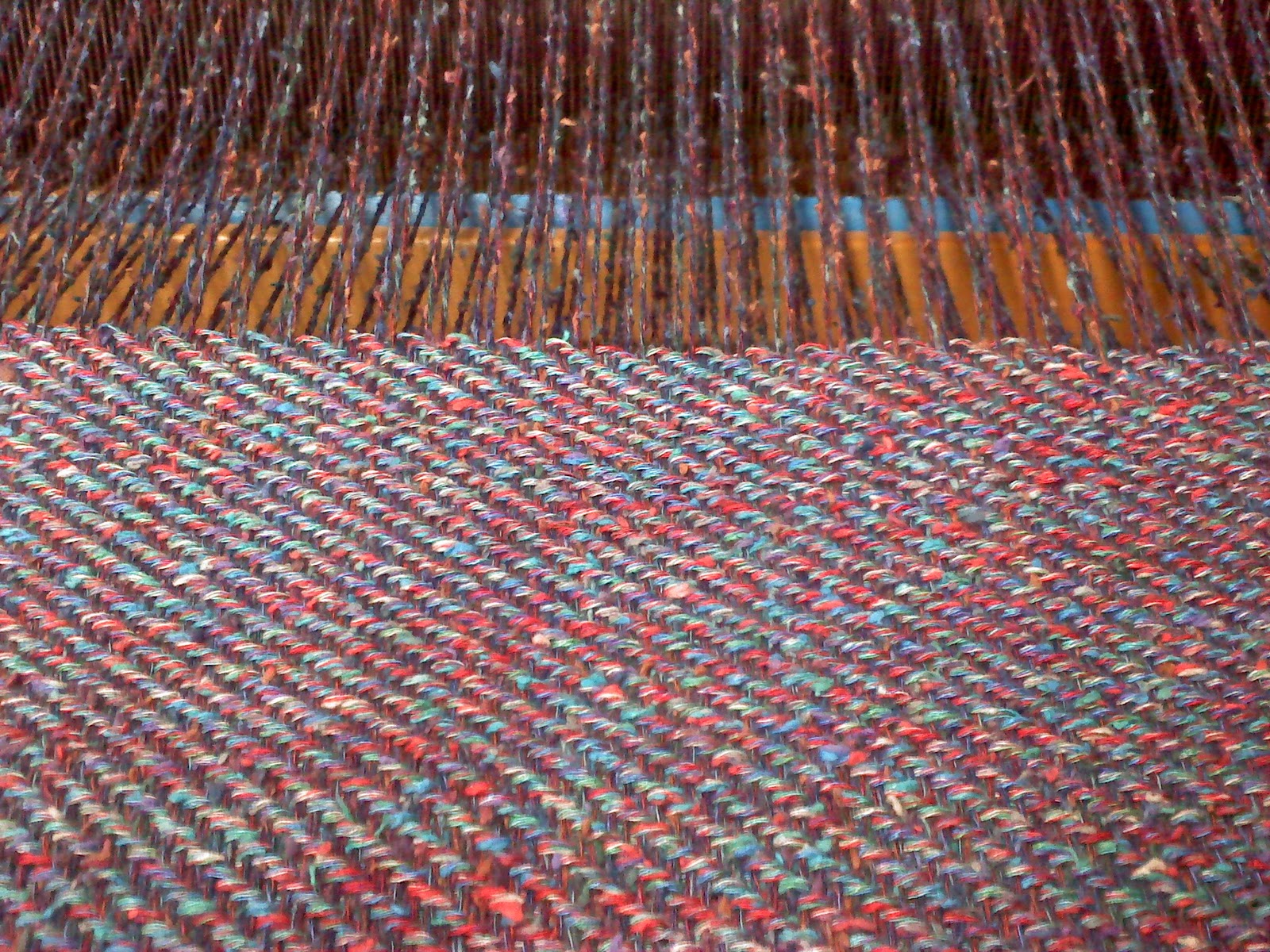
Here is a view of the fabric.  The bottom two-thirds of the image is the actual fabric, and you can see the diagonal striping leading from the bottom right to the top left.  This is the characteristic of the twill family of weave structures.  Beyond the fabric, at the top of the image, are the warp threads waiting to be woven.  The warp is a darker tonal family than the weft (the warp are the vertical threads, the weft are the horizontal ones); the combination of the two is surprisingly pleasing.

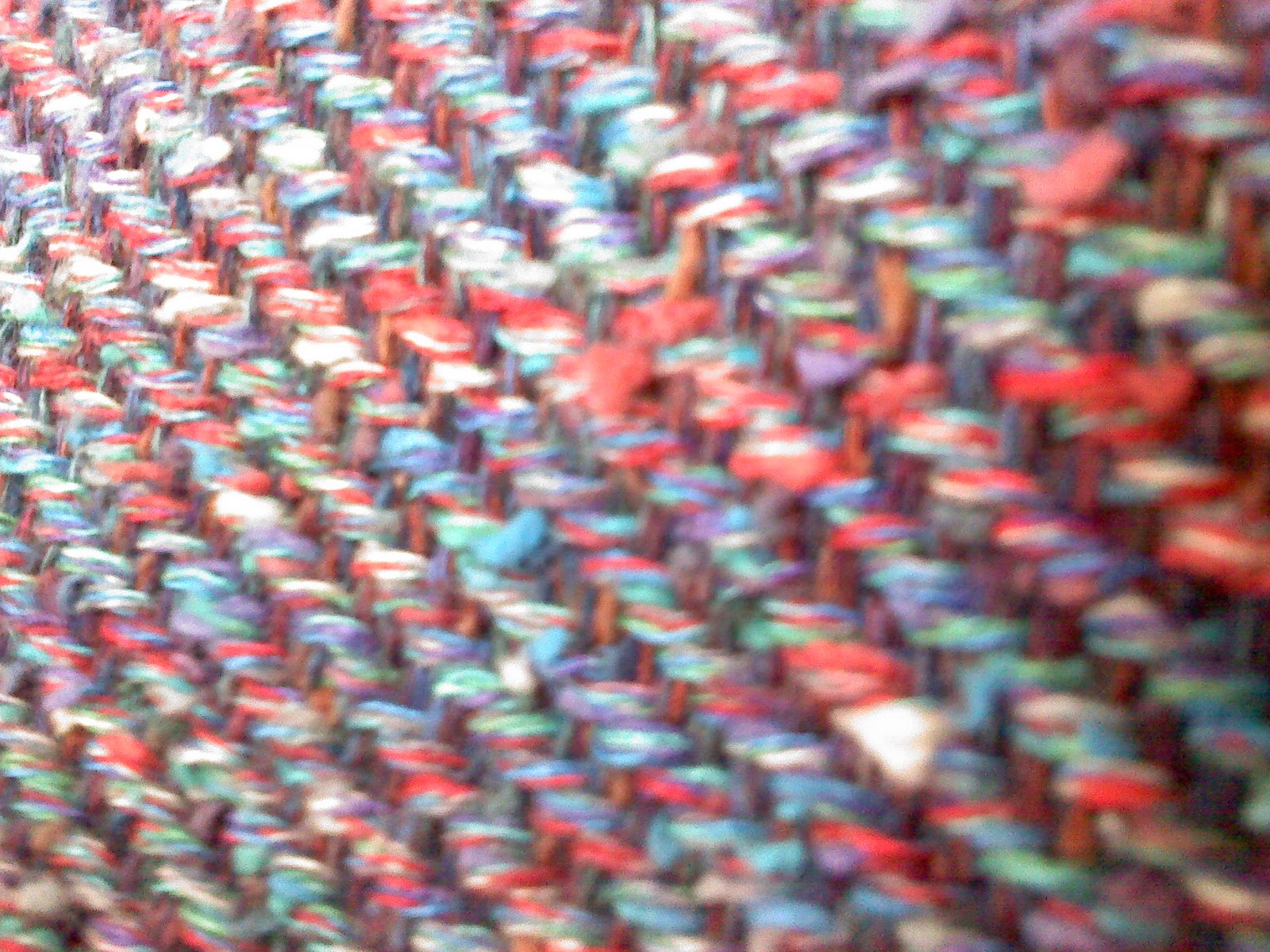
Here is a closeup of the same fabric, showing the apparent ‘movement’ of the fabric.  This fabric is a 2-2 twill, which means two warp threads are up, and two are down, for each pass of the shuttle.  For the weavers among you, I’m using a floating selvage for this project, which is a first for me; I like the edges very much.  They’re a lot cleaner than my last project, where I didn’t use them.

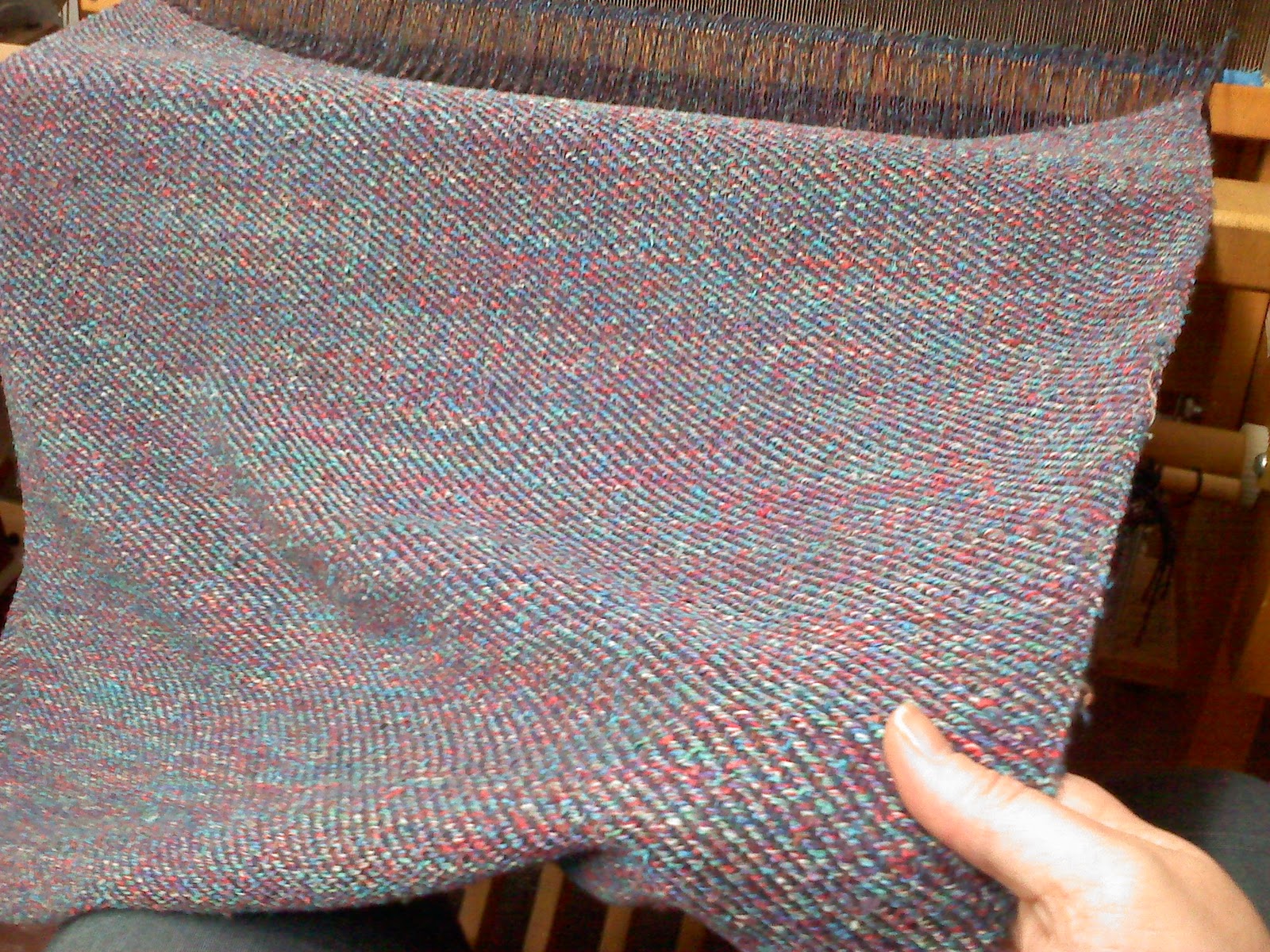
Here is a view of the fabric unwound from the front beam; I included my hand in the shot so you can get perspective on the sizing.  I’m holding this fairly taut; in the next image, you can see more of the drape.

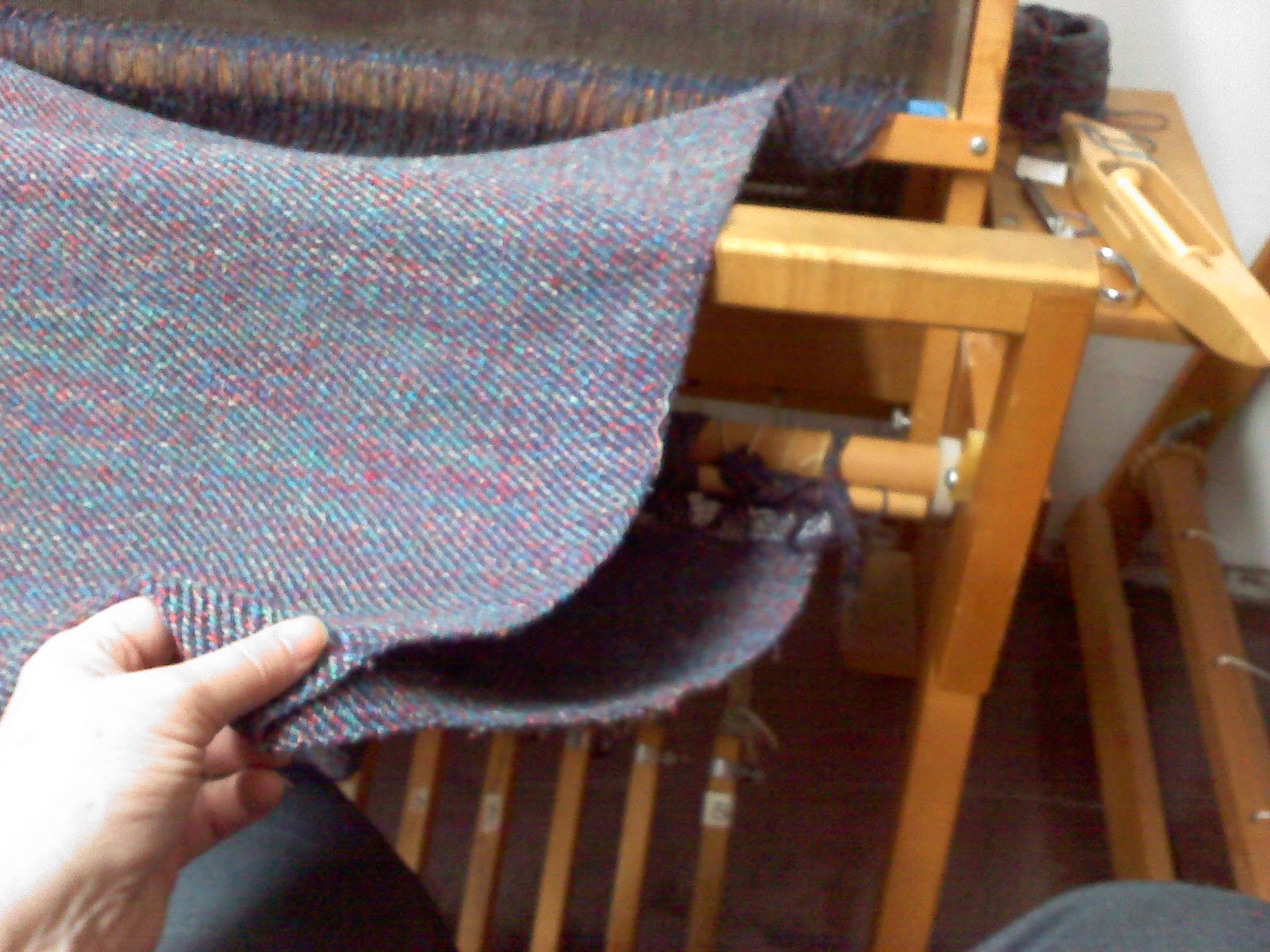
It feels a little bit like denim, but much softer.  It’s a rayon blend and I love it.  As I weave, it creates a lot of fuzz; I hope that isn’t a property of the finished fabric after blocking.

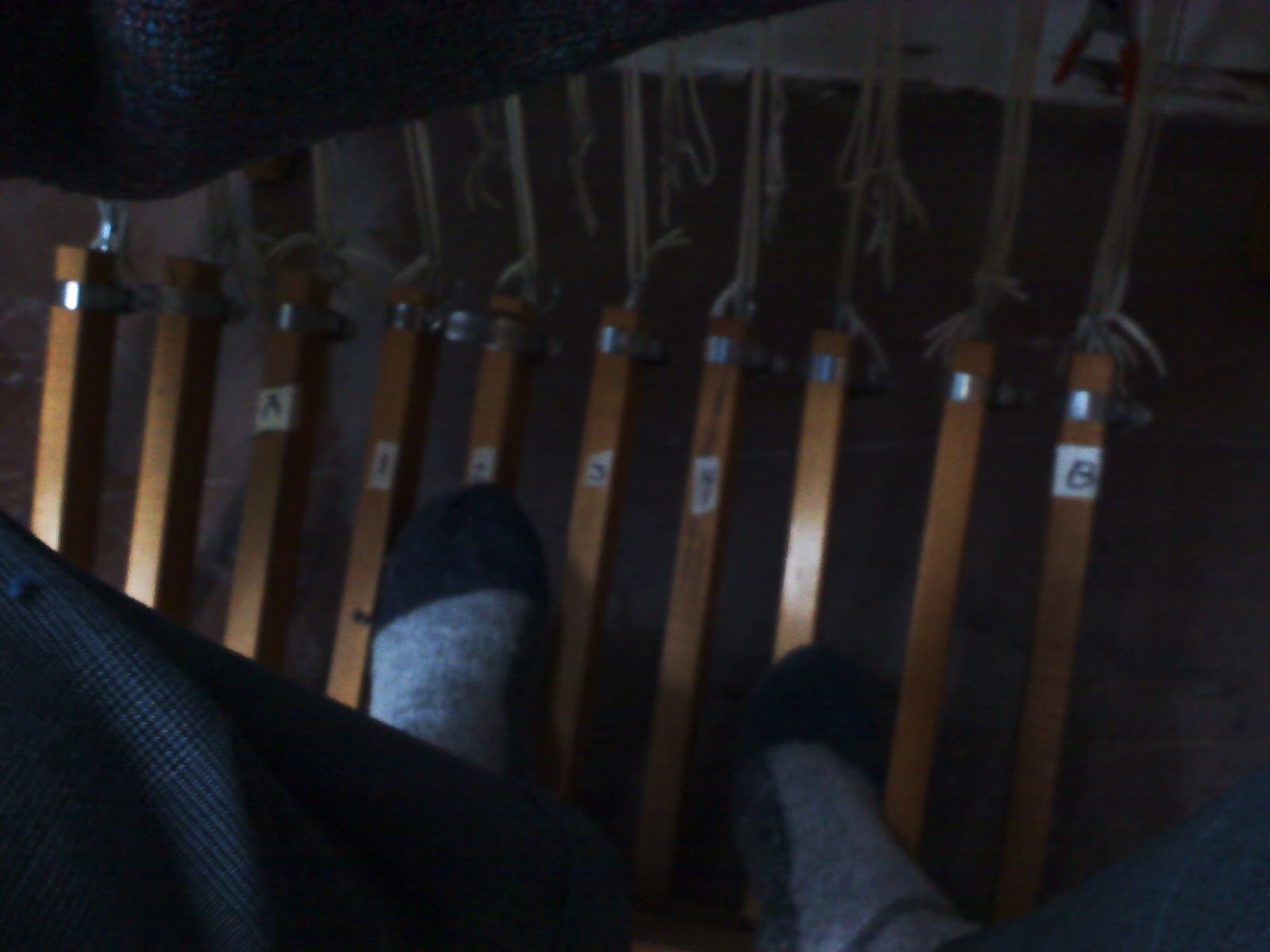
As I mentioned earlier, the heddles are controlled on this loom by foot pedals.  The cool thing is that the foot pedals are variable:  you select which heddles correspond with which pedal.  For my project, you can see there is an A, a B, and 1 through 4.  A and B are set up for plain weave, and the 1 through 4 are set up as a 2-2 twill.  That means that for each pedal, two heddles are controlled – this way, I just have to press 1 through 4 in succession and I have my pattern.

I’ll admit that was very difficult for me to grasp when I first sat down to weave on this loom; my instructor set up the heddles.  The geometry of it just refused to penetrate my brain (I think it’s that old 2-D/3-D problem).  But now that I’ve woven this project on it, and am nearing completion, it makes a lot more sense.

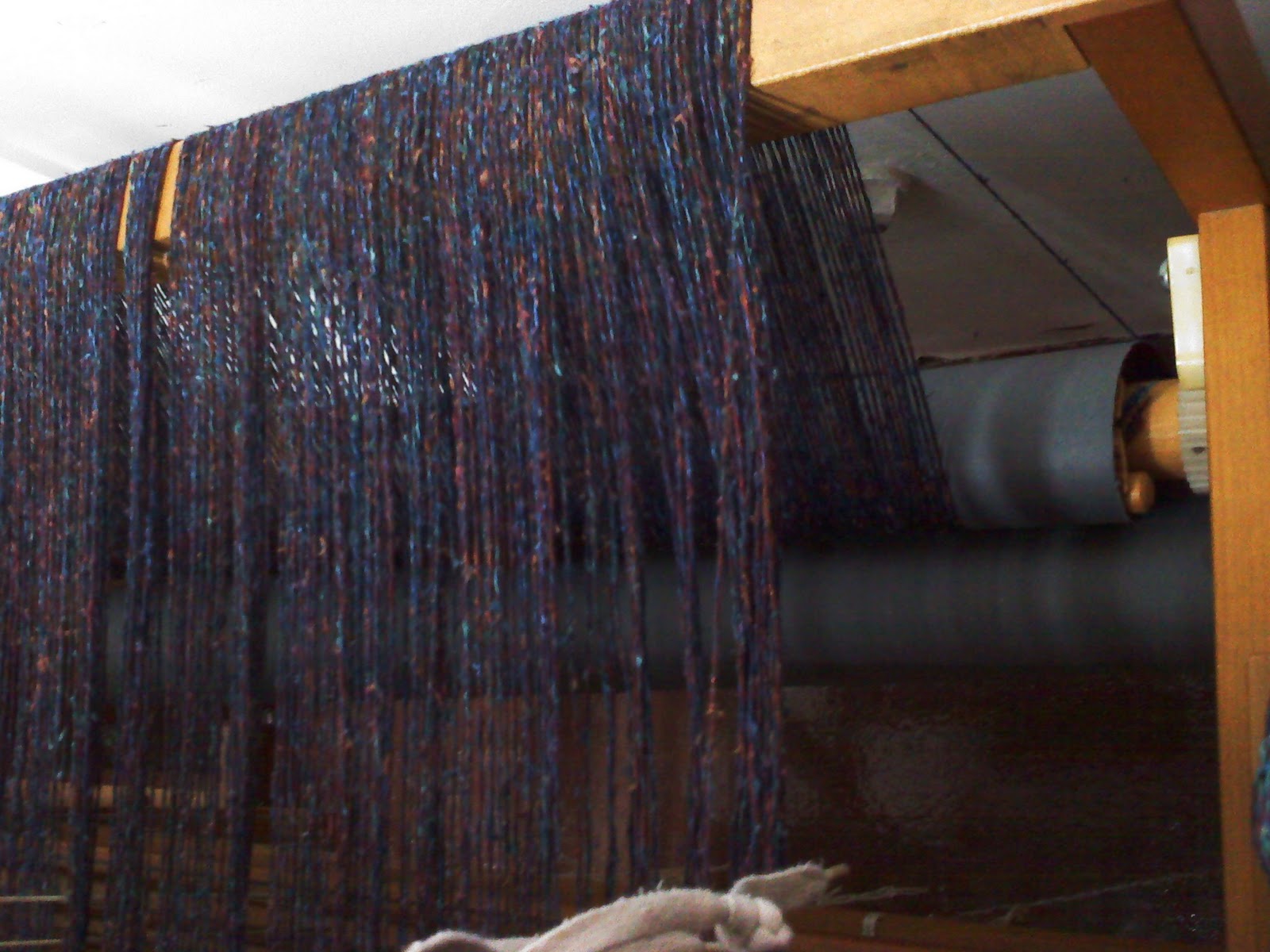
Here is a view of the back beam, for those of you curious to see where the warp goes.  The left foreground shows the warp threads traveling over the back beam and down onto the roller.  The gray paper is there to keep successive rolls of the threads from knotting across each other; each layer is protected by paper (or one could use clear plastic or even newsprint, whatever is handy).

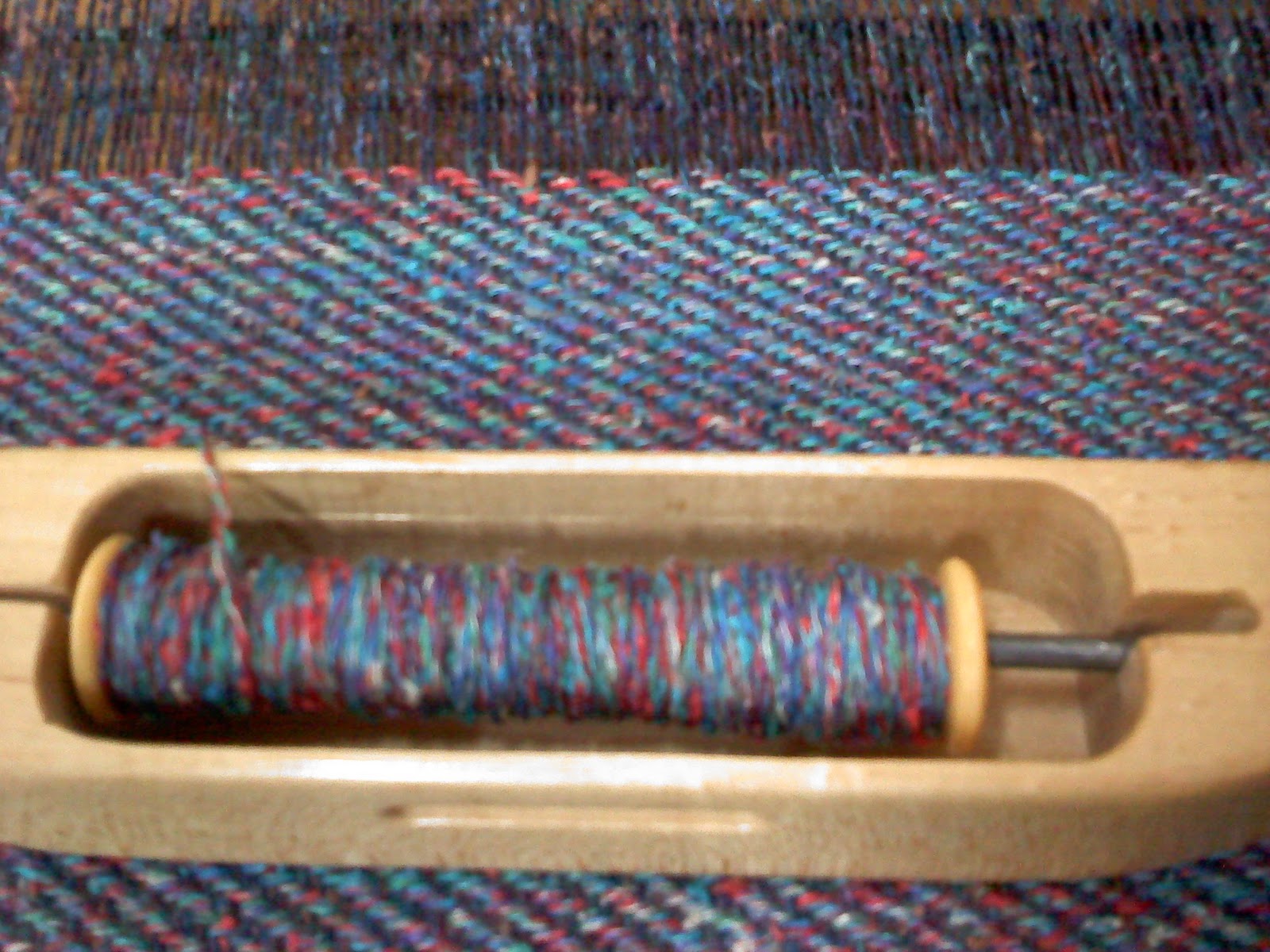
This final image is the boat shuttle, so named because the bobbin of thread sits inside the shuttle on a peg.  This allows the weaver to load multiple bobbins and not have to get up each time the end of the thread is reached.  It’s taken a little bit to get used to how wide this loom is; my last project wasn’t this wide.  But once I got the hang of it, it’s rather fun to whiz back and forth.

Update from the World of Weave!

A Catherine Noon

I have some news from my weaving classes and pictures, as well as an announcement about WeaveSpa.  Check it out on Knoontime Knitting!  And another entry, here!

News from the World of Weave

A Catherine Noon

I continue to attend weaving classes at the Chicago Weaving School, which in turn continues to grow and prosper.  Founder and Instructor Natalie Boyett conceived yet another excellent idea called WeaveSpa – single weaving classes with a pre-dressed loom or packages of lessons for very reasonable prices.  It’s a great way for people to dip a toe into the weaving world without having to take an expensive and time-consuming plunge.  (It’s also a great way to get hooked on the weaving addiction, but that’s beside the point…) 

The first WeaveSpa is February 2, 2011.  Check it out on Facebook.

As for what the heck I’m weaving, I’m weaving a Quesquemitl!

Say huh?

A Quesquemitl!

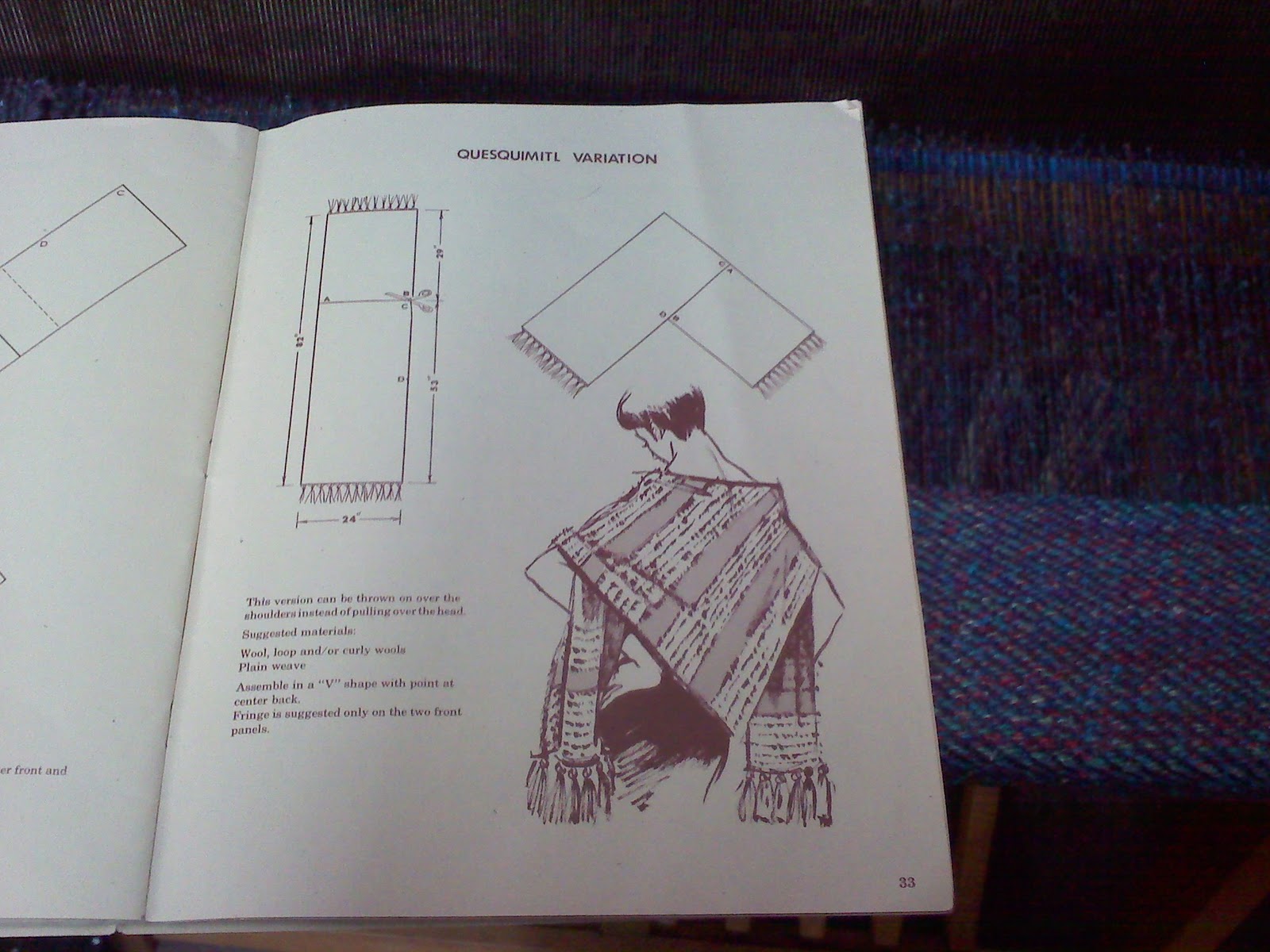
Nope, doesn’t make sense to me either, other than it’s a Mestizo shawl thingie.  It’s pretty cool.  Here’s a pic:

The schematic on the left is the drawing of what you weave:  it’s a long rectangle with fringe on the ends.  I think I might add some clear crystal beads to the ends of fringe and macrame them in some fashion; we’ll see.  I don’t have to decide that til next week. 

Why next week?   BECAUSE I’M NEARLY DONE!!!  I’m so excited.  Here is a picture of the loom I’m using; you can see the fabric in the front wound around the beam and the threads on the back with the knots sticking out – those knots are the end of the warp!  That means I only have a few more inches that I can weave before I’m all finished!

And since a friend of mine asked me about what the school is like, and I realized I haven’t posted any pictures, here are some views of the school.

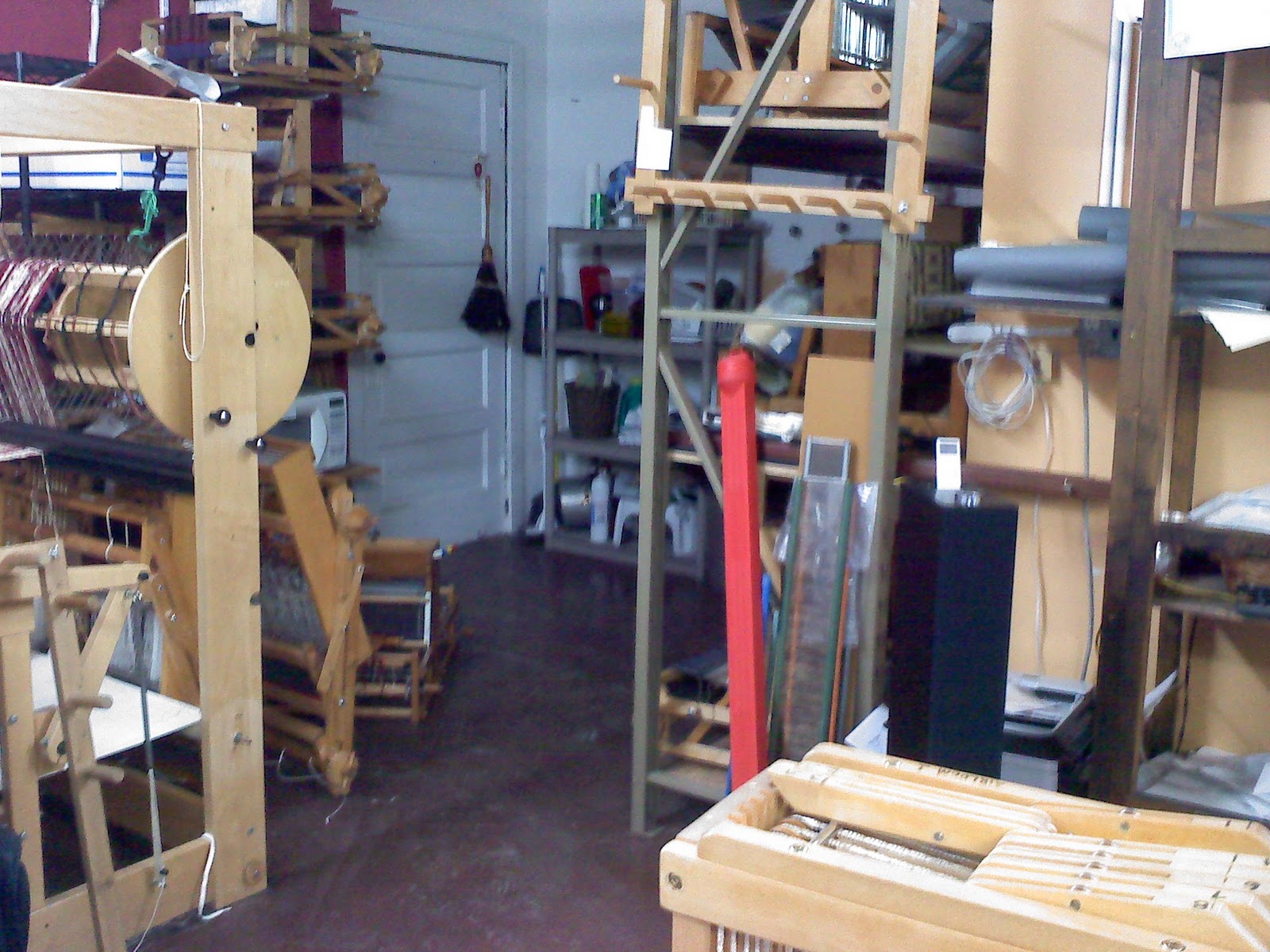
‘My’ loom is in the back on the left.  In the foreground on the left is another floor loom, and the yellow threads are the warp of what will be a blanket.  The bookshelves are the weaving library, and the odd shapes on the right are, in the foreground, my jacket over a chair and behind that my classmate’s coat hanging on the corner stantion of a giant floor loom.

The left is the back of that same enormous floor loom, then the back door that leads to the other room of the school, a long hallway and the all-important restroom.  What you can’t see is there’s a little bit on the right where there’s a sink and more shelves with looms.  In the foreground on the right is the castle of another loom; what you’re looking at are the levers that control the harnesses.

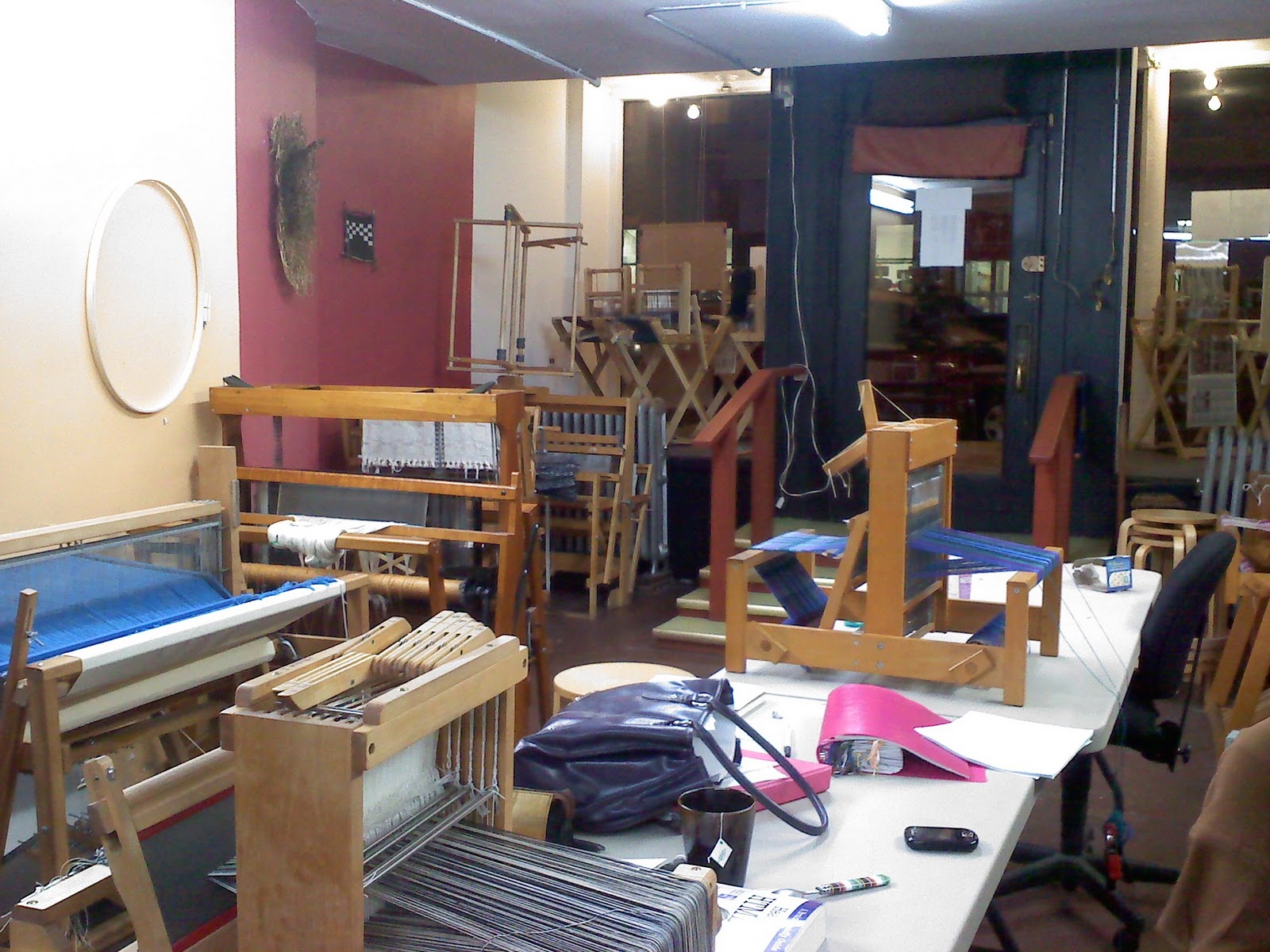
This is looking toward the front of the school.  The center table is the main worktable, and looks different each time I come depending which students will be working.  When not in use, those table looms go on shelves.  On the left is a floor loom with a blue warp; beyond it are three more floor looms and a large wooden contraption for winding lengths of warp threads.  It’s got a name but I can’t call it to mind at the moment.

It’s a fun shop, full of electric and creative energy.  The students are just as interesting as the instructor; I’ve really enjoyed the time I spend here and look forward to many more days weaving here.

That Good-For-You Food – Yogurt!

A Catherine Noon

Stemming from discussions with some friends, my contribution to Thursday 13 today centers around 13 Things About Yogurt. An unusual topic, perhaps, but an interesting one none-the-less:

1. Yogurt can be made from cow’s milk, goat’s milk, even soy milk. One article I saw said “any mammal milk,” which gave me pause – elephant yogurt? o.O…

2. It’s fermented milk. Commercial yogurts have the fermentation added, but you can make it at home with a commercially-available home yogurt maker.

3. I have a commercially-available home yogurt maker.

4. I’m not brave enough to try it yet…

5. The bacteria that make the yogurt are VERY beneficial to the human digestive tract. By now, most folks have heard about “acidophilus” (which my spellcheck tried to make “audiophiles,” but I digress…), but there are a broad spectrum of bacteria that are useful.

6. When you have any kind of intestinal trauma, from simple stomach flu and food poisoning all the way up to intestinal disease, yogurt can help re-populate the healthy flora in the intestines and ease up on painful symptoms.

7. Yogurt is an excellent facial cleanser.

8. No, that’s not a typo – yes, it is a non sequitur (my spellcheck tried to make THAT ‘squirt’). You can simply take yogurt in your hands (use a spoon, don’t just dip your paws in the container, sheesh!) and spread it on your face with gentle, upward sweeps of your fingers. HINT: let it come up to room temperature first. (Ask me how I know.)

9. It is an excellent cure for yeast infection.

10. No, I have not personally tested that theory. I used to get them a lot (infections) and did a LOT of research. Something about the beneficial bacteria eats the yeast in your system, and so applying it directly on the … um, affected area… is how it works. I just couldn’t do that myself, but my herbal instructor confirmed it is effective. (Couldn’t eat yogurt for months when I found out, as a matter of fact…)

11. Now, I eat yogurt pretty much daily. I have intestinal problems that I won’t bore you with, but the yogurt helps a) soothe my stomach and gut and b) helps keep the good flora well-populated. Cuz a flowery colon is your friend. (Um, forget I wrote that last sentence…)

12. Yogurt impersonates sour cream REALLY well, and if you use the 0% fat yogurt, it’s MUCH fewer calories. I put it in my spicy Indian food (which, happily enough, is actually rather authentic – they put yogurt on it too!), Mexican food, my baked potatoes, in soup, all sorts of stuff. Even put cocoa powder and honey in it! (The yogurt, ya goof, not the Indian food…)

13. If you need a quick dip for fresh broccoli florets, put some mild curry powder and a smidge of garlic salt into half a cup of yogurt and stir really well. YUM! And, 0% fat is your friend!!

Wow. Despite my worries, I actually ran out of 13 before I ran out of list! We might have to do this one again!

Happy TT!

New World Order – Chapter 17: Banker’s Hours (Belinda)

A Catherine Noon

The long-awaited next installment of New World Order, Chapter 17, “Banker’s Hours,” is up on Taurus and Taurus for your perusal.  Enjoy!

Thursday 13 – 13 Stress-Busting Tips

A Catherine Noon

I’ve had quite a bit of stress in my life lately, and it’s reminded me of the tools I’ve been given, learned, or, let’s be honest, been forced to incorporate in my life in order to manage the stress. While the obvious best solution is to eliminate the stressors in life, sometimes that’s not an option. When stress rears its ugly head, and we aren’t in a position to slay it outright, here are some of the tools that have worked for me. I hope they help you, too.

1. Breathe. This is one of the most effective, in-the-moment tools in the arsenal. Recently, I learned that breathing in through the nose and out through the mouth can give it an extra stress-busting kick that can help to bring the adrenaline down.

2. Drink lots of water. So what, it makes you go to the bathroom a lot? (Seriously, this is one of the most common complaints in response to this suggestion that I hear.) Water helps to wash toxins out of our bloodstream. Stress releases toxic chemicals into our system (that’s part of why it feels yucky and why, over time, stress is actually damaging to the human body).

3. Learn about stress. There are a lot of good materials out there, from places like the Mayo Clinic or your health provider’s website, to your doctor, books, friends, and the internet. Get good information about what stress is, how it affects the body, and what you can do about it. Knowledge is power.

4. Take your own advice. Many times, we know what we “should” do, we just don’t do it. Take the steps to remove your own blocks to good behavior, and implement what you know will help you in the long term.

5. Don’t be the lone gunman. While that has an echo of ugliness, because sometimes people literally become gunmen when under stress, I mean it more figuratively: don’t suffer in silence. Tell your friends, your pastor or rabbi or other religious counselor, your therapist, or other trusted advisor. Talking about it, even just admitting “I feel stress” is the first step to taking control and reducing the stress in your life.

6. Understand bravery. Being brave isn’t lack of fear. Being brave is doing something even when you’re afraid. Sometimes, the things that are causing the most stress are within our power to change, we’re just afraid to. Practice bravery in the small things so that when big things come up, you have the skills polished and know what to do.

7. Trust yourself. Your own inner guidance, that moral compass inside you, is your best and truest friend. Learn to listen to yourself, so that when you need it, you’re there to advise you.

8. Exercise. Endorphins that are released when you exercise lower stress. It can also boost your ability to handle new stress, so it’s kind of a perpetual-motion machine of goodness that can beat back that stress. Just do it!

9. Eat well. Medicating ourselves with too much sugar or fat is a common response to stress. Be aware of this impulse and make good decisions about food. If you need to get yourself into a program like Weight Watchers or Overeaters Anonymous if food is your drug of choice.

10. Remember, or learn, the Serenity Prayer: “Grant me the serenity to accept the things I cannot change, the strength to change the things I can, and the wisdom to know the difference.” Simple, powerful, liberating.

11. Learn what you can control in a situation. There are always options. When you can hone your ability to see those options, you empower yourself. You may not like the options, but having them can give you, well, options. When you can make decisions, you exercise control. It’s a self-perpetuating cycle.

12. Go easy on the drugs. Understand the effects of your drugs of choice: caffeine, nicotine, alcohol, or others. Know that putting them in your system has consequences, and that when we’re stressed, it’s natural to want to self-medicate. The problem is that doing so can cloud our ability to effectively deal with the stress that caused the urge in the first place, which is why it’s difficult to stop. If you need help doing so, see a therapist or cessation group and get information and support.

13. Massage. I’ve said it before, and I’ll say it again: massage works. It works with the body’s natural healing processes and boosts your ability to manage the stress you’ve already developed as well as prevent further stress from having adverse effects. If you haven’t tried it, make a resolution to find a good massage therapist. Highly worth the money and time you invest.

Above all, remember: you are the architect of your life. If there are things happening on a regular basis in your daily round that you don’t like, you have the power and authority to change them. Be open to the abundance in the universe and trust yourself. You can do it!

Post navigation

← Older posts
Newer posts →
©2026 - A Catherine Noon - Weaver Xtreme Theme
↑