Chapter 18 of The Night Is a Harsh Mistress is up. We get to find out about the mysterious Viktor and his father, and who, exactly, David Greene is. Enjoy!
Weaving! Harness the Power…
Sorry, weaver’s joke. (Harnesses hold the heddles, which are how the fabric is made… get it? Yeah, it’s not that funny.) (MAN, maybe I need to get out more.)
ANYWAY. So, I’m going to give an update in reverse order of my weaving progress. Why?
Because it’s Friday?
I went to class yesterday and did some more work on my placemats. I am learning to make balanced-weave patterns and twill, which is actually kind of fun once you get the hang of it.
However, THIS was my view on the train. Talk about PACKED – this dude’s butt was in my face, practically. I mean, nice butt, but jeez. I’m sorta married, and anyway, I’m not gonna sample the merchandise on the train without asking first, and it’s sorta public, an’ all…
But riding the train is sometimes like you and four million of your closest, smelly friends all mashed into a sardine tin on metal squealing wheels.
On to the weaving:

This is the breast beam of the loom, which sits toward the weaver. My instructor jokes that is because it’s where you put your breasts. ~smirk~
Mine are a leetle big for that…
The balanced weave is every other strand of the warp (the vertical threads) is lifted, and the weft goes in between them. There are as many threads vertically per inch as there are horizontally, which is why it’s called a balanced weave.
The thing I’m learning about this art, is that it’s very logical. The explanations make a lot of sense and aren’t like trying to figure out calculus. Once you get familiar with the terms (warp, weft, shot, shed, etc.), then it’s much easier to understand.
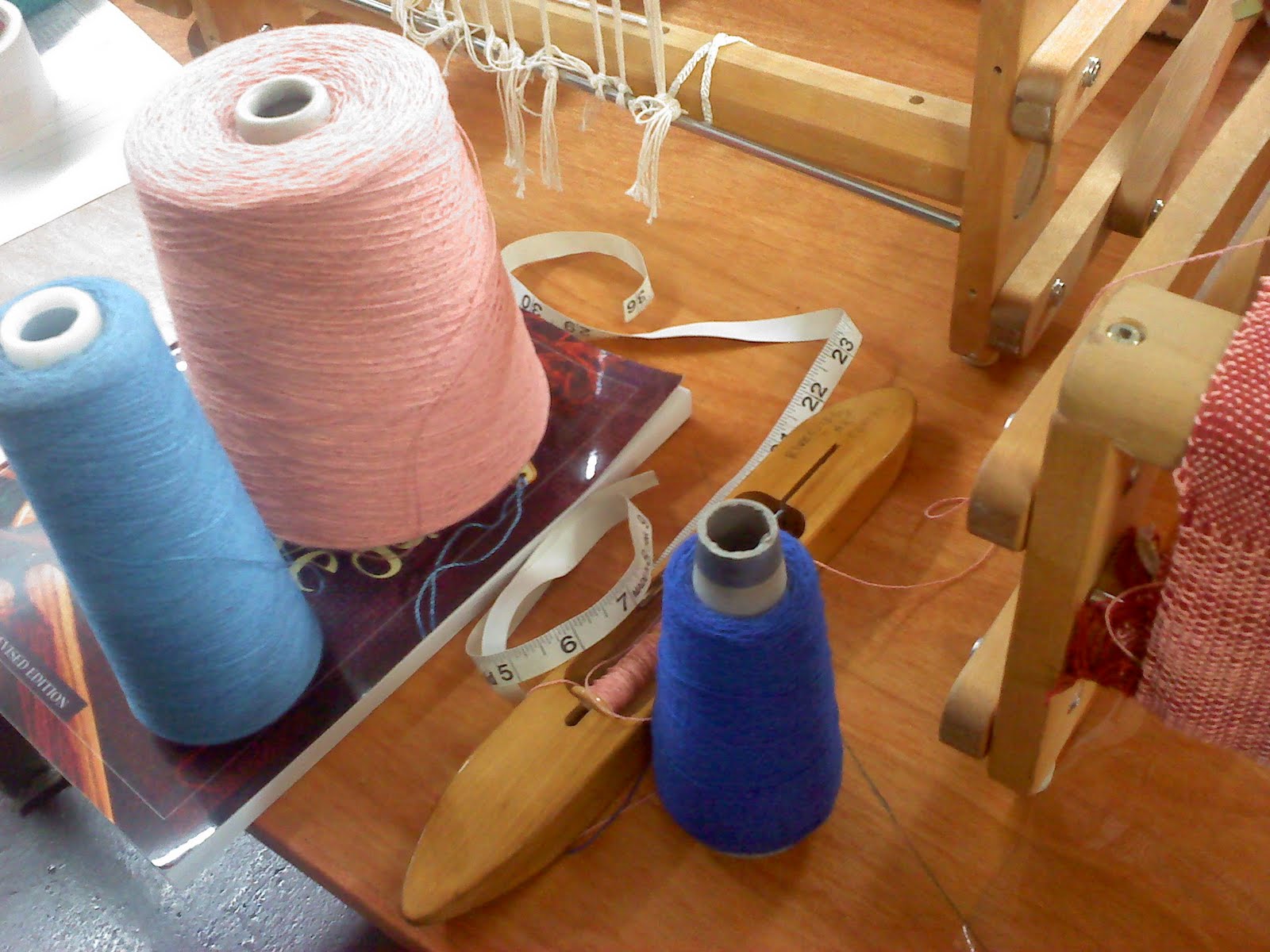
These are the three yarns that I’m using for this project. The other two, which I used for the warp, (the vertical threads that are tied into the loom itself), are a dark rose and an ivory. These threads are used for the weft, the horizontal threads. Starting at the center and moving clockwise, the dark blue is for the narrow stripe that runs across the width of each single placemat and intersects with the narrow strip I wound into the dark rose warp.
The light blue is a very narrow gauge yarn that is used to make the hem allowance between each placemat. My instructor had me use this narrow thread so that the woven area for the hem won’t be as thick as the main fabric.
The pink is the thread I’m using for the main part of the weft. When it’s woven, as you can see from the other photographs, it’s much less PINK and makes a nice blend with the dark rose and ivory.
Also in this image are several of the tools I used. Again, going clockwise and starting next to the dark blue thread is the “boat” shuttle, since it looks like a little canoe and the bobbin sits inside it, like a canoe. Next is the tape measure, used to check the width of the textures that I’m weaving. I am weaving balanced weave for four inches, then a pattern weave, then balanced, etc.
The book I recently purchased on the recommendation of my teacher, Learning to Weave. I like it. It’s very easy to understand and set up like a class itself, so it adapts well to use in lessons.
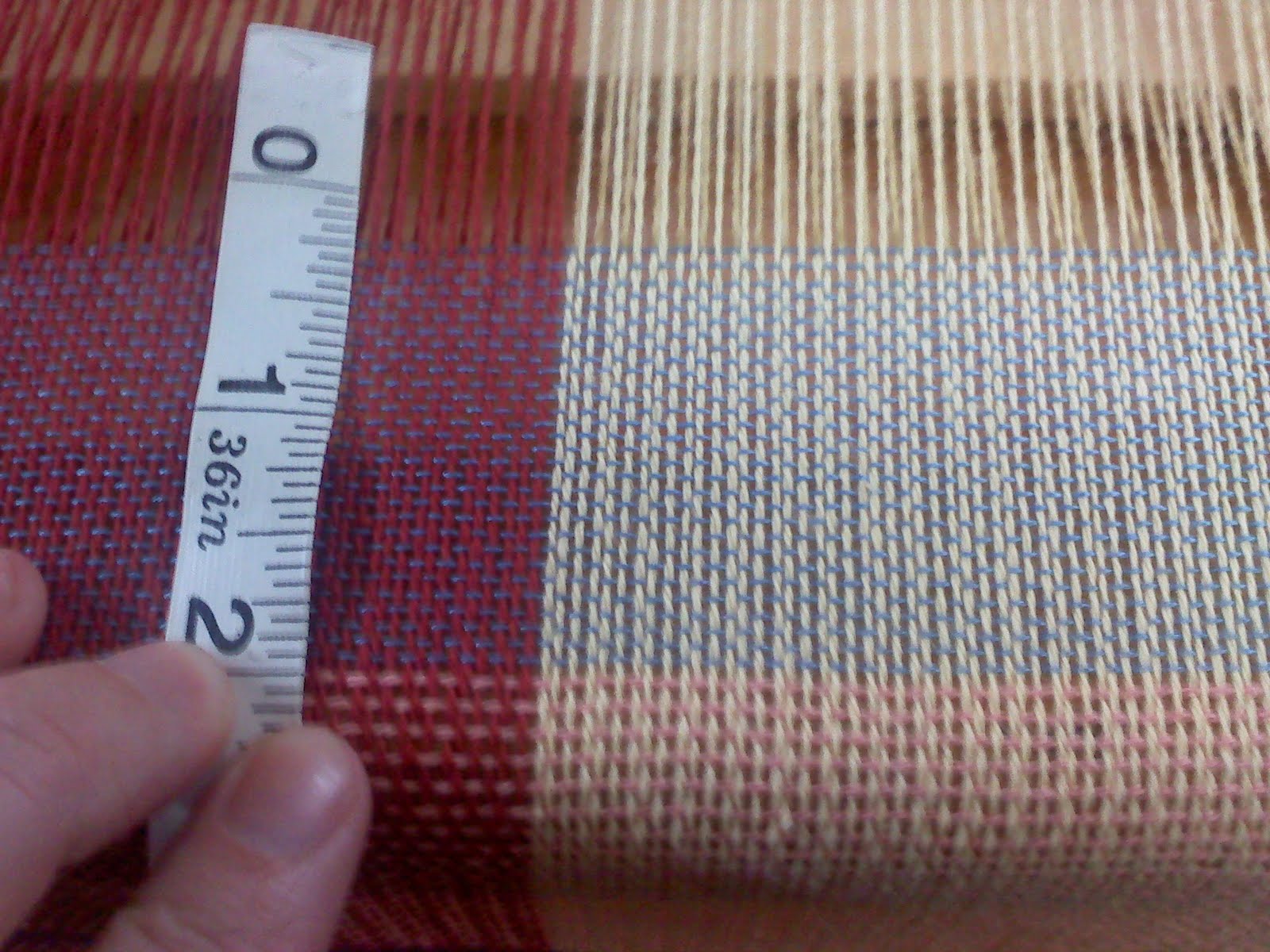
This is showing the measurement of the narrow band in between the two mats. As I mentioned above, I used the narrow light blue thread to weave this portion; as you can see, it’s a great deal narrower than the main pink thread.
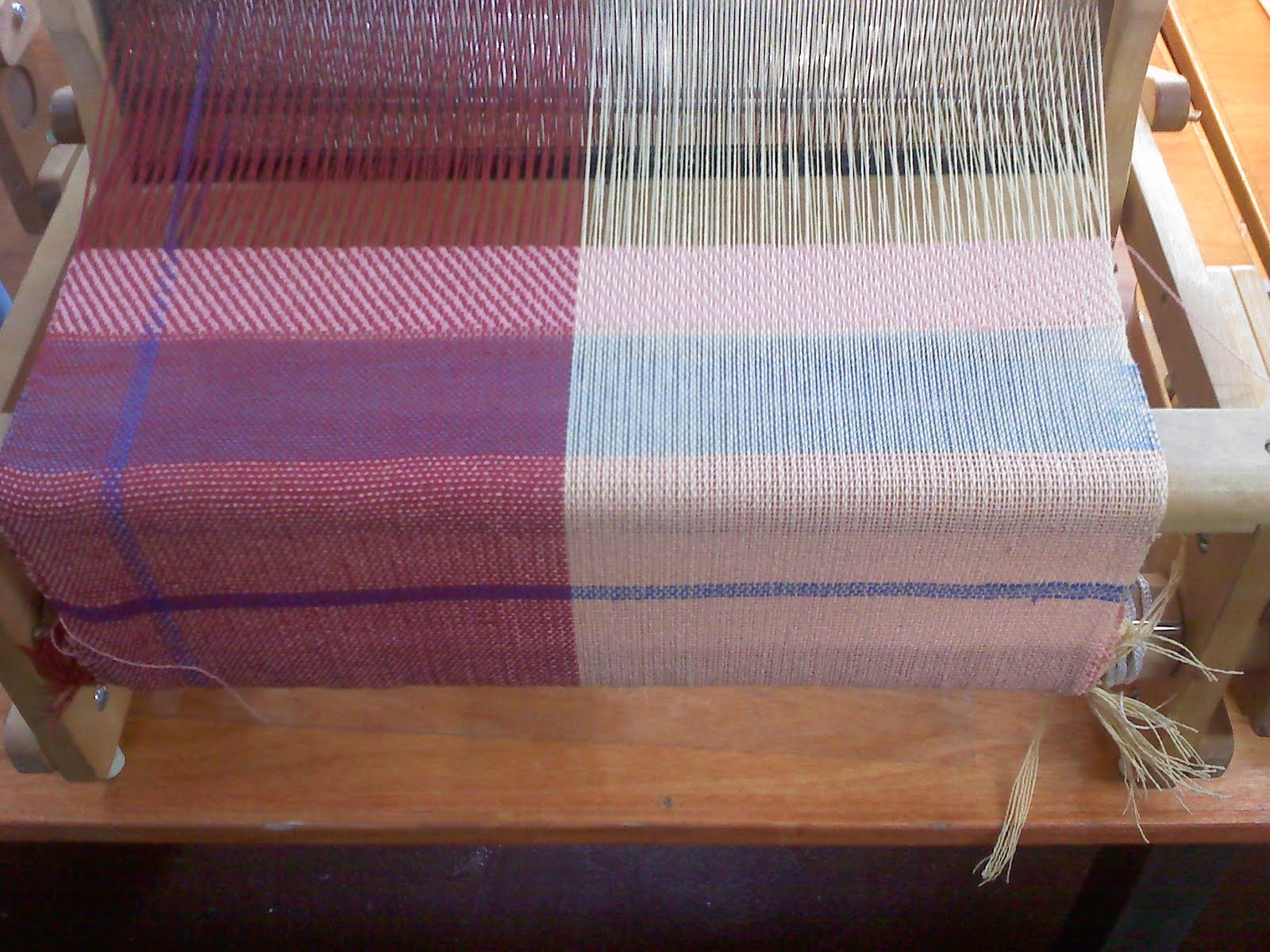
Here is a view of the twill that I wove. I love the diagonal look of this weave and if I needed to select a pattern to weave all over a design, this would probably be the one I’d select.
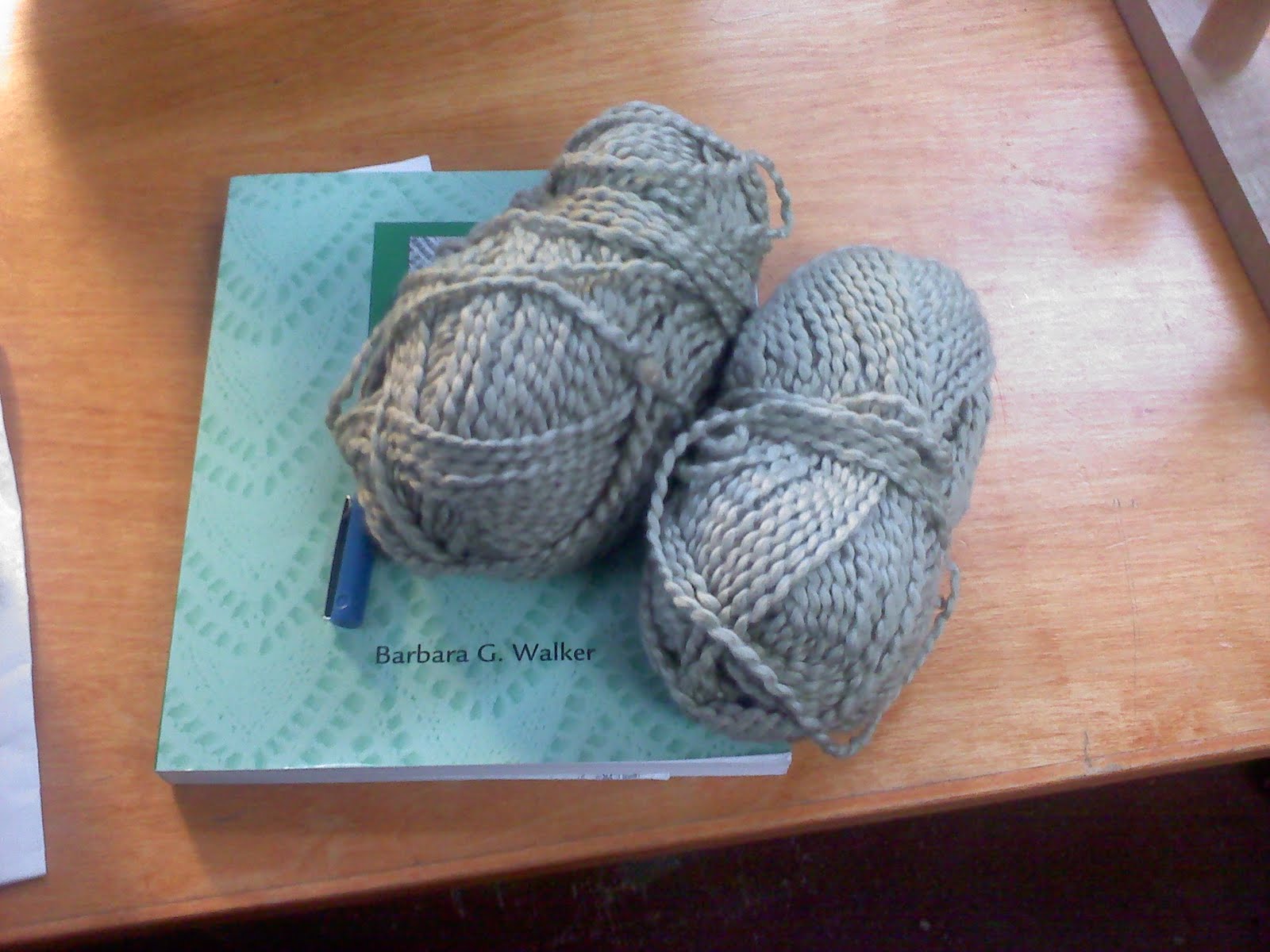
My instructor had some leftover yarn, so I’m going to knit her a scarf in a new cable pattern, from my new book by Barbara Walker, A Fourth Treasury of Knitting Patterns. I’m going to attempt “Cable #2.”
We shall see how this experiment goes in future articles. For now, have a Happy Labor Day weekend and enjoy your craft!
Labor Day Blog Hop
Happy Labor Day! Thanks to Booknibbles.com for the wonderful tour! If you’re just coming across this post, you can catch the beginning HERE.
In celebration of the beginning of the end of summer, here is a brief excerpt from a novel about the intersection between the world of Men and the world of the Fey. Enjoy!
Chapter 1: Shards
Daniel Guthrie sat in the street, the blood and the noise made no impression on him. The body in his arms dragged against him; its weight pulled at his shoulders, his back. The tears had dried on his cheeks, his chin; he stared at the ground somewhere by his feet. He felt hollow, numb. David Behan was dead.
He knew when the police came, their sirens pierced his ears. Blue and white strobed through the nighttime blackness, cut through the street lights. He heard Bryan Sullivan speak to them, his voice cutting through the din.
“Yes, sir. I saw the whole thing. Self defense.”
The words made no sense to Danny. The detective kept trying to speak to him, even asked Bryan to try to get a response. Danny didn’t care. His throat closed, shut tight, and it felt like he’d never speak again.
“Sir, we have to take the body.”
A hand closed on David’s shoulder, crossed in front of Danny’s face, tried to lift the body away. He saw that much before Bryan appeared, holding his arm and shoulder in front of Danny, blocking him from moving. He realized Bryan had been speaking for a while, repeating the same phrase over and over.
“Danny. It’s okay. They’re here to help. You have to let them take David, Danny. It’s okay.”
It felt like his ears popped, like in a plane landing. He sat on the ground, in the street. The grit stuck to his hands grated where he gripped Bryan’s arm. His neck felt stiff but he turned to meet Bryan’s gaze from inches away. Bryan’s face looked haggard, twenty years older than his twenty-five. Tear tracks and blood splotches stood out against his pale skin. Danny blinked.
“Bryan.” Danny’s voice felt worn, hollow.
“Danny!” The relief in Bryan’s voice almost embarrassed Danny, like Bryan revealed personal information to strangers.
“Yeah. I’m here. I won’t… fight them.” Hurt them, he almost said. He couldn’t say that openly, not when the detective hung over his shoulder.
After a moment or two, the paramedic apparently decided Danny was not going to interfere again and motioned his partner forward. They moved David’s body to a waiting gurney. He saw Bryan out of the corner of his eye, watched him track the gurney and swallow. But Danny didn’t turn. He knew they would take David to the ambulance and then the hospital morgue. All he could focus on was the blood. So much blood, it pooled in the street, soaked his jeans and shoes, squished in his socks. He knew it matted his hair, streaked his face. The mad detachment welled up again, swallowed the sound and the light. Bryan started to speak again but Danny could only focus on the blood on the ground nearby. Gravel and broken glass studded it, here and there sparkling in the light from the nearby police cruiser.
David Behan was dead.
Okay, on to the next blog. I hope you make it to the end, where I’ll be giving away a gift certificate. Good luck!
Thursday 13 – September 2, 2010
So, I got some grumpy news from a friend this week. Rather than expose it to the world of the internet, which could give it legs I don’t intend, I figured I’d vent in a general fashion. It’s been a tough couple weeks, and I’ve been kind of off my game.
On the other hand, staying off my game seems silly. So the second half of my list is stuff I’m grateful for. In fact, since half of 13 is 6.5, the greater part of my list (7) will be grateful stuff. That way, I can vent and then focus on the happy.
1. When people say stuff and then don’t follow through. This is sometimes annoying, sometimes unprofessional, but can be hurtful.
2. Lack of communication. If you do something that doesn’t include someone it should have, don’t let them find out through Facebook. That’s like finding out at recess.
3. Broken fingernails that break off beneath the quick. Ow.
4. When my dog poops on my carpet. GAH!
5. When the alarm clock goes off in the morning.
6. When I can’t find my hammer to kill the alarm clock with. GRR!
And what am I grateful for?
7. My family.
8. My friends.
9. My pets.
10. My writing community. Y’all are awesome, d00ds!
11. Airplanes. Srsly. I get to go visit mah peeps later this month by plane. I’m very excited!!
12. The telephone. The friends who can’t come are going to call in later this month. I’m so excited!
13. Forum software. It lets me stay in communication with people all over the globe, and maintain friendships that otherwise wouldn’t happen.
Thank you!
Happy TT!
Chapter 3 of Initial Public Offering
Chapter 3 of Initial Public Offering is up.
For a quick blurb on the story, visit our “About the Stories” page.
Wiley Wednesday: Irreducible Minimums
I’m blogging about Irreducible Minimums over at the Writer’s Retreat Blog this week. Stop on by!
Mochi Progress
I’ve been working away… well, playing away, really… with my shawl. Here are a couple quick updates.
I’m on row 14 of a 16 stitch sample of rippled rib. I may extend it past this current spot because I like how it’s shaping up and one repeat of the pattern is a little too little to see.
I’m learning to read charts now, which is getting easier the more I play with them. I’m using post-its to track the row I’m on and I numbered the stitches on the post-it, which helped me to keep track of them. I found that to be a lot more helpful than trying to count in the middle of the row. As long as I kept count of what stitch I’m on in the knitting itself, then I know what stitch I’m on in the diagram.
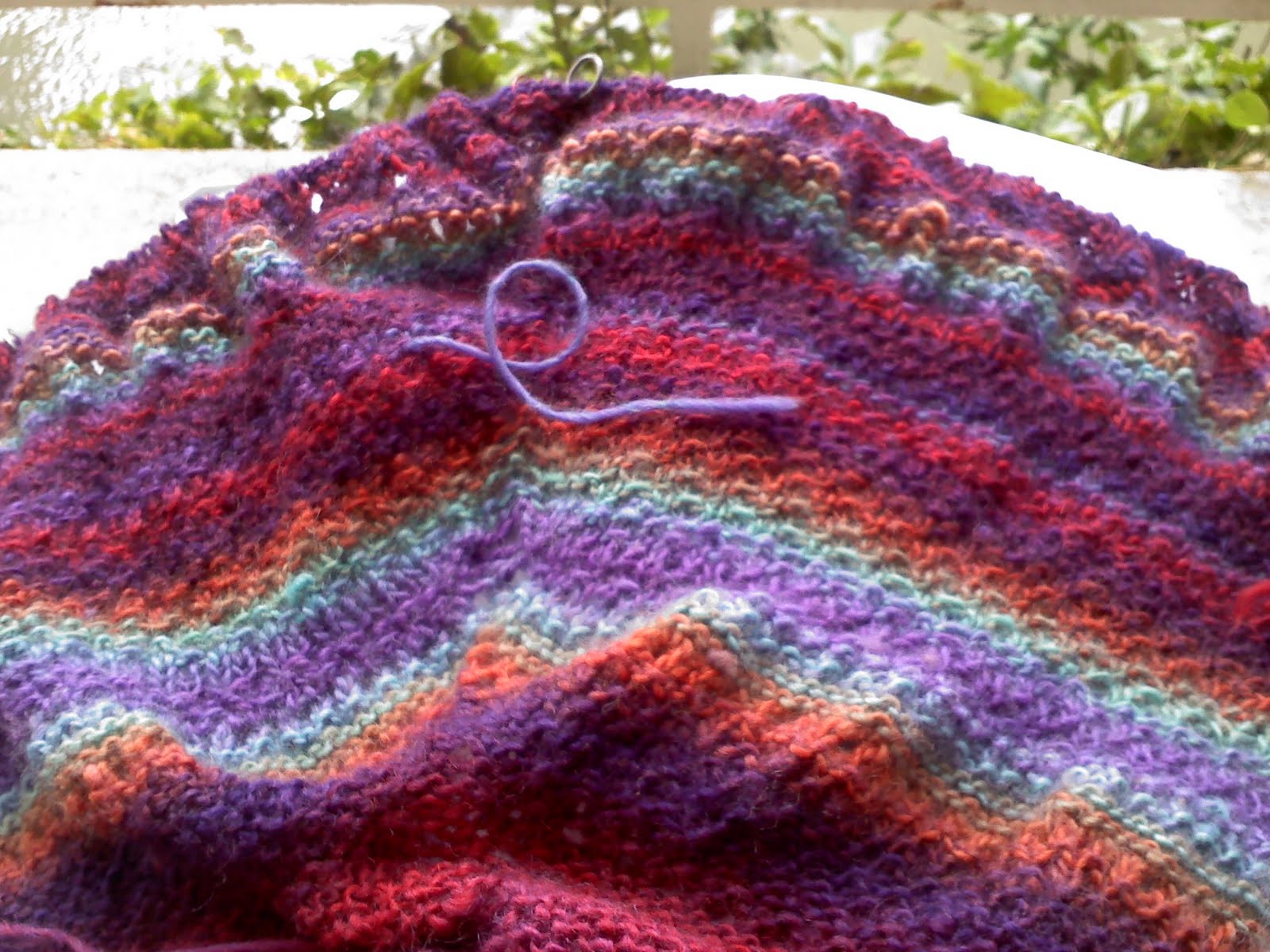
The stitch in the middle is the cross-stitch pattern that I mentioned in my previous article on this project. It has less give than other patterns, and would be good for a jacket or something that needs to hold its shape. I love the look of it, but it’s less loose than I would like for a shawl. I may continue with it for this project anyway, simply for the practice.
The wavy ribs that I’m working now are at the top of the photograph and in the detail below; I like them in the book but less so on this project so far because it’s only one pattern repeat. That’s why I think I might continue the pattern through several more repeats in order for it to establish itself on the piece.

This shows the lace in the pattern, but it’s hard to see the rows of wavy ribs that go up vertically along it. I’d love to try it with a worsted-weight or heavy yarn in a scarf with a couple of repeats width will allow the pattern to really shine. (This yarn is a lace weight, maybe a DK, but very light. Worsted-weight is more traditional, what Americans think of when they think ‘skein of yarn’ in the store.)
Final Day of First Session, June 24th
My final day of class, and I’m hooked. I will definitely sign up for the four-harness class, and even have purchased my first instructional book: Learning to Weave, by Deborah Chandler. It only just arrived today, so I don’t have an update, but I’m excited to feel like a ‘real’ student.
So, on to the last day of my first set of class:
These images show the fabric all the way up to near completion; I also have some images of the fabric off the loom but I’ll save those for another post.
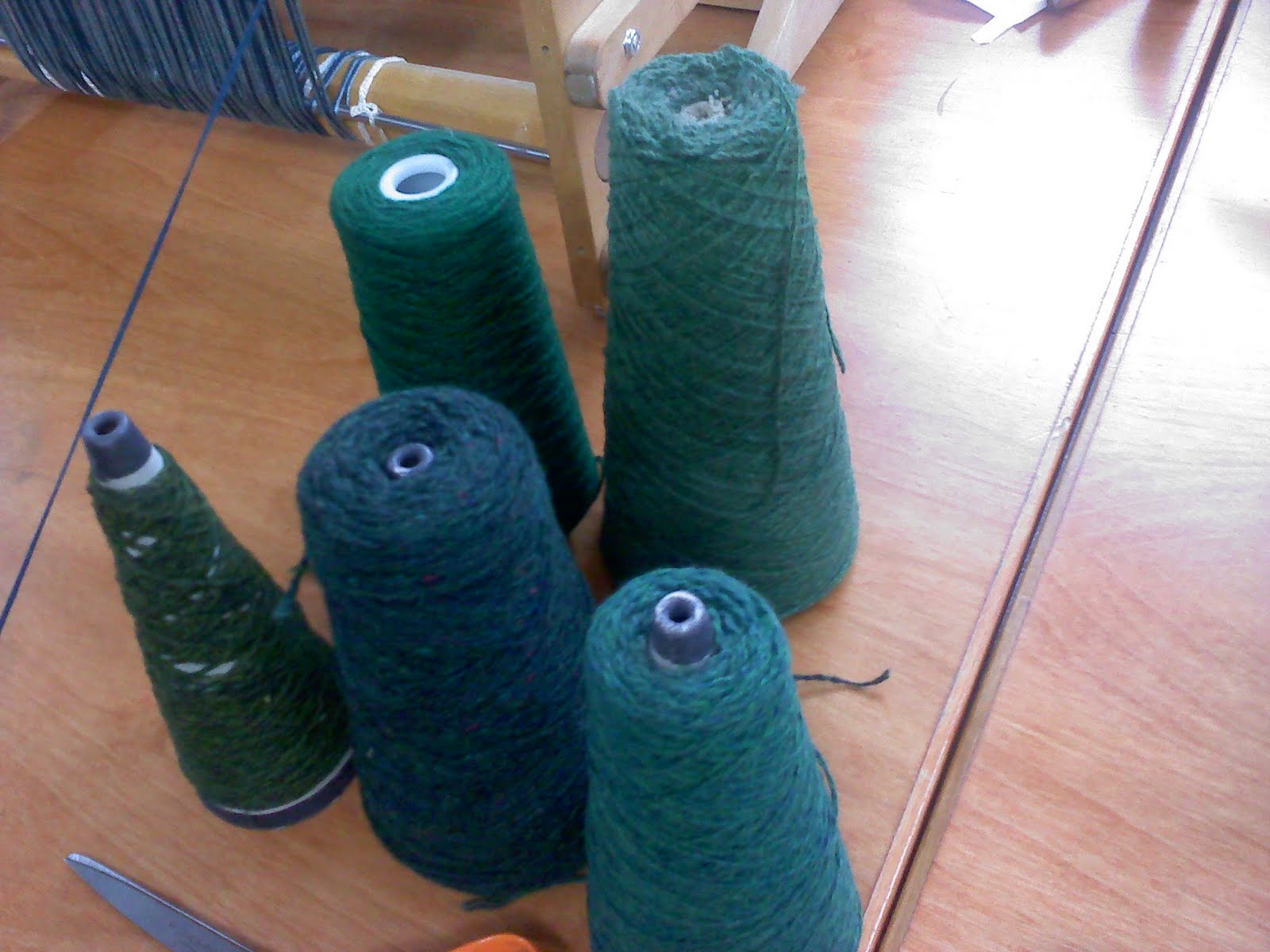
This shows the rest of the greens and the aquas that I used. At this point, I’m starting to actually run out of warp, which I didn’t think would happen. I’m disappointed to not have more to test the colors on, actually.
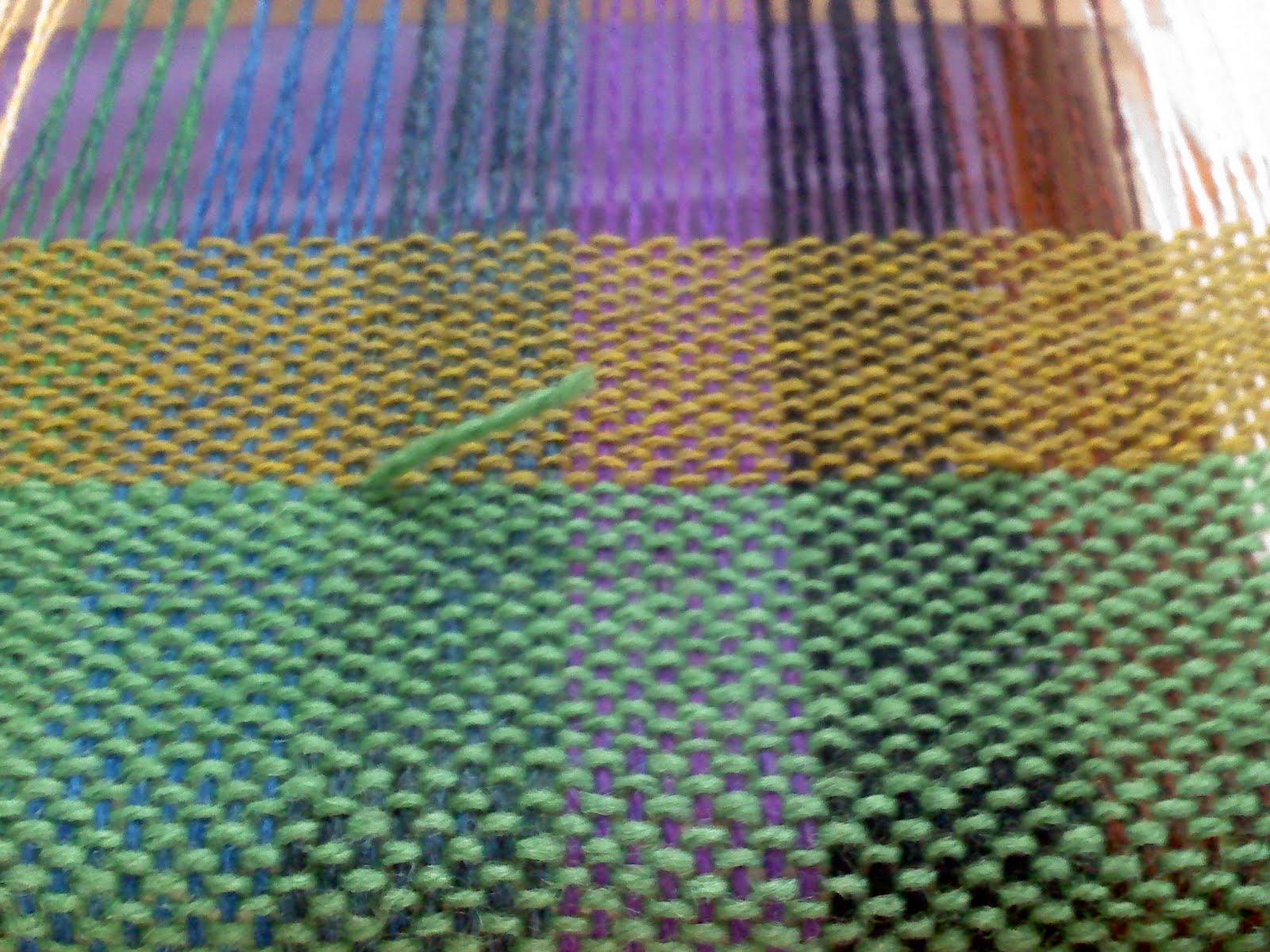
Here is a close-up of the light green. The little string sticking up is actually woven into the fabric at the sides when you change colors, then clipped at the end of the process. I started clipping once they wove in, so I didn’t have as much to do when I pulled the fabric off the loom, which is something I’ll continue to do.

Here is the finished product, with the exception of actually coming off the loom. It shows all the way through the indigo; I didn’t have enough room to work through the purple/violet tones of the spectrum. You can see how different each of the stripes looks as it progresses through the spectrum on the warp; this is a good exercise in seeing how colors interact in fabric. They do so quite differently than when knitting.
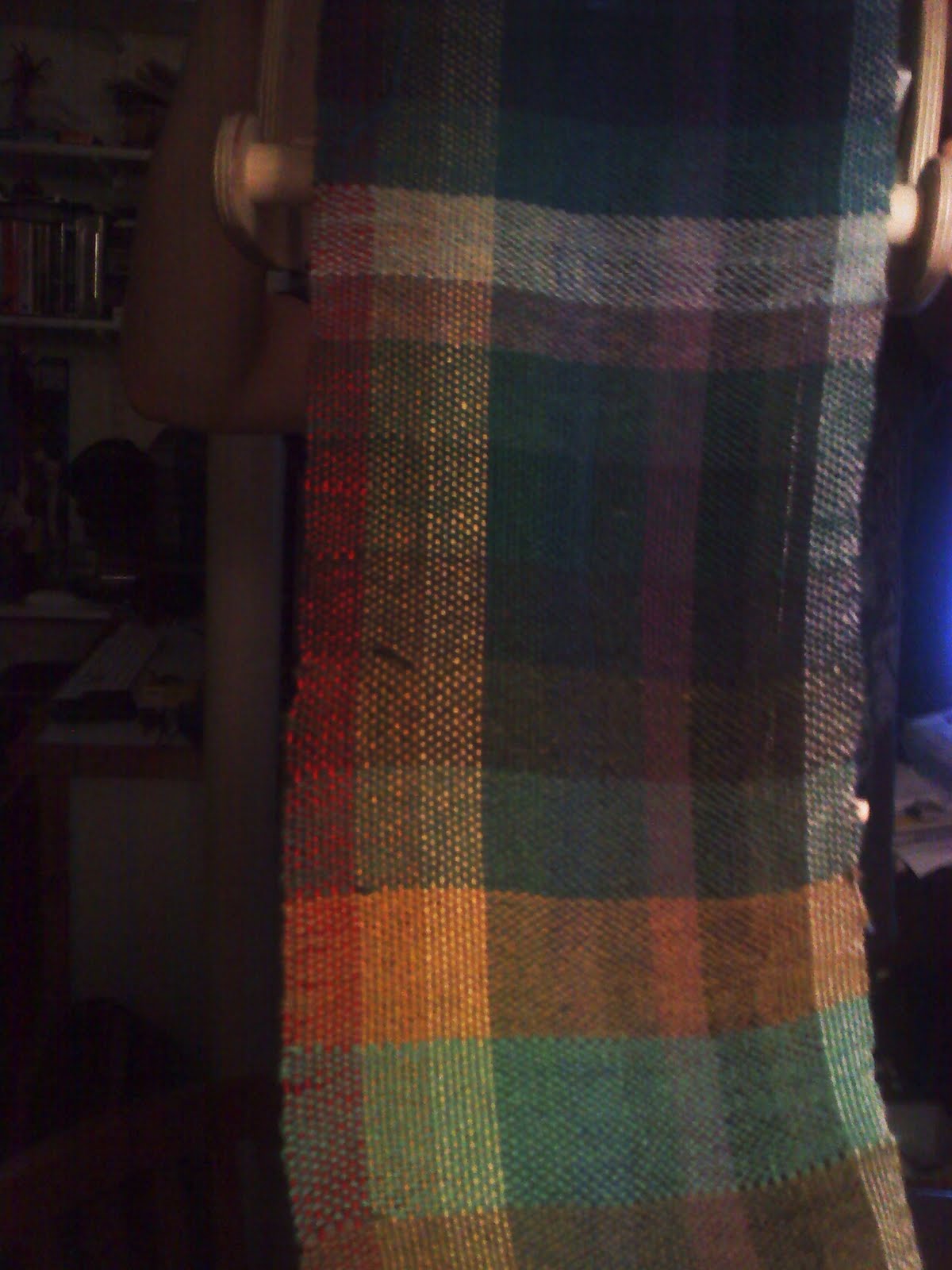
Here is another view of the same segment of fabric. In this view, it seems much more plaid-like. There are some interactions that I didn’t expect to like but really do, including the red and green and the center sections.
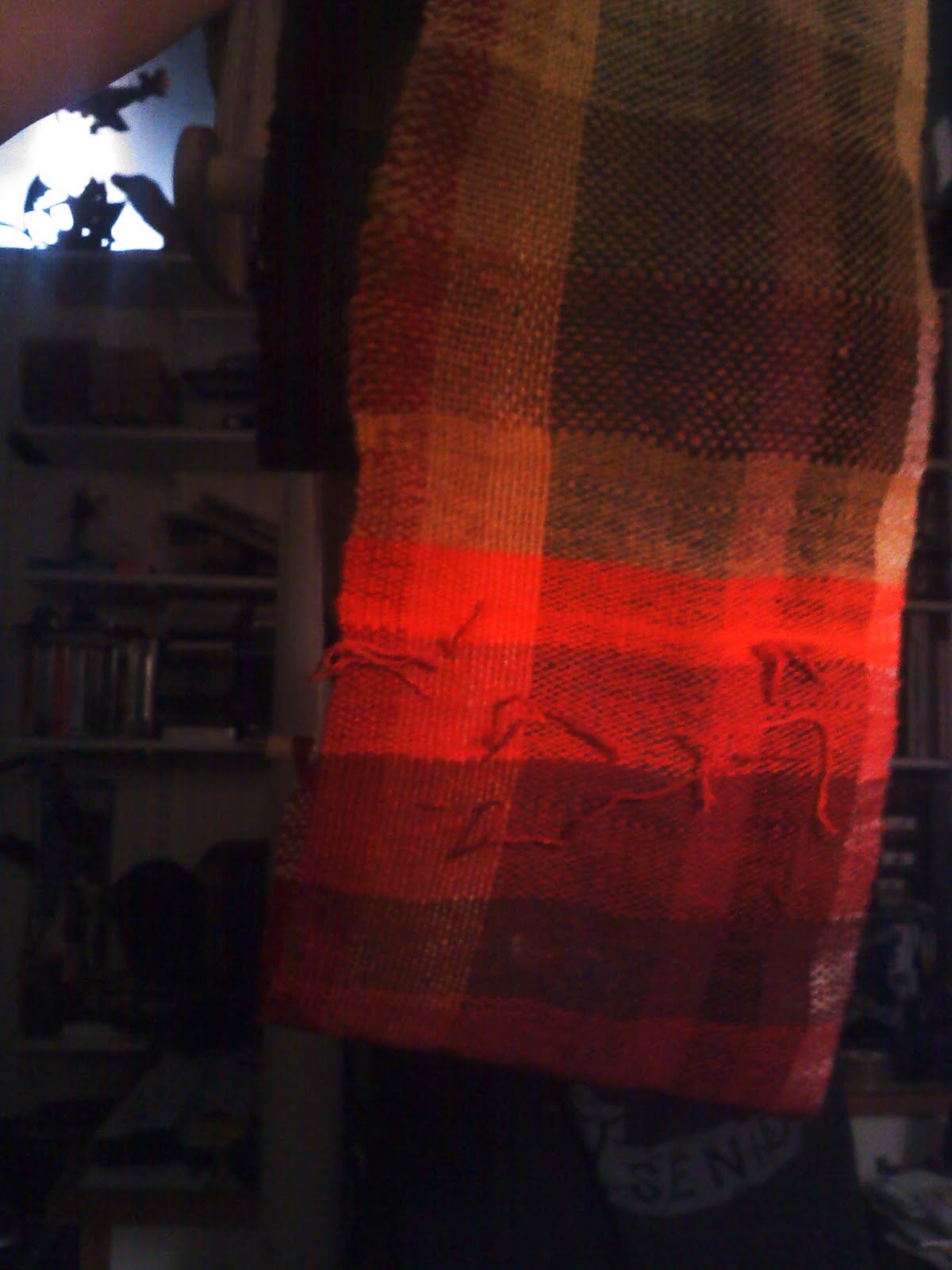
You can see a couple things in this image. One is how many threads there are when you don’t clip as you go – which is why I decided to do so. The other is how really bright that one band of orange is. Part of that is because the acrylic fiber is much brighter in tone than the wool, and the strand was a lot looser so when I packed it, it packed very tightly and ended up letting the weft dominate in that segment.
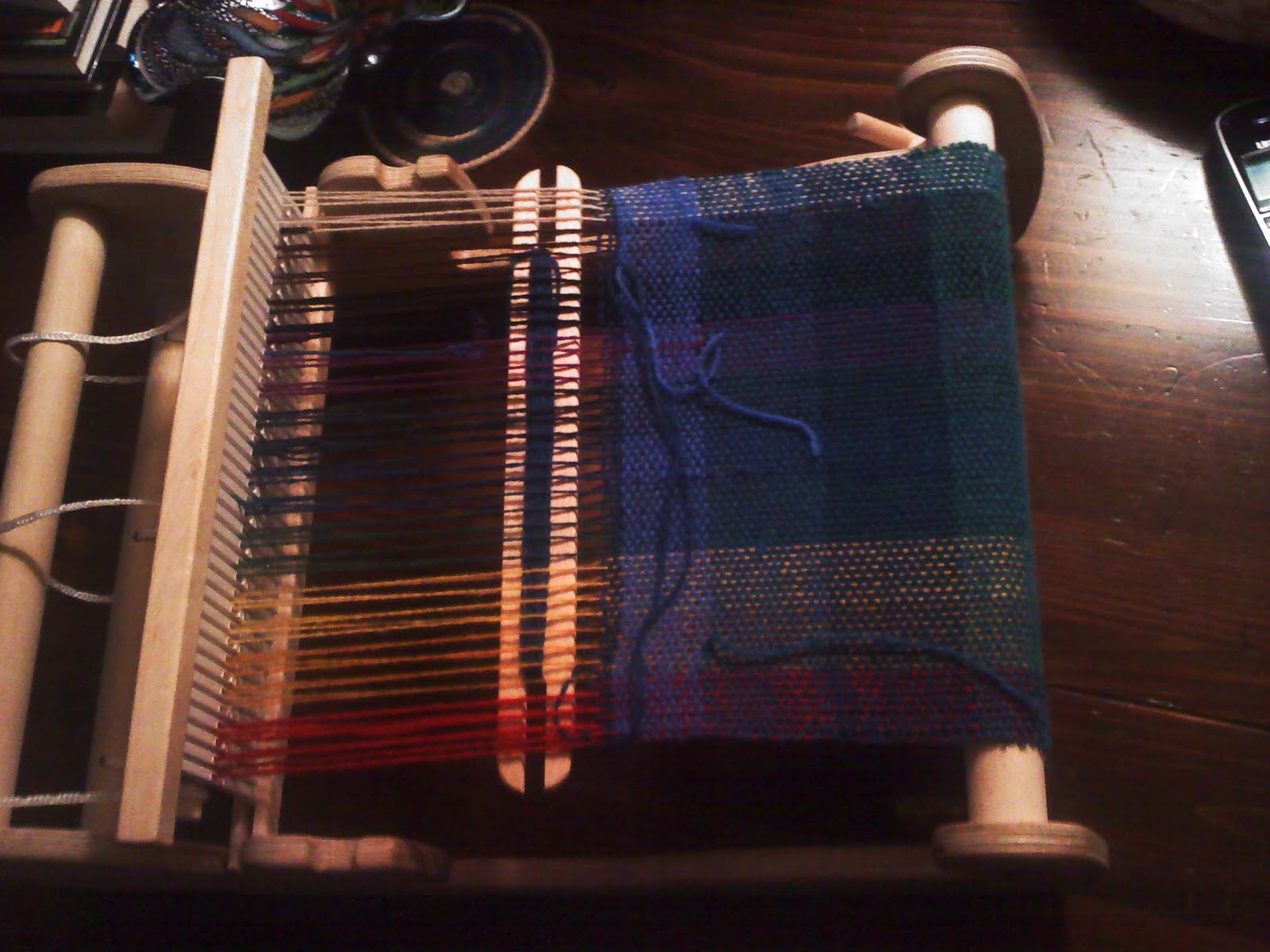
This is the final piece, all wound back on, ready to go back to class to take the fabric off the loom. I ended with a clear royal blue, since I couldn’t get all the way into the violets. Not a bad day’s work – well, really, four days’ work!
Weaving, June 17th
Back to the workshop! June 17th was my third session at the Chicago Weaving School. I made some good headway with my weaving, though I had some trouble getting the beating consistent. Stress really made a difference in how I interacted with the fabric, which I found interesting.

In this view, you can see in the bottom left corner of the image how the same color in the weft as in the warp comes out in the fabric. Remember that the warp are the threads that are tied onto the loom, and the warp are the threads the weaver passes back and forth. (Warp = vertical, weft = horizontal.)
For the detail-oriented, there is a stripe in the bottom third where I forgot to more the heddle and there are two weft rows right next to each other, making a wider stripe of color than usual.
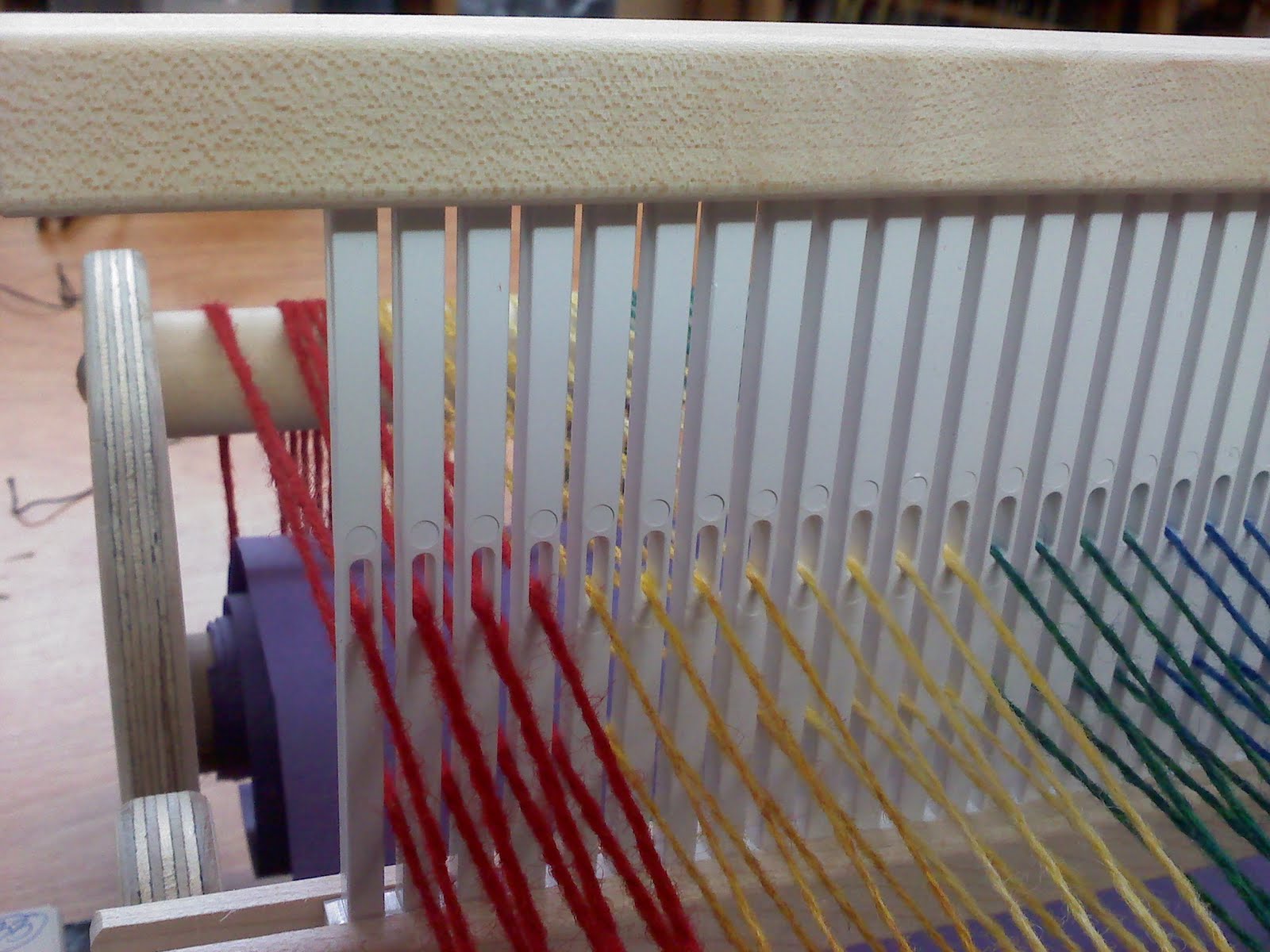
Here is a close-up of the heddle with the warp passing through. The purple paper wrapping around the back beam keeps the threads from tangling up with each other. As you can see, the last red thread is falling off the edge of it; we found that with this loom, it’s better to not go all the way to the horizontal edge when weaving because that seems to happen.
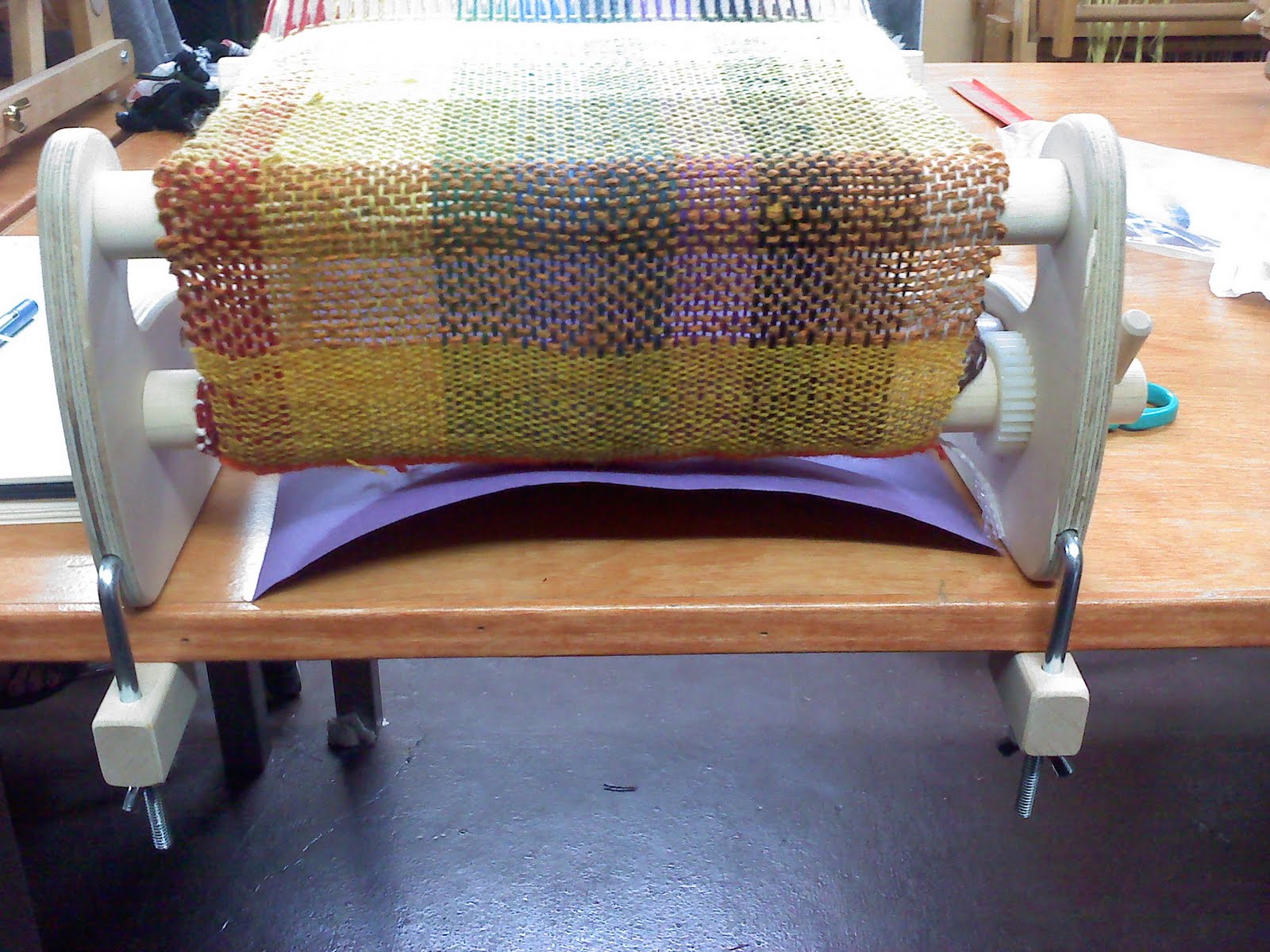
Here is a front view of the loom with the fabric; there’s quite a bit finished already. The two clamps hold the loom to the table – which, having forgotten them the next lesson, I have decided are very necessary. It keeps the loom from jumping back and forth.
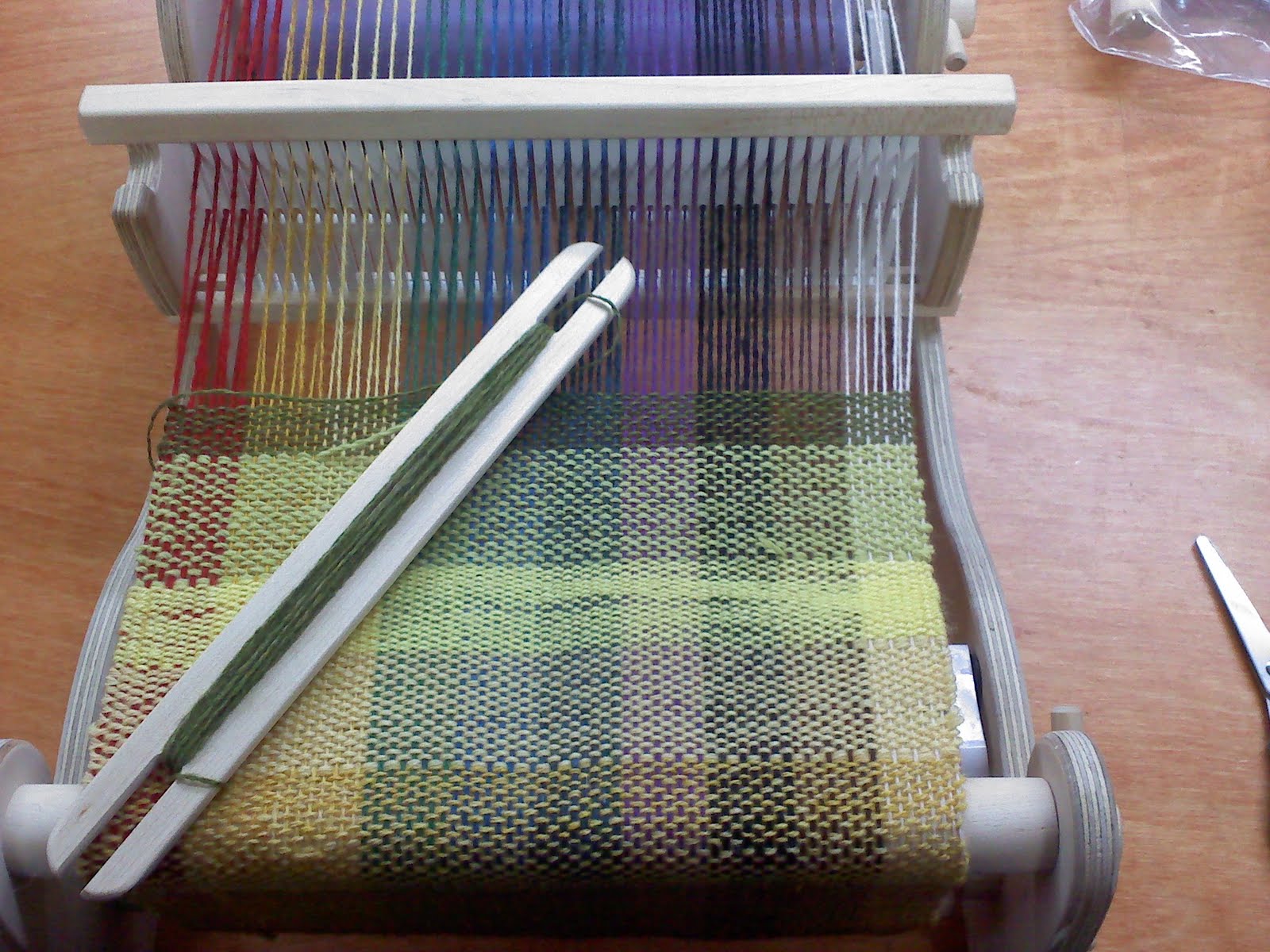
Here is the weaving with thread already on the spool for the weft; we’ve progressed up to green tones at this point.
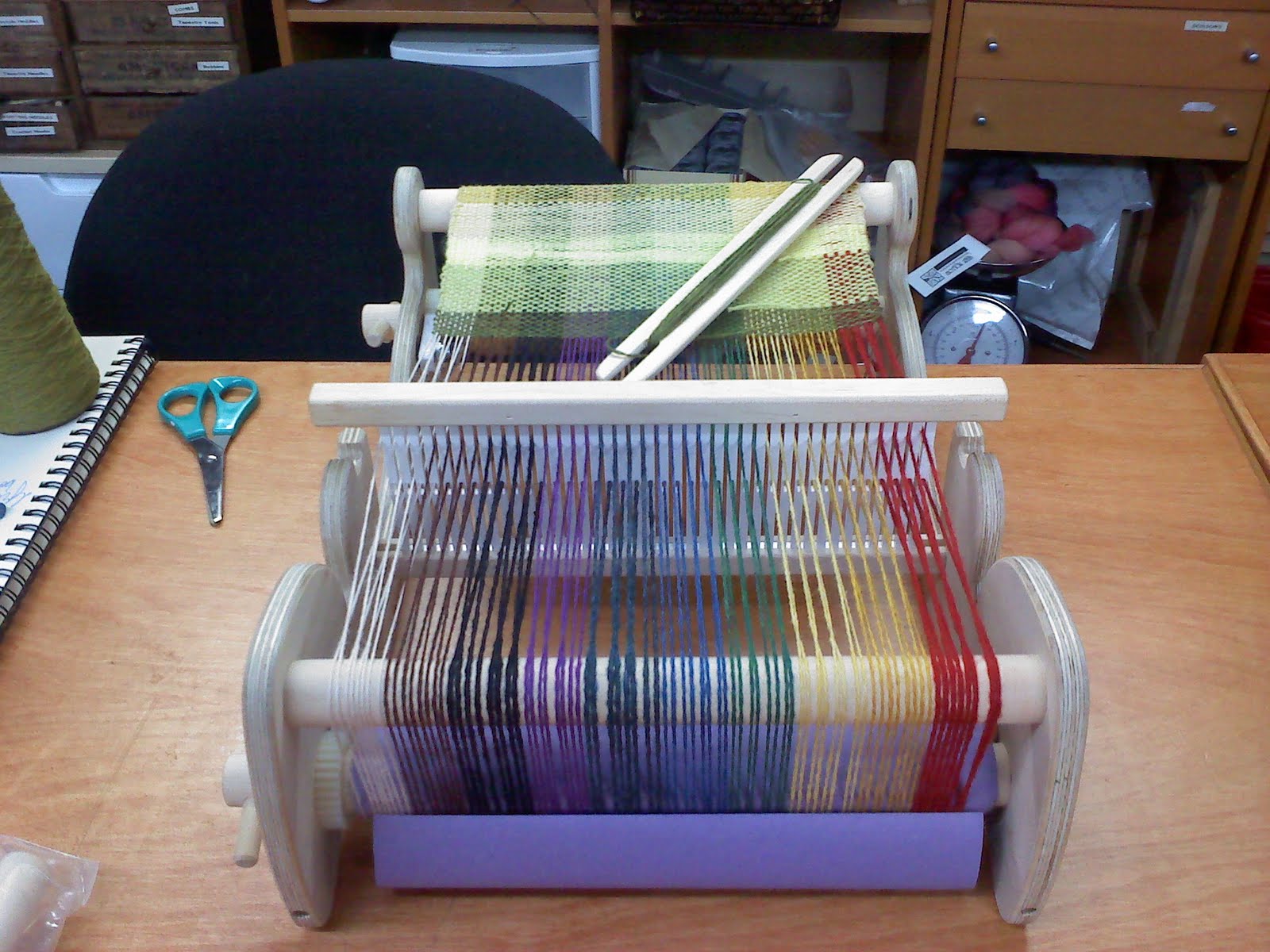
Same view, but from the back of the loom instead. There is a cone of thread in the extreme left of the image, along with my notebook tracking which colors I used in the piece.
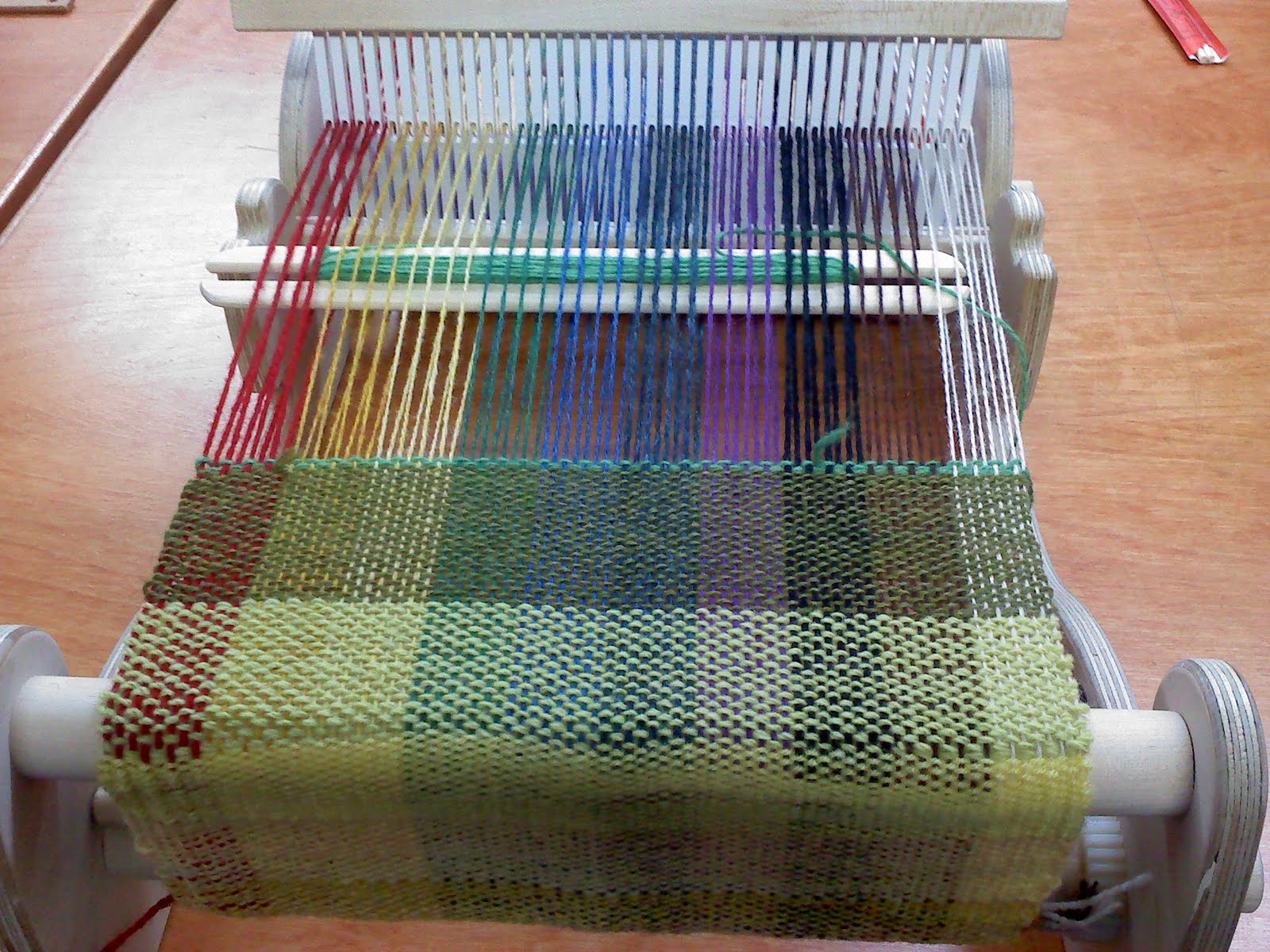
More of the green, this time with the heddle in neutral position for traveling. When the heddle is in the neutral position, it lays the threads on top of each other. If you set the spool inside the shed before you do that, then it closes over it to allow it to stay in place.
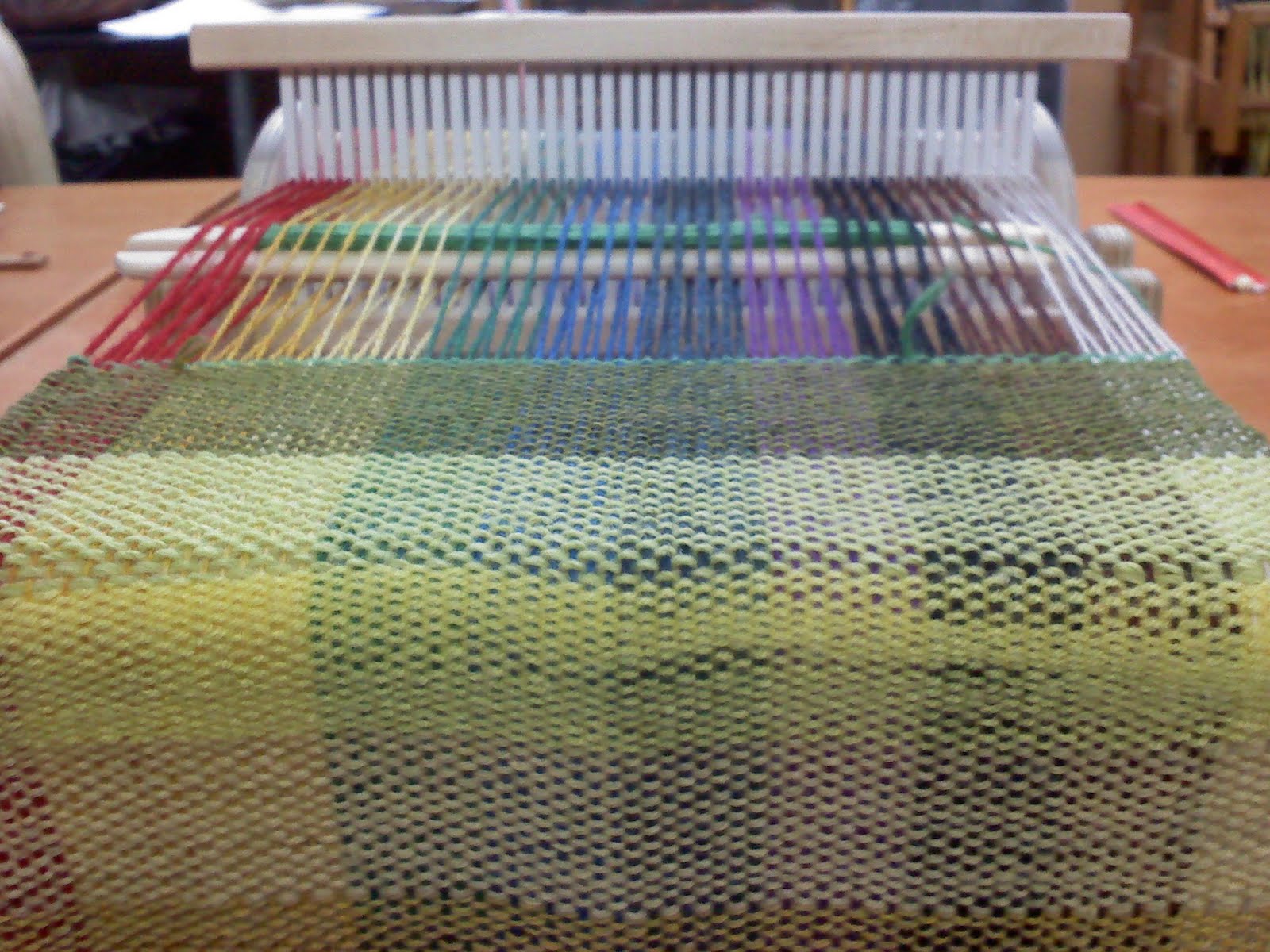
Another shot, this time horizontally across the top of the warp, showing the heddle in neutral position. You can see the unevenness I mentioned in the yellow section right in front of the camera; it’s rather wavy here. The edges also waver in and out from this day’s weaving.
Weaving Update
As I’ve discussed in prior posts on weaving, I’ve been working on learning the Cricket loom, a rigid heddle loom. I have successfully taken the fabric off the loom and it is now a table runner in my dining room! It’s exciting. It turns out that weaving is only part of the tale…
Once one is finished weaving, the finishing process is critical to the success of the fabric. My instructor says that an unfinished weaving is like an unbaked cake. You can finish by pressing or washing (or both); we finished mine by steaming it with an iron but not pressing it flat (in order to not crush the weave).
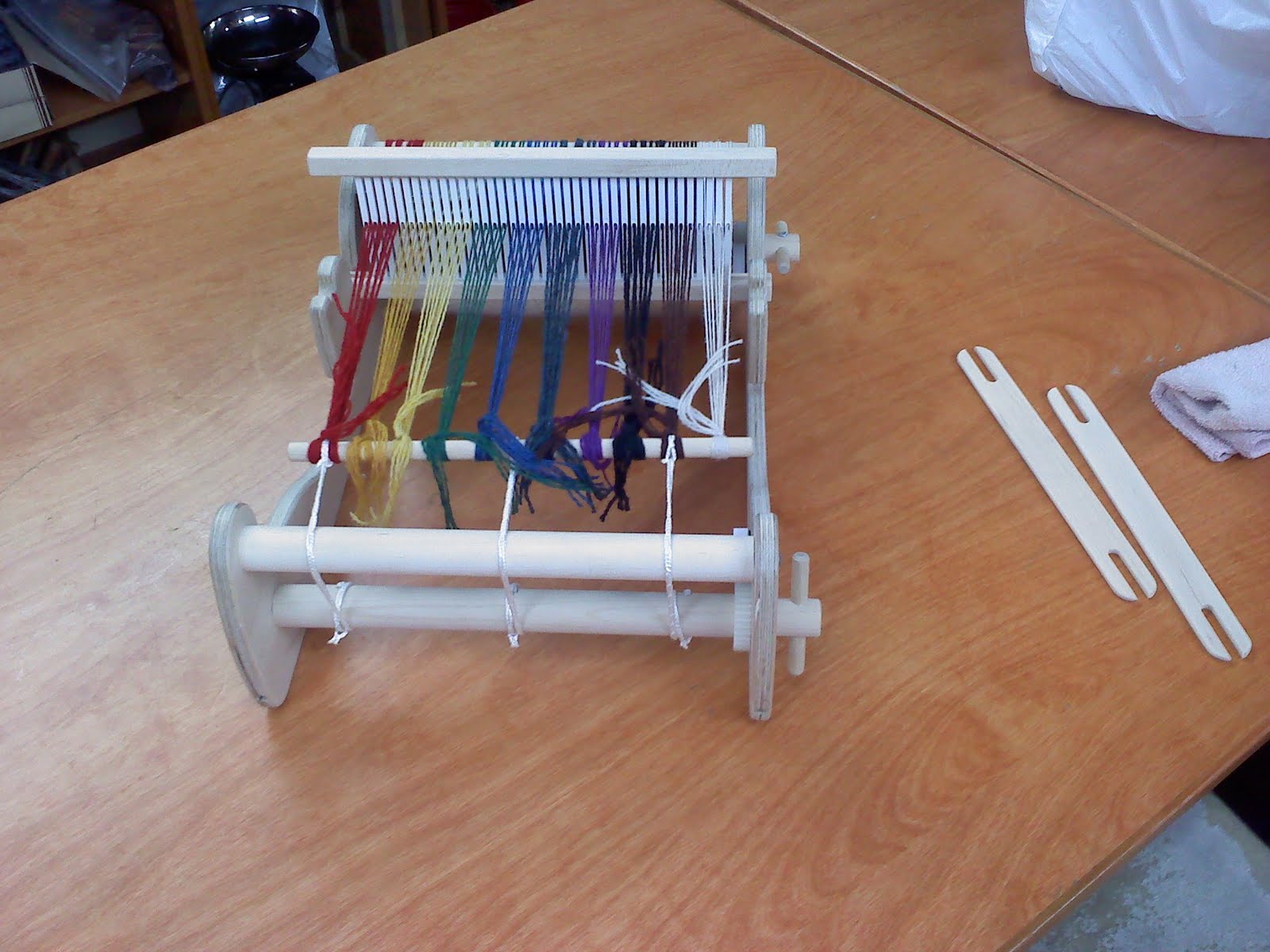
This is a picture of the front of the loom, with the breast beam. The threads are tied on now, and are prepared for weaving the ‘header.’ This is a part of the weaving that will not be used in the final fabric, and will pull the warp threads into alignment.
The flat plastic grid that the threads are pulled through is called the heddle. In this loom, which is a rigid heddle loom, the heddle is moved by hand up and down. In a four-harness loom, the heddles are controlled by levers and springs (which will make more sense when I get some pictures up on that topic, later).
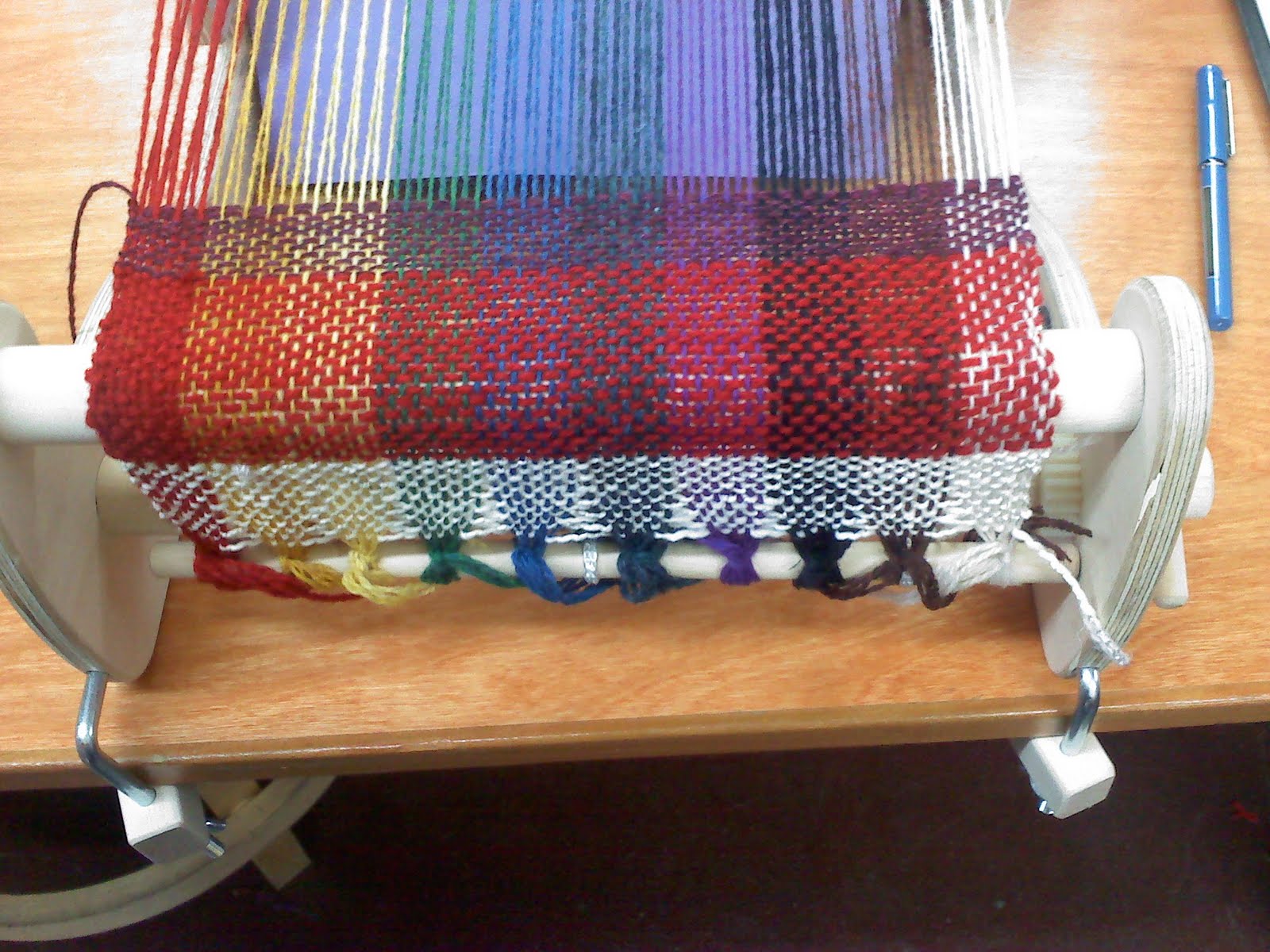
This view shows the header, which is woven in white, and the beginning of the weaving. If you recall, I wove a color ‘gamp,’ which is a sampler piece that shows the properties of the weaving. A color gamp is to show how the colors interact; a texture gamp shows the various types of stitches. I decided to do this one in the colors of the spectrum (red, orange, yellow, green, blue, indigo, and violet), as well as brown, black and white. This would let me see how each of those colors interact with each other.
My instructor suggested I use shades of each of those tones, which is what I did. It made an interesting effect in the weave.
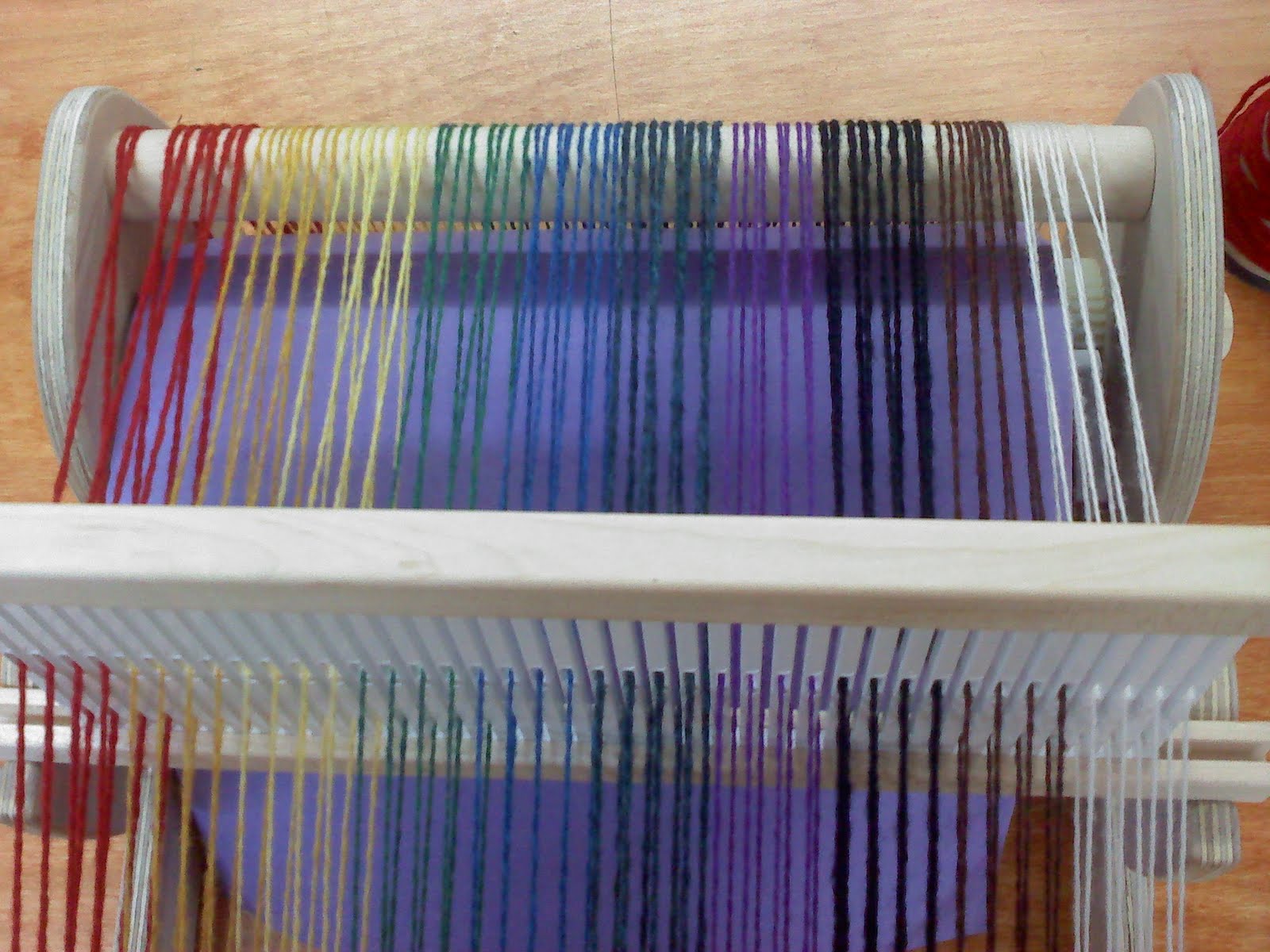
Here is a top view of the warp with the threads coming through the heddle. You can see that there is a hole in the center of the heddle, as well as gaps in between, and one thread comes through each.
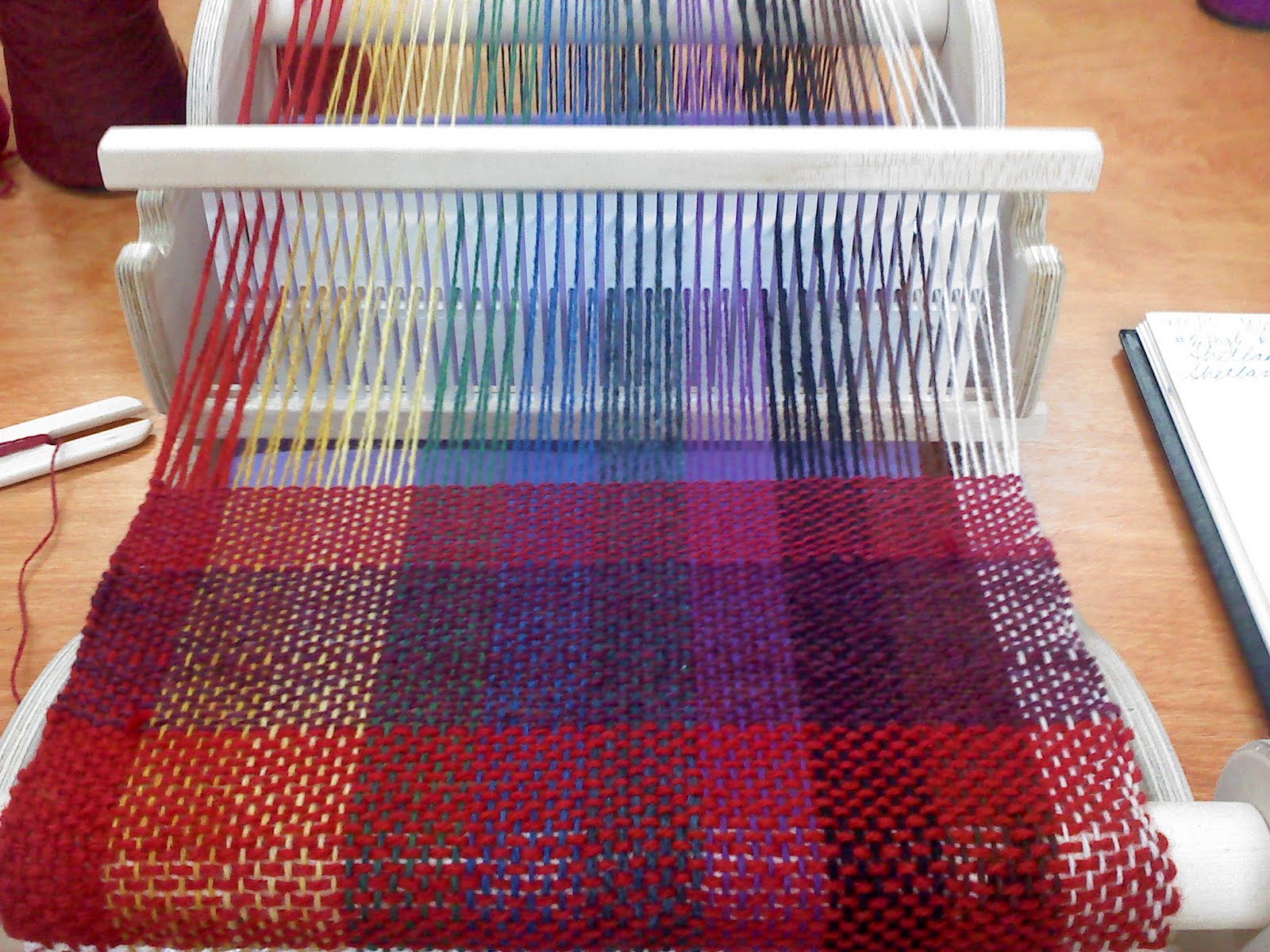
These are the red tones as they’re woven on. I like the plaid effect as they get woven.
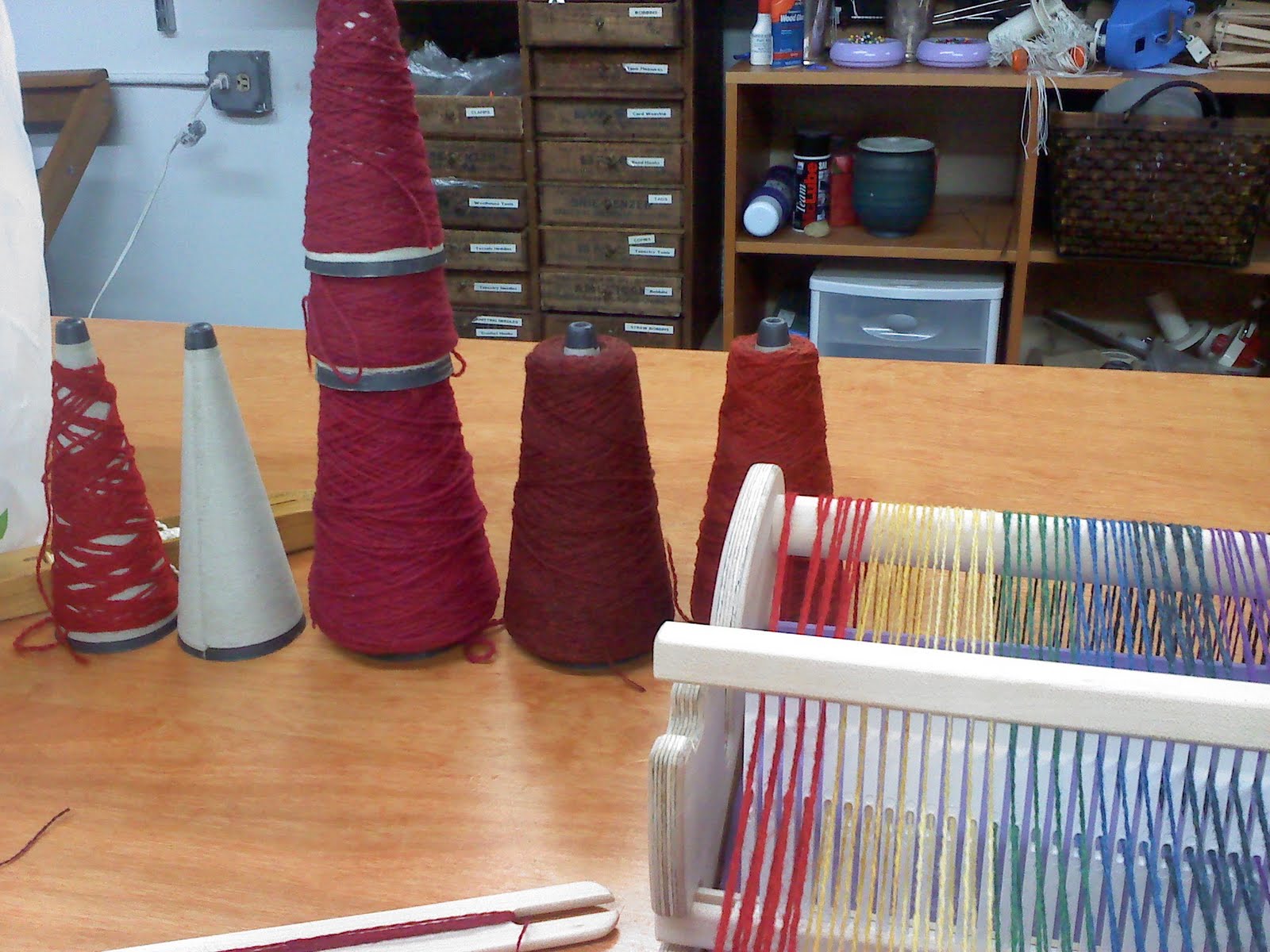
This shows the cones of yarn waiting to be used. My gamp is made with wool that’s spun especially for weaving. The weight is a good deal lighter than knitting yarn (about a lace weight), and a lot stronger to withstand the repeated beatings it takes when in the warp.
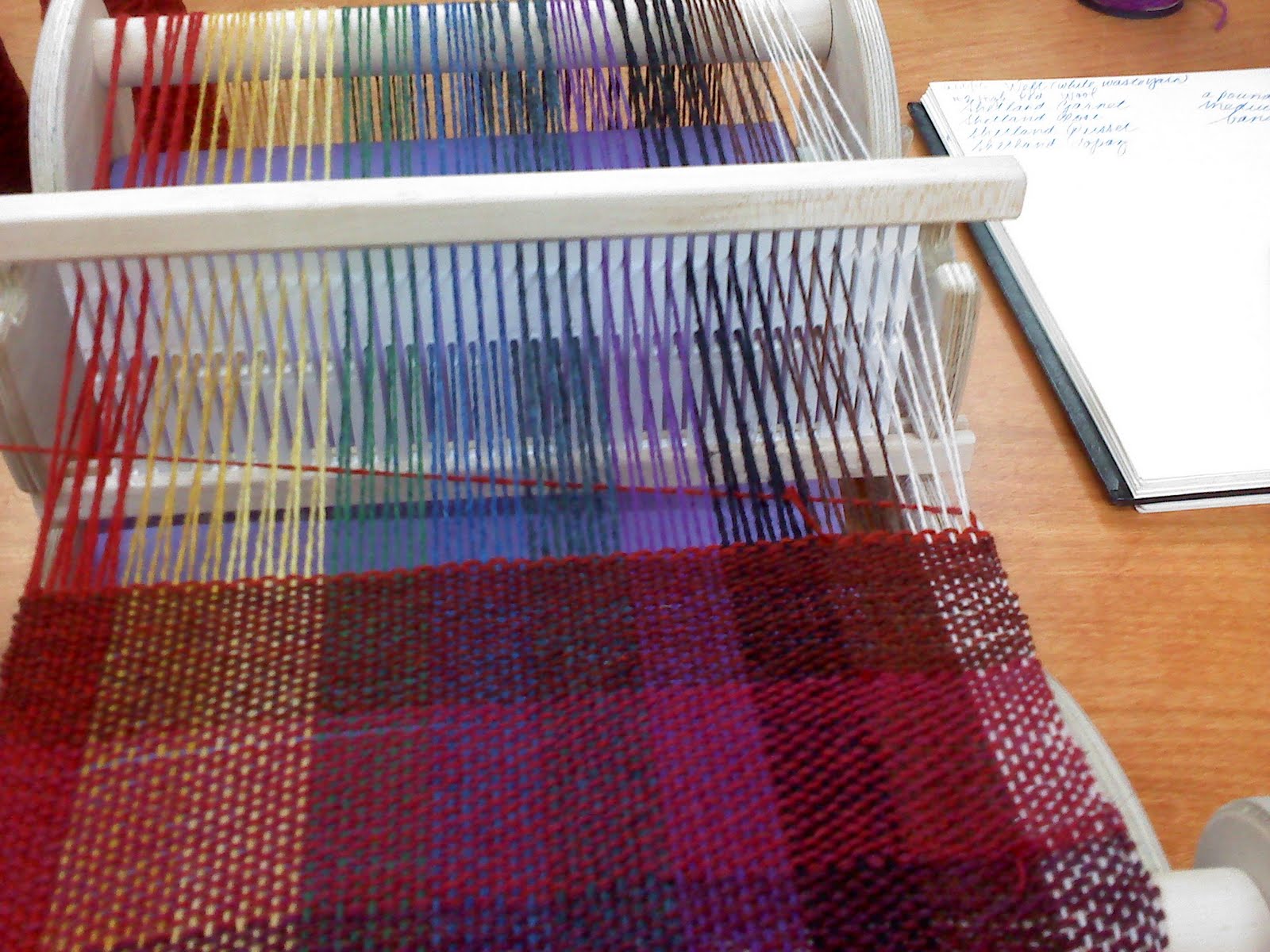
Another view of the red tones, with the warp extending off to the upper left of the photograph.
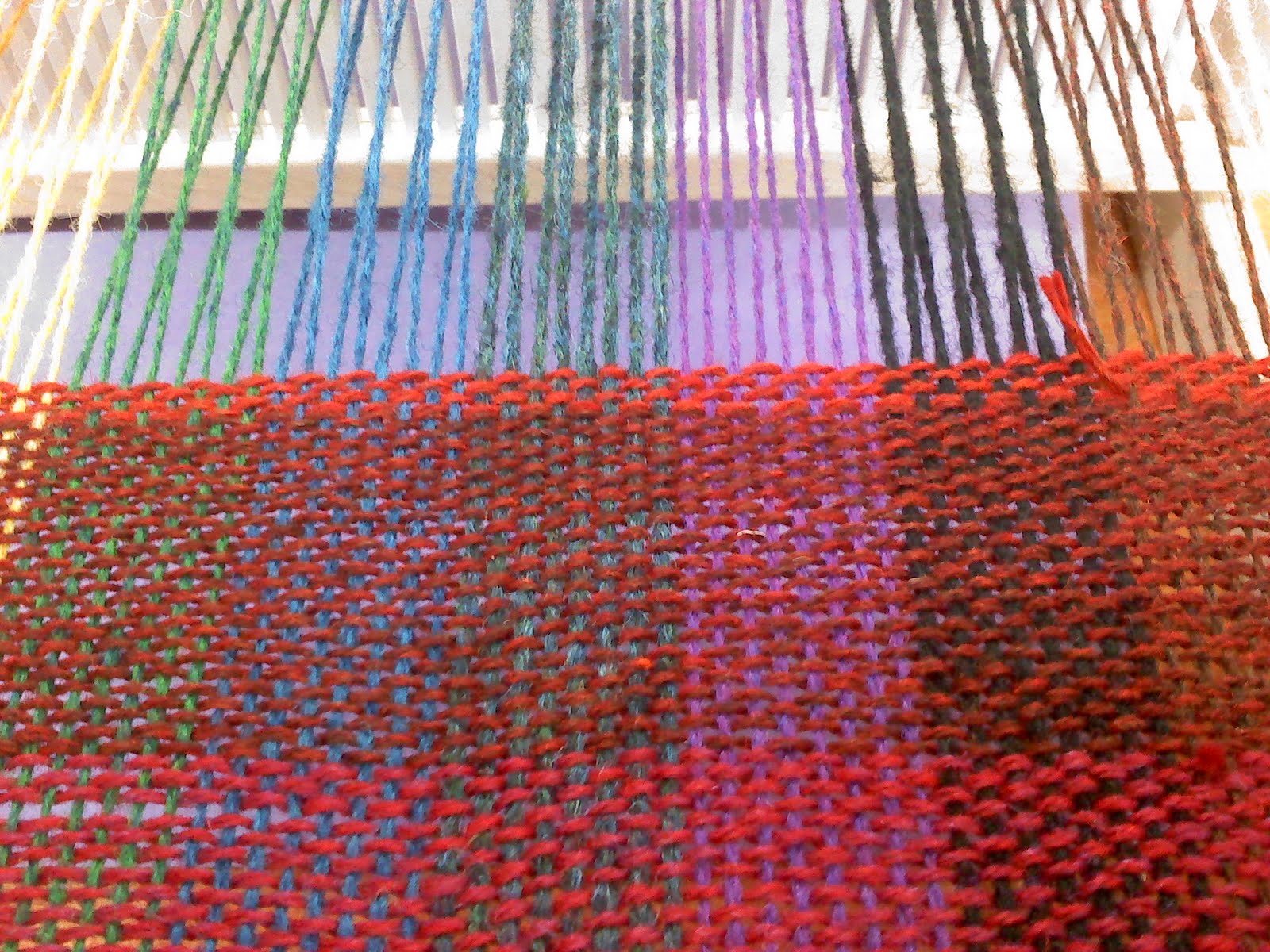
Closeup of starting the orange segment. This is what’s called a ‘plain weave,’ which is where every other thread of the warp is lifted and the weft is passed through. Other patterns can be made by moving the warp differently, but those patterns are easier on a harness loom because the heddles can be controlled more precisely.
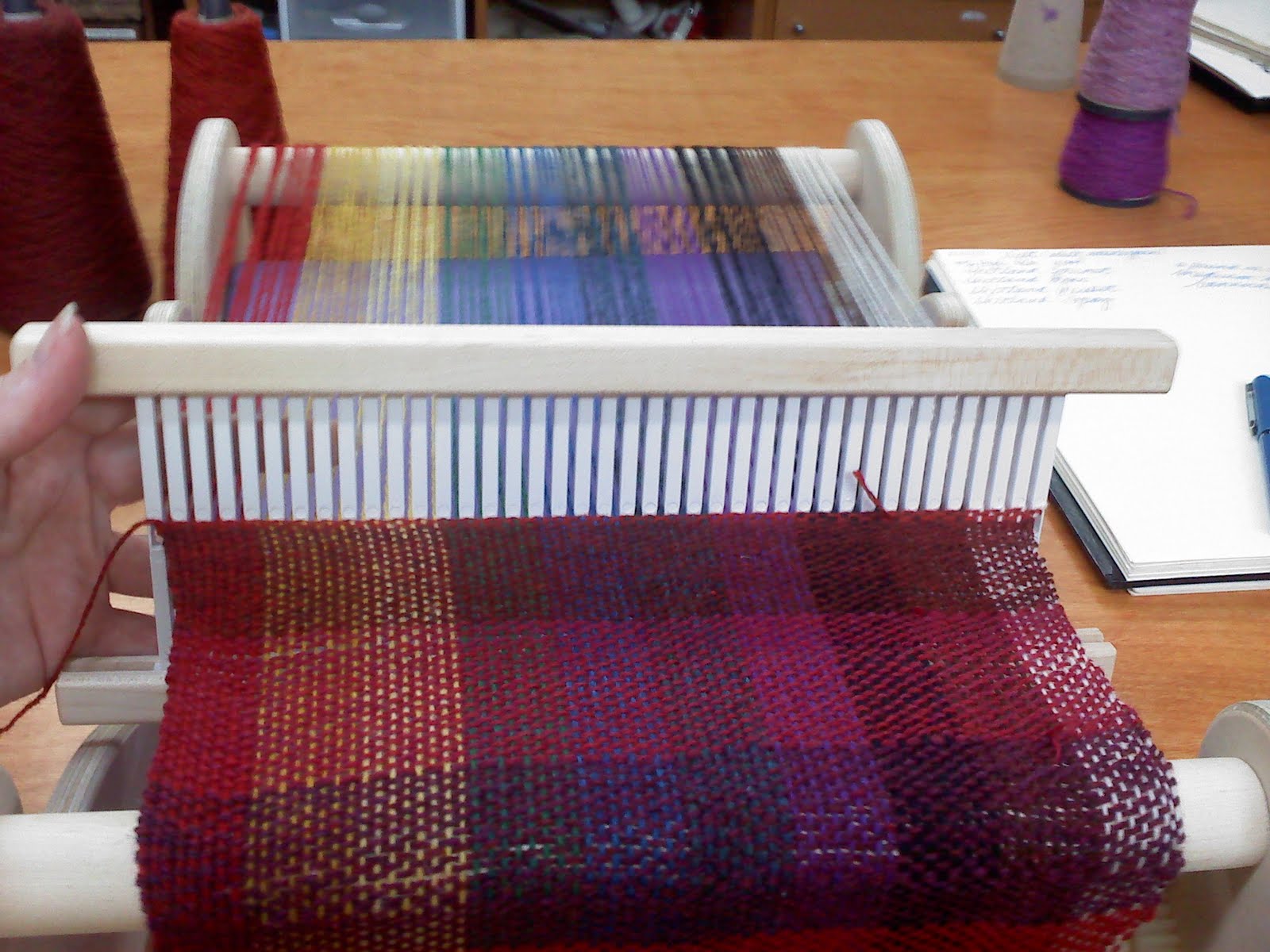
This is another view of the weaving, where the heddle is brought toward the weaver to ‘beat’ the threads into the warp. It’s a meditative, repetitive action: pass, beat, pass, beat. Depending on how hard the weaver beats the fabric, it will change the density of the weaving (which we’ll see later on when I switched to a different fiber and ended up with a weft-dominated band).
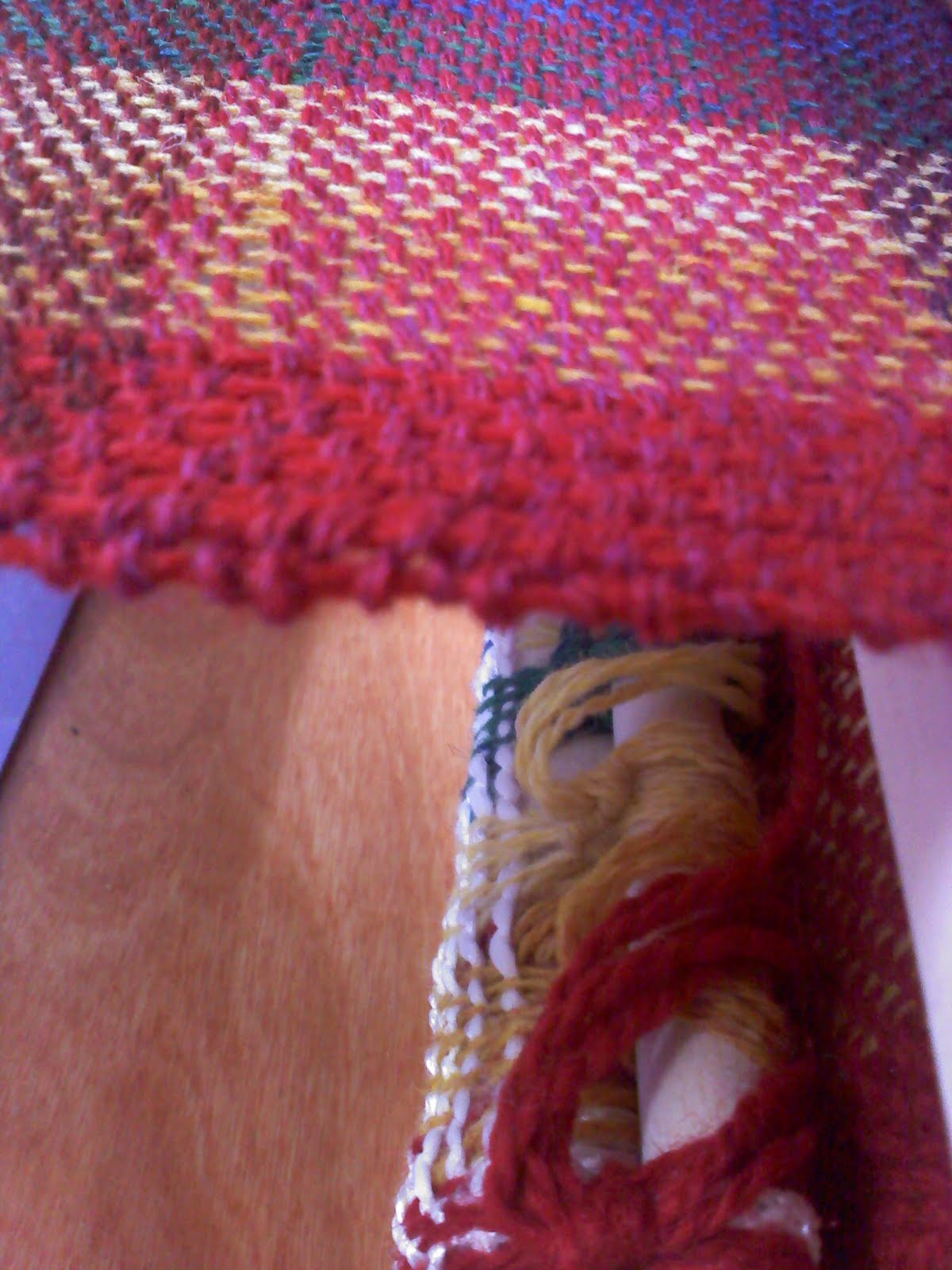
A close-up of the selvege. The goal in weaving is to get a very neat edge, which I found is a lot harder than it sounds. It’s composed of how you beat the fibers in, which can vary based on the mood of the weaver (and it’s interesting to see the differences from class session to session).

As you can see from the very bright orange band, above, the switch in fiber meant that when I beat it into the weaving, it REALLY packed down. That stripe is VERY orange.
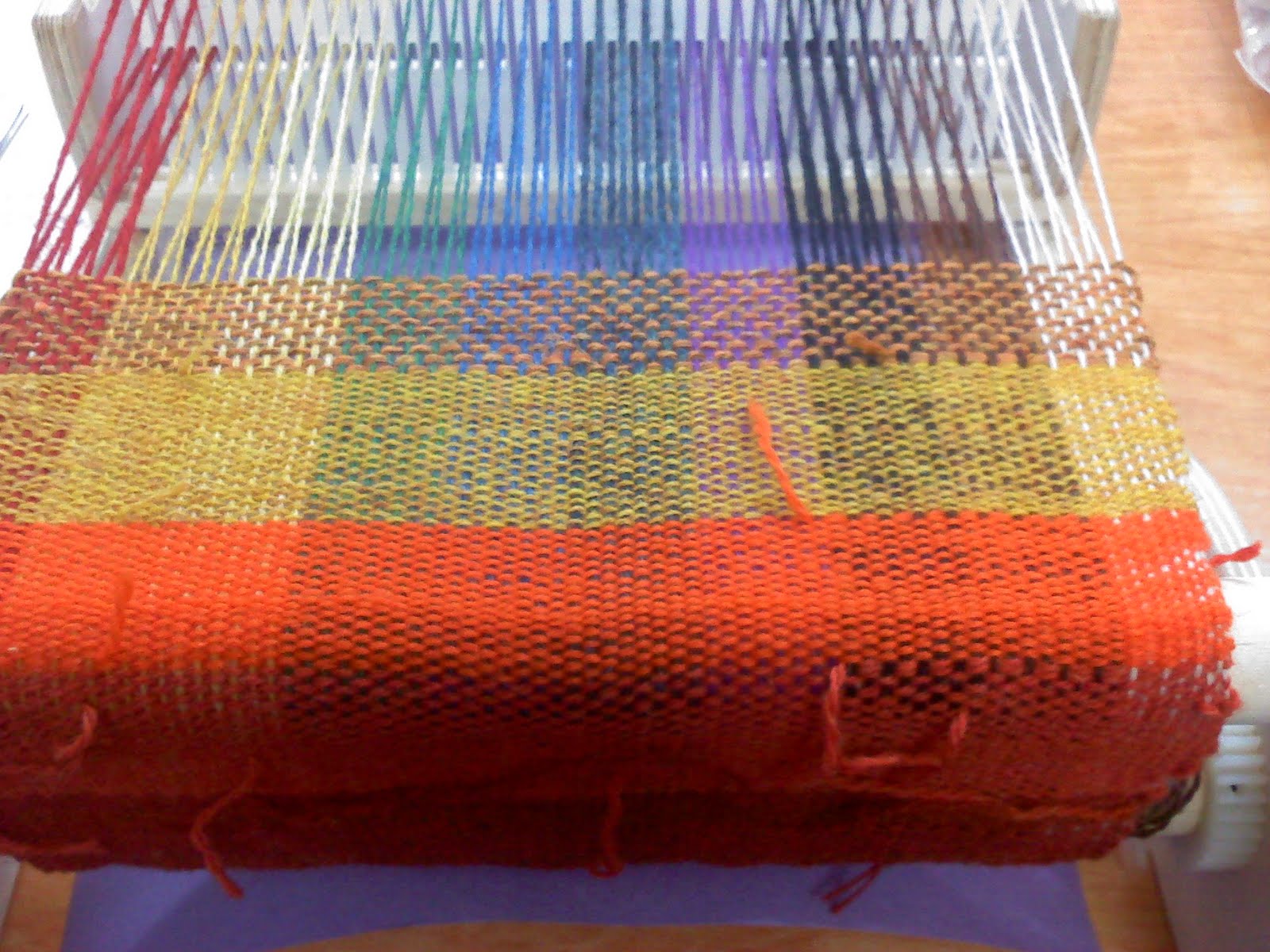
Now we are moving into the yellows. I like the rust tones in this section.
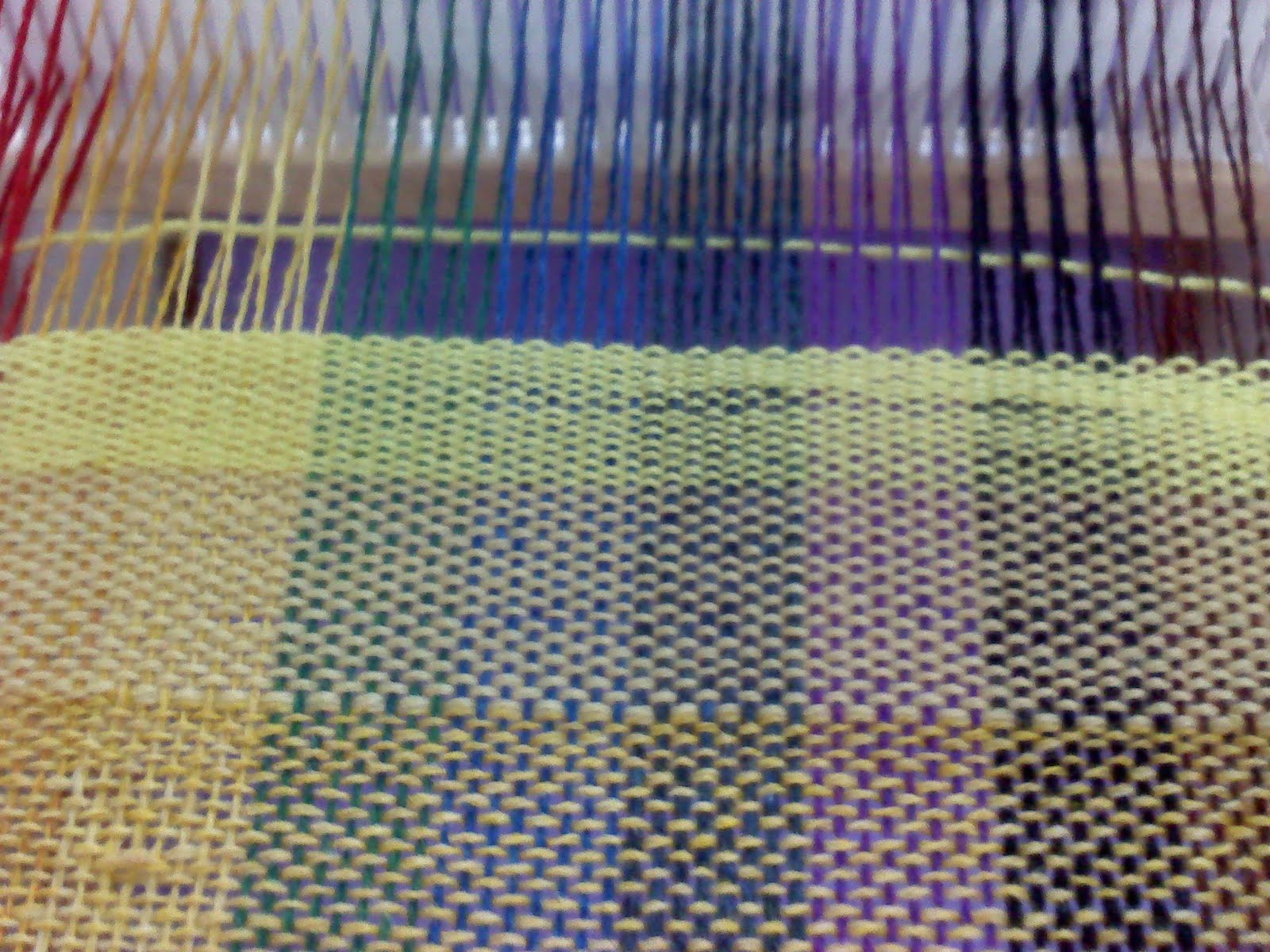
Interesting how the whole tone of the piece is changed in just a few stripes. This section is much cooler and softer, because of the change in the color. Again, you can see how much closer the current segment beats into the fabric, resulting in a more weft-dominated band.