
Tag: Noon and Wilder

  • Q Is For… Quotes!

    Q Is For… Quotes!

    \"2015-04-20

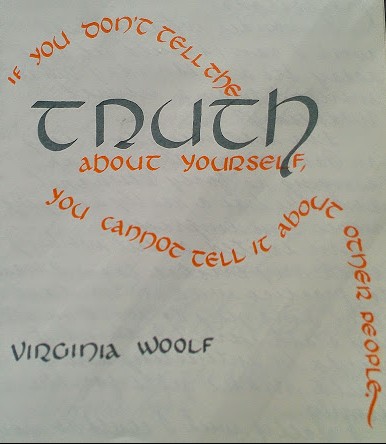
    I love quotes.  I have several quote dictionaries on my shelf, on subjects ranging from leadership to inspirational to a treasure trove for public speakers.  On Twitter, one of the popular hashtags is #quotes, and people from around the globe share things that inspire them.  There are many online resources, including BrainyQuote and Bartleby.  As a calligrapher, I like quotes to use as the genesis of an art piece.

    \"Calligraphy

    What about you, Dear Reader?
    What are some of your favorite quotes?

  • Q Is For… Quilling!

    Q Is For… Quilling!

    \"2015-04-20

    One art I\’d like to try someday is quilling.  This is an art that uses small strips of paper, wound to various tightness, to create a three-dimensional art.  When I was a child, I remember seeing ones that were usually monochromatic, usually white.  I don\’t know if that\’s because it was in vogue at the time or if that particular area of California just had artists that liked working in plain colors; but when I did some research for my post, I found some amazing, inspiring images.  Take a look.

    \"2015-04-20

    I love how simple this star is, and how it cycles through the colors of the rainbow.

    \"2015-04-20

    I love peacocks!  This one is incredible – look at the level of detail!  The height of the pieces differs depending on whether it\’s the branch or the bird, too.  Such complexity!

    I found a detailed YouTube channel that has classes in quilling for free, here.  You can see all the different kinds of designs possible and maybe get inspired to try it yourself!

    What about you, Dear Reader?
    What art calls to you, that you haven\’t tried yet?

  • P Is For… Physics!

    P Is For… Physics!

    \"2015-04-18
    The first time I realized I loved physics, and not just astronomy, was in a class in high school. The teacher was a ball – he taught photography, as well as physics, and had a bowling ball hanging from a chain over the counter in the front of the class. He would have a student sit up on the counter and bring the ball up to their nose and let it go – a living example of pendulum theory, but of course we all thought there\’d be a bloody nose involved. There wasn\’t, of course, and I was hooked.

    Then he explained that a heat coil on the back of a refrigerator is how the fridge stays cold, and I thought, this isn\’t physics, it\’s magic!

    \”Any sufficiently advanced technology is indistinguishable from magic.\”
    -Arthur C. Clarke, British author, scientist, and natural philosopher

    What about you, Dear Reader?
    Which of the sciences intrigue you? Physics, Chemistry, Biology, what?

  • P Is For… Pysanky!

    P Is For… Pysanky!

    \"img_0009_01\"

    I adore pysanky.  I talked about the legend about them on my main blog a couple weeks ago, here.  Today, I wanted to talk more about the craft of making them, since Knoontime Knitting is about the crafts.  I was first introduced to the art of pysanky, or Ukrainian decorated eggs, when I moved to Chicago back in 1998.  The art, however, has a history stretching back 5,000 years.  The tools are reminiscent of Bronze Age technology:  the kistka, which is used to draw on the egg with melted wax, is a simple metal funnel attached to a stick with wire.  The wax is typically beeswax.   The egg…

    Well, we all know where eggs come from.

    But which came first, the chicken or…

    Come on, I couldn\’t help myself.  ANYway, pysanky is a slow process, because you draw the designs on the egg, then put it in a dye bath, then draw some more, then dye, until the design is finished.  You\’re not done there, however.  You then melt the wax from the egg, using either a candle and paper towel or a melting board and an oven.  I\’ve only used the candle method, though I\’m curious to try the oven method one of these days.

    The designs themselves have ancient history too.  The design above, for example, represents bear claws.  The colors represent the mother goddess.  The red is actually supposed to be solid, but I like how the wax didn\’t quite cover it all the way and there are flecks of black in it.

    That\’s what pysanky teaches you:  no matter how painstakingly you work, the pysanka always has the last word.  Part of the art is about acceptance, and another is about patience.

    What about you, Dear Reader?
    What have your hobbies taught you?

  • O Is For… Ojos de Dios!

    O Is For… Ojos de Dios!

    \"20150413_0013\"

    Ojos de Dios is translated from the Spanish as, \”Eyes of God.\”  First worked by the coastal South American indigenous peoples the Huichol, they are a  combination between a prayer, hope, and protection.  They became popular in the States during the 1970\’s during the resurgence of the Arts and Crafts revival.  As a Wiccan, I see them as a lovely way to intentionalize my craft and to make something tangible out of a wish.

    This one was made from a continuous yarn and woven with differing weaves (which is why you can see the dowel in the center at different points on the diamond).  I bought the dowel at the hardware store, sanded it, and then painted a combination stain and varnish on it to darken it and preserve the wood.  Tip:  if you decide to do that, let the finished wood sit for at least a week so the fumes dissipate and any stickiness is gone.  It was pretty pungent to work on the next day.

    What about you, Dear Reader?
    For what would you make an ojo?  New job? Writing project? Love?


  • O Is For… Outdoors!

    \"\"

    The outdoors. It calls to us, if we let it.  It wasn\’t until I moved to Chicago and met people who had been raised their entire lives in a metropolis, (Chicago is the third-largest city in the United States), that I realized not everyone feels the call the way I do.

    When I was young and living with a mentally-ill mother, one of the common escapes for me was to go hiking into the mountains behind our ranch.  It backed up to a thirty-acre cow pasture, but beyond that, it was just National Forest – no houses for, literally, miles.  Since my mother disapproved of my writing, I hid my papers and pen under my shirt and took off with my dog to go walking.

    At the time, I only knew I was escaping.  Now, at a couple decades\’ remove, I realize that I was also communing with nature and finding peace in what was a very dangerous and unpeaceful situation.  Many spiritual traditions talk of the silence one gets in touch with when one walks, and I find that silence is accessible as much in the city as it is in those faraway mountains of my childhood.

    What about you, Dear Reader?
    Where are your favorite places to walk?

  • N Is For… Needlepoint!

    N Is For… Needlepoint!

    \"20140111_0017\"

    This is one of the earliest pieces I\’ve worked in needlepoint.  It\’s comparatively early in my stitching career, since I did it when I was sixteen to seventeen; it took me about eighteen months in total.  It was, at the time, my most ambitious piece.  Sadly, it was damaged by the recipient when it was removed from the frame and returned to me; however, the fine folks at North Shore Needleworks were able to help me start the repairs (which is why their tape is around the edges, stopping the canvas from unraveling).  It\’s incredibly difficult to age-match colors, let me tell you; but North Shore helped me do so in a way that will look good in the final design.

    This piece is characterized by long floats, where the yarn is brought several inches across the canvas.  This is to simulate the difference in texture between the water, the objects in the picture, and the sky.  Most of the stitching is just satin stitch, which made it a pretty easy piece and certainly something a beginner can work.  It was originally from a kit, though I no longer recall the company\’s name that produced it.  I like it because it reminds me of Coyote Point near San Mateo (it\’s actually in San Mateo County, though not the city itself).

    What about you, Dear Reader?
    What crafts did you do as a child that make you nostalgic?  Or, if you weren\’t into crafting, what places did you visit?

  • N Is For… Needlepoint!

    \"2015-04-16I\’ve got a sister post up at Knoontime Knitting, showing you some of my needlepoint. But since it was one of my first arts, I wanted to share some more thoughts about it.

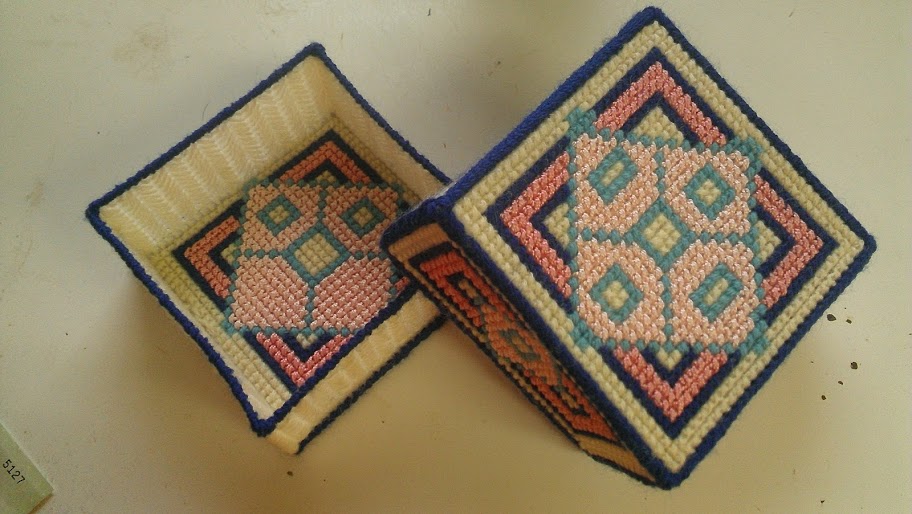
    To get started in needlepoint is a snap.  It\’s a great art to try if you find stitches intimidating.  The basic method is that you color in a grid using single stitches, and \”painting\” a design with the threads.  There are, of course, very fine designs with teeny-tiny stitches; but you can also find nice big grids that aren\’t at all difficult.  There are even stiff plastic grids that you can get and use them to make physical objects like boxes and, yes, really ugly tissue box covers.  🙂

    I love making boxes, actually.  There\’s no reason one has to use ugly, fake-looking, cheap yarn to make a box.  One can just as easily use nice yarn and pleasing designs.  Making small boxes isn\’t difficult, either, which is part of the appeal.  And here\’s a mind-bender:  select a nice overdyed yarn (one of those multi-colored yarns) and you don\’t even have to \”paint\” the design – the yarn does it for you.

    What about you, Dear Reader?
    What would you put in a needlepoint box?

  • M Is For… Macrame!

    M Is For… Macrame!

    \"Project

    Remember macrame? No? I do. It was the go-to fiber art of the early 80\’s. Man, folks made everything from plant hangers, like the one I made above, to wall art, rugs, belts, covers for jugs, jewelry, vests, and anything else they could think of.  You used to find the macrame cording at the craft store, but I haven\’t seen any in a long time.  (If you have a source, please tell me in the comments as I\’d love to make something again.)

    I made two plant hangers and a few other things; the plant hangers are the only things I still own.  This one is the larger of the two and is made with a light green and white cord in a simple square knot.  I mastered square knots and half-square knots, (which I keep trying to spell as \”nots,\”), but didn\’t advance beyond that because the drawings, at the time, didn\’t make sense.  But knowing what I know now about my 2D to 3D translation difficulties, I\’d like to give it another shot.

    And if you, Dear Reader, are interested in trying your hand at the art, there\’s even an online Macrame School on YouTube.  I swear, what did we do before the internet?  As much as I love my offline activities, I\’m sure grateful for the capacity to make bridges, connections, and share knowledge that the internet has brought us.  Miraculous.

    https://www.youtube.com/user/macrameschool

    What about you, Dear Reader?
    What daily activities do you have in your life that have been altered by the internet?

  • M Is For… Midsummer!

    \"2015-04-15Midsummer is coming in June, the solstice when the day is longest and night shortest.  To many, this is a special time – if for nothing else than to enjoy the sun.

    Of course, this is just for us Northern Hemisphere types.  If you\’re below the equator, it\’s Midwinter.

    My favorite way to celebrate Midsummer is with a barbecue.  I like going to a beach, and here in Chicago my favorite one is Lunt Street Beach.  In researching it for a link to show you, I just discovered it\’s called Leone Beach.  It\’s a lovely place, where you can relax, play in the water and, of course, barbecue.

    My favorite side dish for barbecue is potato salad, and my favorite recipe for it has apples and sweet onions.

     Ingredients

    3 lbs red new potatoes

    1 large sweet onion (Vidalia or Maui are best)

    1 large green apple (Granny Smith are yummy)

    12 green olives, sliced

    1.5 C mayonnaise

    1 tsp Dijon-style mustard

    2 T distilled white vinegar

    1 t steak or soy sauce (HP Sauce is good too)

    salt and pepper to taste

    Directions

    Cut potatoes in half or quarters and boil.  Cover pan and cook until tender, about 25 to 30 minutes).

    Drain and let cool.

    Dice into bite-sized pieces and put in a large mixing bowl.

    Slice onion thinly and add to potatoes with the cubed apple and olives.

    In a small bowl, whisk mayonnaise, mustard, vinegar and steak or soy sauce.

    Pour sauce over potatoes and toss gently (I find a wooden spoon works best).

    Add salt and pepper to taste.

    Cover and refrigerate for up to one day.

    Makes 10 to 12 servings.


    What about you, Dear Reader?
    What\’s your favorite barbecue or potluck dish?

  • L Is For… Lace!

    \"\"

    Lace | Art | Fun

    Lace is to a knitter what oils are to a painter:  something toward which to aspire, elevated from craft to Craft, and darned fun to work with.  Tricky, too; did we mention that?  You can\’t just clean your oil paint brushes in water, and it takes 24 hours at least for a layer to dry so you have to have commitment to paint in oils.  Knitting lace is similar:  it looks complicated to do (but isn\’t always); it requires concentration; and it\’s a ton of fun.  But it\’s tricky – if you lose count of your rows or stitches, you can get lost in the middle somewhere without the breadcrumbs to come home.

    I would be mistaken to say that lace knitting and knit lace are the same; there\’s a hot debate in the knitting community, (yes, Dear Reader, knitters have our quibbling over details just like readers and writers do).  The difference, simply put, is lace knitting is putting holes in regular (plain) knitting, and knit lace is making lace with knitting needles.

    Wow, that\’s a really obvious distinction, huh?  Not.  🙂

    I have found that I like lace knitting.  I have found knit lace more challenging, because it\’s easier to mix oneself up; however, if you concentrate and start with a simple pattern with just a few row repeats, you\’ll be off to the races in no time.

    What about you, Dear Reader?
    What complicated tasks can you perform today, that seemed hard before you learned to do them?

  • L Is For… Lace!

    L Is For… Lace!

    \"20131004_0037\"

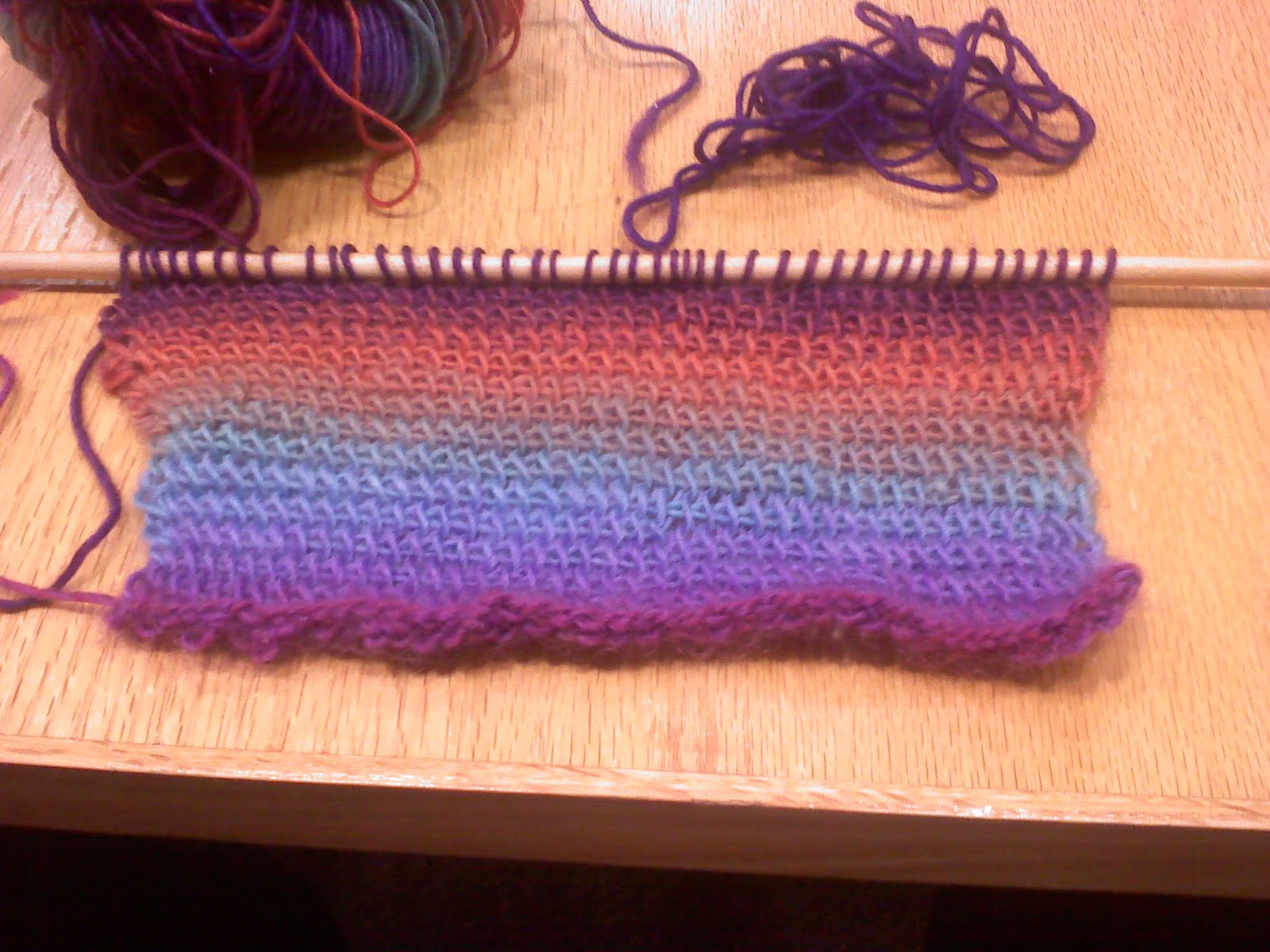
    I\’m doing another dual post today, this time on lace.  I adore lace – doilies make me swoon.  When I was little, I would get those little doilies they give you under coffee cups and color them in.  I know, lace is traditionally white or a single color, (who doesn\’t shiver at the idea of romantic black lace and stockings?).  But me?  I adore color.

    I learned how to do what\’s actually called \”faggoting,\” no lie, and despite the unfortunate name it\’s a lovely technique.  It\’s got the advantage of being super easy to work, too, which is great if you, like me, are a gerbil-brained knitter who doesn\’t want to have to concentrate on long, drawn out lines of instruction and repeat this, yarn over that.  The lace above, for example, is Turkish stitch – it\’s got one – count it, one! – row repeat!  It has a grand total of three – yup, I said three! – stitches:

    Even number of stitches:
    k1, * yo, k2 tog; rep from *, end k1.  Repeat this row.

    C\’est fini.  Just as easy as plain stockinette stitch.  I also like it because when you\’re using an overdyed (or ombre) yarn, like the one in the picture, sometimes the colors all smushed together in plain knitting can look muddy.  Using a faggot stitch can help spread them out and allow the colors to \”pop.\”

    What about you, Dear Reader?
    What complicated-looking task do you find surprisingly easy to perform?