Tag: Weaving

  • X Is For… X‑Acto, Crossings, and eXperiment

    X Is For… X‑Acto, Crossings, and eXperiment

    Some letters arrive with a whisper, and some arrive with a blade. X is the latter — sharp, precise, and full of possibility.

    In the studio, X is the moment where something shifts. It’s the cut that reveals the next layer. It’s the crossing where two paths meet. It’s the experiment that asks, What if I try it this way instead?

    X‑Acto

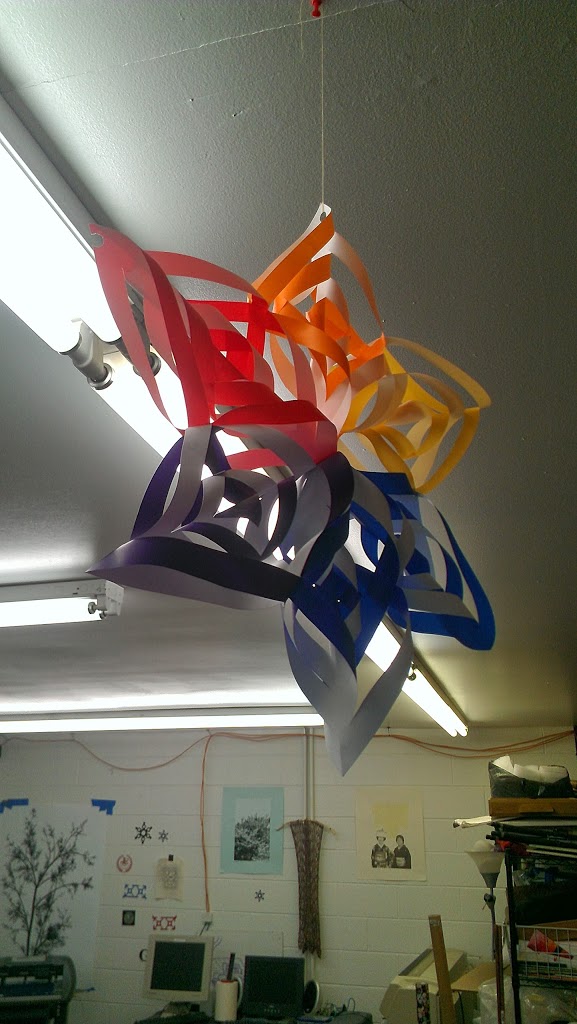
    There’s a particular sound an X‑Acto knife makes when it moves through paper — a soft, decisive whisper. It’s the sound of commitment. Of choosing a line and following it. Of trusting your hand.

    I love the way an X‑Acto knife demands presence. You can’t rush it. You can’t multitask. You can’t be anywhere except exactly where the blade meets the page.

    It’s a tool that teaches attention.

    And sometimes, that’s all creativity really needs — a single, clean line to follow.

    Crossings

    Crossings are the places where things meet: materials, ideas, moods, seasons. They’re the hinge points in a project — the moment when you realize the thing you thought you were making has become something else entirely.

    Crossings can be:

    • the shift from drafting to stitching
    • the moment a color palette clicks
    • the decision to abandon a plan and follow the work instead
    • the quiet recognition that you’ve outgrown an old way of making

    Crossings are where the work deepens. They’re where you deepen.

    eXperiment

    Experiment is the heart of the studio — the willingness to try, to fail, to try again, to follow curiosity instead of outcome.

    Experiment is:

    • cutting into the “good” paper
    • mixing inks you’re not sure will blend
    • weaving a square on the pin loom just to see what happens
    • choosing texture over perfection
    • letting your hands lead instead of your expectations

    Experiment is the antidote to pressure. It’s the reminder that making is supposed to feel alive.

    Together

    X‑Acto, Crossings, and eXperiment form a kind of creative triad:

    • X‑Acto gives you precision.
    • Crossings give you direction.
    • eXperiment gives you freedom.

    Together, they create the conditions for work that feels honest — work that comes from the body, not the performance of productivity.

    Today, X feels like a doorway. A small, sharp opening into whatever comes next.

    A Question for You

    Where in your creative life are you feeling the pull toward a new crossing or experiment?

  • Gone Visiting!

    \"Image

    I\’m back at author Delilah Devlin\’s blog today, and I have a question for you:

    Why Weave?

  • Writer Wednesday

    \"\"

    It\’s Wednesday, and I\’m a writer. That\’s about the only reason the title is what it is, and because I couldn\’t think of anything else to use. Check-in sounded too session-y, and holy shit the world\’s on fire a little histrionic. Both are, however, true. So this is a Writer Wednesday Check-In Because the World Is On Fire.

    And in some ways, my sentiment is, Burn, baby, burn. It\’s well past time we reckon with the consequences of the genocide we\’ve committed against Black and brown people in this country, (I\’m in the U.S. if that wasn\’t already clear), and the convulsive changes occurring here and around the world are necessary for growth.

    Sure ain\’t easy, though. Mr. Floyd was laid to rest yesterday. I keep trying to write something coherent about it but run up sharply against the fact that the world doesn\’t need another horrified white lady extolling … well, anything on race right now. No shit, it was horrible that he was murdered. But the truth is, this has been happening for hundreds of years, in big cities, in small towns, and in rural places in the back of beyond. Like Will Smith said, racism isn\’t new, it\’s just being filmed.

    So how do we move forward from this moment? Particularly when we\’re gripped in a global pandemic and an environmental cataclysm that may make everything else moot if we don\’t get on it?

    I don\’t know. And that\’s not a bad thing, this not-knowing. It\’s not comfortable, I know that. But I want to invite you to sit with that not-knowing, that place between what we knew to be true and the place of what is actually true, or at least the next threshold. The more we can hold this place of not-knowing, the better we can listen and have a chance to really hear the lessons we\’re being called to learn.

    What that looks like for me is a couple things.

    One is, I learned a new concept this week: \”Performative.\” There are many kinds of resistance and, unfortunately, we\’ve seen a lot of performative acts over the last week and a half in the wake of Mr. Floyd\’s murder by white people. The most egregious example of this are the statements by NFL CEO Roger Goodell, where he apologized to … whom, us? the players? Colin Kaepernick? for censuring players for their peaceful protests of police brutality. Why is this performative? It cost him nothing. Mr. Kaepernick wasn\’t re-signed, and the fines paid by him and other players have not been returned, at least as of this writing. But it\’s on a smaller, more localized scale too. Many of my fellow whites have been vociferous on social media about the horrors of racism and police brutality, and there\’s a subset of these folx who are acting as though they\’ve just become aware of it. There\’s also a sense that this is what we\’re doing this week, but next week when something else comes into our consciousness we\’ll go do that and forget about Black Lives Matter. What makes it performative is this aspect of publicly doing it: \”See? I\’m a good person because I\’m shouting out loud how bad this is, and how much it hurts me to see it, and how enraged I am.\” I\’m not going to restate things that BIPOC folx have said better and more informatively than I can, and frankly we should be listening to them.

    Which is my point: I\’ve been very quiet the last week or so because I\’ve been sitting with my own racism and unconscious bias, and asking hard questions about why I\’m posting this or that? Am I doing it to keep the focus on BIPOC voices and activists? Am I doing what they are asking me to do as an ally, or am I doing things to make myself feel better or express my horror and outrage without realizing that the BIPOC community has been traumatized from watching on video Mr. Floyd\’s murder? The young woman, all of seventeen years old, who filmed the murder has been the subject of frequent harassment and has been made to feel unsafe. Is my jumping up and down going to help her? Or Mr. Floyd\’s devastated family and friends? I ask myself, if it was my family member murdered on a video went viral so that I see it everywhere from social media to the news to analysis shows, how would I feel?

    And so, I\’m quiet. Because I\’d be fucking devastated.

    I\’ve joined a private reading group to wrestle with these ideas and educate myself better. The book we\’ve chosen to read first is called How To Be An Anti-Racist, by Ibram X. Kendi. The link is to Chicago\’s only Black woman-owned bookstore. It\’s a safe space to discuss the ideas in the book as well as a place to ask embarrassing questions like, what do I tell my Black friend when her neighbor is acting badly? I\’d just call the police, but I don\’t fear that I might be shot if I did that. I\’m at absolutely no risk of it, and in fact depend on the authority my whiteness gives me. What does wipipo mean? Can I use it, or is that not a term that I should be using? How do I talk to my friends and coworkers of color about race? How do I not be an asshole when I\’m trying to help?

    There are many resources, and if you\’re looking for things, may I suggest you look to BIPOC leaders who have already written extensively on the subject? You don\’t need me, a white person, educating you on how to be a better ally. We, each of us, need to be doing that work for ourselves and listening to the BIPOC thinkers who are willing to talk to us about it. And we need to not bother our friends, neighbors, and family members with it – they\’ve been traumatized by the events of recent days. It\’s not up to them to educate us. And we need to be very suspicious of our own desires to ask them: are we asking out of a genuine desire to know? Or are we asking them in specific so they know we\’re \”enlightened and woke\” now? If you absolutely don\’t know where to start, check out your public library. They\’ve got curated lists and librarians willing to answer all sorts of questions for you.

    I know this is a long one, but thank you if you\’ve read with me this far.  I wanted to share, and I wanted to write about what\’s going on, but it\’s been really difficult to find my voice in the middle of what\’s going on. For that reason, I\’ve decided to coordinate a session of Finding Water starting this Sunday. There is no charge for it and the course will go for fourteen weeks. Head on over to our writing group site, Writer Zen Garden, for more info.

    Other than that, I\’ve been learning to weave and having a ball with it. I\’m also taking a class on Herbalism called the Science and Art of Herbalism, and I made some lavender tincture with brandy this week. It will steep for a month, and then we\’ll see how it turned out. I\’m going to start featuring more of that kind of activity on my craft blog, Knoontime Knitting. If you enjoy making things, I hope you\’ll come on over the join the conversation.

    I hope you are staying safe and healthy. COVID appears to not be going away any time soon, so make sure to strengthen your immune system and be smart about being out and about in public. Hug your loved ones close and keep on writing.

    Love,

    Noony

  • W Is For… Weaving!

    W Is For… Weaving!

    \"2015-04-27

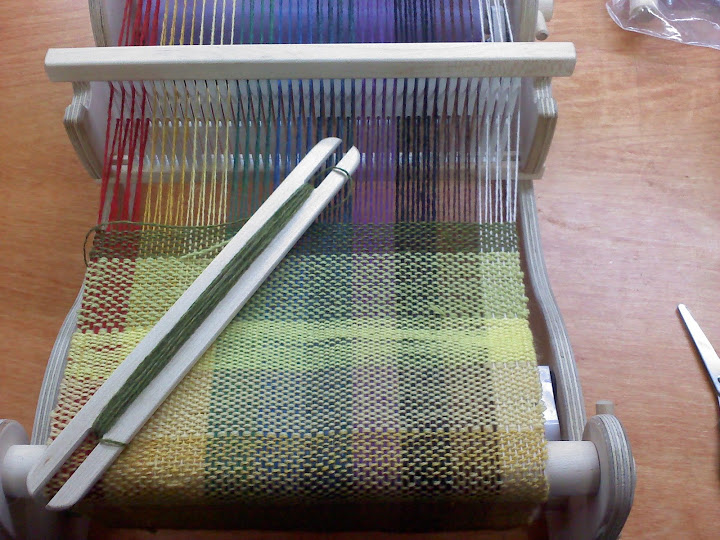
    Weaving is one of the oldest textile arts in the world. The most complicated looms, like the huge one featured in the movie Wanted, are the same in principle to the simple back looms used in the mountains of Peru for centuries.  The idea is you use something to put the warp under tension.  Shown above is my simple Cricket Loom, with the warp threaded and some of the weft worked.

    The thing I find interesting about weaving is that it\’s more complex, at least to my brain, than knitting.  I have to make peace with winding on the warp, and with the mechanics of the loom itself.  The process of actually weaving, meaning putting the shuttle back and forth, is relatively straightforward.  But, as my weaving teacher Natalie Boyett of the Chicago Weaving School pointed out, half of weaving is winding on the warp.  Accepting that, embracing it, helps one enjoy the process of weaving even more.

    What about you, Dear Reader?
    What unexpected thing has your crafting taught you?

  • I Is For… Inkle Weaving

    \"I\"Ever wonder where things like reins for bridles, belts, pet collars, and trim come from?  If they\’re not leather, they\’re most likely woven (though there are many other ways, for example, spool knitting, but I digress).  The type of loom used can vary, but here\’s what I find interesting.

    My weaving instructor, Natalie Boyett of the Chicago Weaving School, (and if you\’re here in the city, or visiting, and have ever thought about maybe learning to weave, go there.  She\’s hands-down one of the best instructors I\’ve ever had), showed me that weaving is one of the oldest textile arts.  Here\’s a brain-bender –  all looms are fundamentally the same:  they are designed to put tension on the warp (the length-wise threads) so that the craftsperson can put the weft (the cross-wise threads) in between them.  In this way, fabric is created.

    So what\’s an inkle loom?  It\’s a small, usually portable, loom that allows you to wind on a continuous warp, which means it can be really, really long.  The weaving surface isn\’t very wide, usually only a few inches, because the idea is to weave narrow fabric.  There\’s an example of one here.

    What about you, Dear Reader?
    What would you want to make if you could wave a magic wand and know how to use an inkle loom?


  • A to Z Challenge, Day 17: Q Is For Quesquemitl

    A to Z Challenge, Day 17: Q Is For Quesquemitl

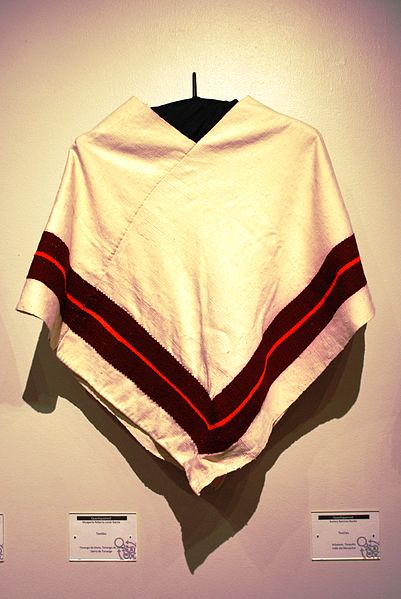
    In my weaving class, I am making a quesquemitl, a type of poncho that is made from a continuous piece of fabric – and, thus, a popular choice for handweavers.  The photo above is from Wikipedia, of a garment on view at the Museo Popular in Mexico: \”Large shawl called a quechquemitl by Margarita Roberta Lucas Garcia from Tenango de Doria, Hidalgo as part of a temporary exhibit of crafts from Hidalgo at the Museo de Arte Popular, Mexico City.\”

    I love the yarn that I got to use.  It\’s a rayon with many different colors, as you can see from the spool here; however, from a distance it looks blue.

    I haven\’t yet sewn the piece, which means that will be my next project.  I\’m finishing the hand-sewn edge and then will baseball stitch the pieces together.

    I don\’t know how to baseball stitch yet.

    Guess I have my work cut out for me.

    What do you want to learn this year?
  • Weaver\’s Journal – The Fringe of Weaving

    Weaver\’s Journal – The Fringe of Weaving

    I\’m working on the fringe for the Belii Shawl and wanted to do a laticework effect with the beads.  Since the image I\’m using is from a book to which I don\’t have the rights, (I almost typed, \”writes,\”) I drew it for you here by hand:

    The top picture is straight fringe; the bottom one is the lattice effect that I wanted to try to achieve.  I used a fringe winder to ply the fringe together.  What that means is, you take the yarns that are the fringe and figure out direction they are spun.  All yarn has a natural direction of spin.  One direction spins it further, creating more energy in the twist; the other direction essentially unspins the yarn (and with looser yarns can cause them to fuzz up).

    When you ply fringe, you take two or more of the fringe yarns and twist them further in the direction of their natural twist, and then tie a knot.  When you release the yarns, after they\’re knotted, they roll together creating a pretty, and more stable, fringe that will not knot up when you wash it, for example.

    What my hope was, was that by taking yarns adjacent to each other and plying them together, I could create a lattice effect like I\’ve drawn, above.  What happened was that in plying the second row of fringe, it increased the twist of the fringes above it and when I released the yarns after the second knot, they twisted together, creating a mess and not a pretty, flat lattice.  I\’ll show you what I mean, and what I did instead.

    This is the second side of fringe; the yarn ends are longer on this side (meaning, the fringe is longer).  The fringe on the right has the first row of plying and beading done; as you can see, the beads are held in the middle of the twist by the energy of the plying.  (They\’re not so tightly in there that they cannot move; I suspect when I wash it, for example, I\’ll have to push them back into place.)

    The tackle box is there to provide weight on the main body of the weaving.  By doing so, the fringe has something to pull against when you ply it.

    This is the first row of fringe all done.  The fringe will be trimmed at the end, but I\’ll wait until I have the beads in place, (three rows in total).  The finished length will be between six and eight inches.

    In this view, you can see both sides of fringe as well as the main body of the shawl.  The loose threads on the body of the shawl will be snipped after its first wash.  I don\’t want to wash it until the fringe is done, otherwise the threads will knot with each other and make a mess.

    These are the tools I\’m using.  Clockwise from top left:  fringe winder tool, gold beads, scissors, COFFEE mug (if you don\’t think this is an essential tool at Knoontime Knitting, you haven\’t been paying attention), fringe comb, extra yarn, and purple beads.

    This is the first attempt at the latticed fringe.  As you can see, the second row of beading just causes the whole thing to twist up on itself.

    We tried again, this time with my instructor holding the yarns under tension.  It didn\’t help; as soon as we released the tension, they twisted together.  I need a sound-effect, like FOOP!  Foop, they twisted together.

    I put the tackle box on the first row of beading and made the second row of plies on the same ply as the first.  On the first row, I plied it 13 times; the second row didn\’t need that many because of residual twist; so I used seven twists instead.

    Detail of both rows.

    Final view showing the whole side.  I\’m really curious to see what it looks like when it\’s done and washed.  The fabric right now is thick and dense; it\’s mercerized (perle) cotton and it softens up after washing; I\’m curious what the hand of the shawl will be like once it\’s all done.

  • Sunday Weaver\’s Journal: The Belii Shawl

    Sunday Weaver\’s Journal: The Belii Shawl

    My beloved street-rescue cat Belii died last year after a prolonged battle with kidney failure.  I decided to weave something in his memory, inspired by him and his place in my life.  It feels a little silly to admit that out loud, that my artistic inspiration is my cat, (Am I becoming a Cat Lady?), but we shared a household for 16 years.  If you have pets, you\’ll understand.  If you don\’t have pets and aren\’t a \”pet person,\” it won\’t make sense – and I feel just a little sorry for you.

    From the time he was a kitten, Belii was the most affectionate cat I\’ve ever known.  His favorite spot was on your chest – whether he knew you well or not.  I used to hand guests a wash cloth to put on their shirt so that he wouldn\’t kneed their skin.  That\’s the other thing he did all his life – kneed with his claws.  I think it was a holdover from living on the street.  I\’ve read that it\’s a way for cats to get the milk to come when they\’re nursing, and that makes sense.  But he took it one step further – he would actually curl his paw around your finger and hold on.  If he couldn\’t sit on you, he\’d sit next to you, as in the picture above.

    His name, Belii, is the Russian word for \”white.\”  When he first adopted me, he was white – all white.  I took him in, got him healthy (he had a slew of stuff that the vet needed to take care of; he was the most expensive \”free\” cat I\’ve ever gotten), and fed him.

    He turned orange.

    As you can see in the photograph above, his ears are the darkest part.  I looked it up; he\’s got some Siamese in him and there\’s a rare colorway called \”peach point\” that I\’ve decided is Belii.  It sounds cool, doesn\’t it?  I have a Peach-Point Siamese.  La-tee-da.  Folks don\’t need to know he was homeless in Las Vegas when I found him, eh?

    The design challenge is how to represent his colors in fabric.  I suspect this won\’t be the first project where I attempt it, since I have some yarn in my stash that I bought with the idea of knitting something.  But for now, my focus is weaving and creating, in cloth, a piece of art inspired by my orange white cat.

    Oh, why didn\’t I change his name?  The Russian word for \”orange\” is оранжевый, or oranzhevyy in transliteration.  Not nearly as pretty-sounding to my American ear as Belii.

    I love the pattern I made for the kimono and I talk about using that warp to thread the new warp, in a Sunday Weaver\’s Journal earlier this year.  I\’ve been working on the project and have pictures but not had time, because of our move, to post anything.  Today, I\’m here to remedy that.  So, without further ado, here\’s some photos:

    My pattern is called \”Twill Complication,\” from A Handweaver\’s Pattern Book by Marguerite P. Davison, page 46 (Marguerite P. Davison, Publisher, Swarthmore, PA, 1994).  I took the treadling pattern and put it in an excel spreadsheet so I could mark off where I am on the pattern.  The wrap is nine feet long in total, so that\’s a lot of pattern repeats!

    We realized that there were a couple boo-boos in the threading once I started weaving.  In between the time I finished the kimono and started the wrap, one of the assistant instructors thought I was done with the loom and started taking the old warp off.  When she realized I was intending on tying the new warp to it, she re-threaded everything.  We\’re not sure if the boo-boo happened then or when I originally threaded it, so her suggestion was to do one entire pattern repeat in a highly-contrasting thread so we could evaluate what to do.

    The options:  keep going anyway, even with the mistake, (if it wasn\’t too visible); cut the warp thread(s) that could be safely eliminated without changing the design; or take the treading out and start over – which I did not, frankly, want to do.

    Here\’s an example of the entire repeat.  There were three problem spots, which aren\’t greatly visible here, but are visible enough that they would cause a problem in the finished design.

    After conferring with Natalie Boyett, we decided to just cut three of the warp threads and let the rest go – primarily because I didn\’t want to rethread everything.

    I am working on a Glimakra loom from Sweden.  It\’s taken a while to get used to, because the shed (the part where you run the shuttle back and forth) is a lot narrower than on American looms.  It does, however, make for much neater edges, which is something I struggle with.

    After using the loom for the last almost nine months now, I\’m really liking it.  We\’ve had some challenges, most notably when the twin holding the heddles in place snapped, but Natalie was able to fix it and it works smoothly now.  The most important part, how the weaving looks, is something I\’m really happy with.

    Here is a the first repeat of the actual pattern.  I decided to use alternating peach and ivory repeats of the pattern, because I loved how the contrasting yarn looked in the header.

    Here is a detail of the pattern.  I love the way it looks beaded.  You can see a comparison with the kimono fabric in the Weaver\’s Journal post here.

    This is a view of the loom in its entirety except for the castle.  It\’s a nice width for me and I love how the fabric is turning out.

    Oh, contrary to popular belief, the Russian word for \”scarf\” isn\’t \”babushka,\” it\’s шарф, or \”sharf\” in transliteration.  A \”babushka\” is a grandmother.

    Stay tuned for more Weaver\’s Journals coming soon.

  • Sunday Weaver\’s Journal

    Sunday Weaver\’s Journal

    Today is weaving class. I am attaching the new warp to the old warp so I don\’t need to re-thread the heddles.


  • Sunday Weaver\’s Journal

    Sunday Weaver\’s Journal

    Today is weaving class. I am attaching the new warp to the old warp so I don\’t need to re-thread the heddles.


  • Friday Weaver\’s Journal – The End Is Nigh!

    Friday Weaver\’s Journal – The End Is Nigh!

    I\’m at the end!  I\’m at the end!  I can\’t turn the weaving any more than it is.  I\’m so excited!

    This is prior to the end, where you can see the dowel rod.  It\’s supposed to be straight.  o.O…  It doesn\’t appear to have affected the weaving negatively, thank the gods.

    This is a shot from farther away, after I\’ve moved the dowel off the back beam and then moved farther.

    Isn\’t this pattern awesome?  I\’m so excited.  It looks awesome.  I\’m looking forward to using the next colorway to begin the Belii Shawl.

    This is the last little bit of the warp.  We\’ll cut the fabric off the loom and then tie the new yarn to it and pull it through.
    This shot is taken from some distance so you can see the fabric\’s sheen.

    Here\’s the fabric.  I didn\’t take it off the beam because I finished just as class ended, and I didn\’t want to have to rush.  So, next week, we\’ll have the fabric reveal and start sewing. o.O…


    “It takes courage to grow up and become who you really are.”
    – E.E. Cummings

    My links: Blog | Website | Facebook | Twitter | Goodreads | Amazon | LinkedIn | Pandora
    Knoontime Knitting: Blog | Facebook | Twitter | Ravelry
    Noon and Wilder links: Blog | Website | Facebook
    The Writer Zen Garden: The Writers Retreat Blog | Forum | Facebook | Twitter
    Team Blogs: Nightlight | Nightlight FB Page | Beyond the Veil | BtV FB Page | LGBT Fantasy Fans and Writers | LGBTFFW FB Page
    Publishers: Samhain Publishing | Torquere Press

    Check out BURNING BRIGHT, available from Samhain Publishing.
    Check out EMERALD FIRE, available from Torquere Books.
    Check out \”Taking a Chance\”, part of the Charity Sips 2012 to benefit NOH8, available from Torquere Books.
    Watch for TIGER TIGER, coming July, 2013, from Samhain Publishing.

  • Friday Weaver\’s Journal – The End Is Nigh!

    Friday Weaver\’s Journal – The End Is Nigh!

    I\’m at the end!  I\’m at the end!  I can\’t turn the weaving any more than it is.  I\’m so excited!

    This is prior to the end, where you can see the dowel rod.  It\’s supposed to be straight.  o.O…  It doesn\’t appear to have affected the weaving negatively, thank the gods.

    This is a shot from farther away, after I\’ve moved the dowel off the back beam and then moved farther.

    Isn\’t this pattern awesome?  I\’m so excited.  It looks awesome.  I\’m looking forward to using the next colorway to begin the Belii Shawl.

    This is the last little bit of the warp.  We\’ll cut the fabric off the loom and then tie the new yarn to it and pull it through.
    This shot is taken from some distance so you can see the fabric\’s sheen.

    Here\’s the fabric.  I didn\’t take it off the beam because I finished just as class ended, and I didn\’t want to have to rush.  So, next week, we\’ll have the fabric reveal and start sewing. o.O…


    “It takes courage to grow up and become who you really are.”
    – E.E. Cummings

    My links: Blog | Website | Facebook | Twitter | Goodreads | Amazon | LinkedIn | Pandora
    Knoontime Knitting: Blog | Facebook | Twitter | Ravelry
    Noon and Wilder links: Blog | Website | Facebook
    The Writer Zen Garden: The Writers Retreat Blog | Forum | Facebook | Twitter
    Team Blogs: Nightlight | Nightlight FB Page | Beyond the Veil | BtV FB Page | LGBT Fantasy Fans and Writers | LGBTFFW FB Page
    Publishers: Samhain Publishing | Torquere Press

    Check out BURNING BRIGHT, available from Samhain Publishing.
    Check out EMERALD FIRE, available from Torquere Books.
    Check out \”Taking a Chance\”, part of the Charity Sips 2012 to benefit NOH8, available from Torquere Books.
    Watch for TIGER TIGER, coming July, 2013, from Samhain Publishing.